
Silver Coin Identifier For U.S. And World Coins


A silver coin identifier helps you confirm the coin type, date, mint mark, composition, weight, melt value, and possible collector premium before you sell, buy, or organize it. Start with a photo-based identification, then verify the result against date ranges, official specifications, and current silver spot value.
> Definition: A silver coin identifier is a photo-first app, catalog, or manual checking method used to identify silver coins, confirm coin silver content, and separate melt value from collector value.
TL;DR
- Identify the coin first, then check date, mint mark, country, weight, diameter, and edge before assuming it contains silver.
- For many U.S. dimes, quarters, and half dollars, 1964 or earlier usually means 90% silver, while 1965 and later circulation issues are generally copper-nickel clad.
- Melt value is only the silver content calculation; collector value depends on rarity, grade, demand, damage, cleaning, and recent sale prices.
| Need | Best option |
|---|---|
| Identify a silver coin from front and back photos, then save it to a collection | CoinEd |
| Research certified population data and professional price-guide references for U.S. coins | PCGS |
| Verify a potentially high-value, rare, or problem silver coin with professional authentication | NGC |
| Run a broad visual search when a world silver coin is unfamiliar or legends are hard to read | Coinoscope or Google Lens |
Silver CoinEd At A Glance
A silver coin identifier is useful when it combines a photo scan with manual checks, not when it guesses from color alone. The core record should include country, denomination, date, mint mark, weight, composition, melt value, and collector value.
Start with the obverse, then turn the coin over for the reverse design. A beginner often spots the key clue only after tilting the coin under a desk lamp, especially when a tiny mint mark sits near a worn date. The goal is bigger than naming the coin. You are deciding whether it is bullion, junk silver, or a numismatic piece worth closer research.
Good identification slows the sale down, in a good way.
A good photo-first coin identifier and value estimation app for collectors and beginners should deliver structured clues and cautious price context, not instant certified grades or guaranteed rare-coin claims.
Five Silver CoinEd Facts Before You Check Value
- Melt value is not collector value. Melt value comes from silver weight and spot price; collector value also reflects rarity, grade, demand, and recent sales.
- Photo tools have limits. A silver coin app can identify many common coins quickly, but worn dates, ancient types, errors, and counterfeits can confuse the result.
- Shiny does not mean silver. Plenty of copper-nickel clad coins look bright in a phone photo, especially on a dark wooden table.
- Date and country control silver content. The same denomination can change metal composition after a reform year.
- Expensive coins need cross-checks. Compare against auction archives, price guides, and grading-service references before pricing a scarce coin.
For a common circulation find, the fastest safe path is identify first, calculate second, and price last because metal content depends on the exact issue.
Before You Start: Tools For Identifying Silver Coins
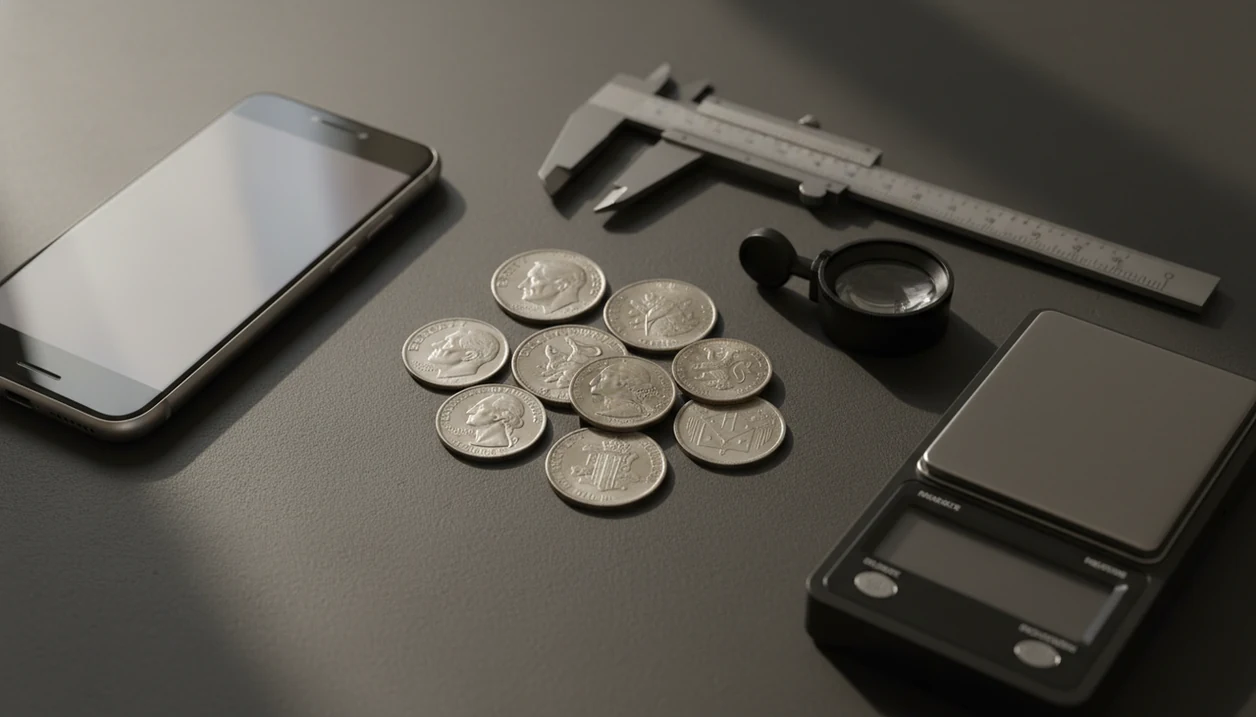
Before you identify silver coins, set up a small, non-damaging workspace. The right tools help you confirm what the app or catalog suggests without harming a coin that might have collector value.
- Use a gram scale that reads to at least 0.1 gram, because small weight differences can separate a normal worn coin from a wrong-metal match.
- Photograph both sides under soft, diffuse light, not a harsh flash. Worn silver can glare badly, and glare hides dates, mint marks, and fine lettering.
- Keep a magnet and ruler beside the coin so you can check basic response, diameter, and edge details before jumping to a value estimate.
- Open one trusted catalog, mint page, or printed reference before doing melt math, then compare the coin’s date, country, denomination, weight, and composition.
- Check the current silver spot price only after the coin type is confirmed, because spot price is useful for melt value but not for rarity.
- Avoid cleaning, polishing, acid-testing, scratching, or rubbing the surface. A dark or dull coin may still be worth more untouched.
How A Silver CoinEd App Works
A silver coin identifier app works by matching coin images to known designs, then connecting the likely type to catalog data, composition tables, and value references. Image recognition looks at the obverse, reverse, legends, portraits, symbols, denomination, date, and mint mark.
Behind the screen, the app may use image embeddings, which are numerical fingerprints of visual features. In plain terms, it compares your coin photo with many known coin images. Tools like CoinEd add a practical layer by returning likely country, type, rarity hints, grade hints, and estimated value ranges.
CoinEd is the photo-first coin identifier and value estimation app that identifies coins from photos, shows rarity and grade hints, and helps beginners and collectors estimate coin value.
Treat the result as a structured starting point, not a final authentication. A blurred nickel on a counter can produce a confident-looking answer that still needs a weight check.
How To Use A Silver Coin Identifier For Dates And Melt
Use a silver coin identifier as a workflow: photo first, physical checks second, melt calculation last. That order prevents the common mistake of pricing a silver-colored coin before confirming the exact issue.
- Photograph both sides in good light, with the coin flat and the date visible.
- Confirm the country, denomination, date, and mint mark before assuming any silver content.
- Weigh the coin on a gram scale, then compare diameter and edge style with a trusted reference.
- Compare the result against catalog specs, especially if the coin has heavy wear, damage, or a strange surface.
- Calculate melt value only after composition is confirmed, then save the record in a collection tracker.
If you want a narrower workflow, an app that tells if coin is silver can help organize the first pass. Still, do not clean the coin before photos. Wipe dust from the cardboard 2x2 flip, not the metal.
U.S. Silver Coin Date Rules For Dimes, Quarters, And Half Dollars
Are U.S. dimes, quarters, and half dollars from 1964 or earlier silver? Many circulating U.S. dimes, quarters, and half dollars dated 1964 or earlier are 90% silver, while regular circulating versions switched to copper-nickel clad starting in 1965, with rare exceptions.
For the U.S. composition change, cite the U.S. Mint's Coinage Act of 1965 history page (https://www.usmint.gov/learn/history/historical-documents/coinage-act-of-1965) and current U.S. Mint coin specifications (https://www.usmint.gov/learn/coin-and-medal-programs/coin-specifications).
For circulated 90% U.S. silver dimes, quarters, and half dollars, collectors commonly use 0.715 troy ounces of silver per $1 face value. That figure accounts for typical wear. A commonly used melt-value reference for U.S. 90% silver coins is NGC's melt-value table: https://www.ngccoin.com/price-guide/coin-melt-values.aspx. A rubber-banded bank envelope marked “old quarters” may look promising, but the date check still comes first.
Nickels, dollars, commemoratives, proofs, and special issues need separate lookup. War nickels from 1942 to 1945 are a different silver category. Kennedy half dollars from 1965 to 1970 are also different. For denomination-specific checks, use a silver dime identifier, silver quarter identifier, or silver half dollar identifier.
World Silver Coin Content By Country And Date
World silver coin content changes by country, denomination, and reform date, so the country must be identified before fineness is assumed. Common fineness labels include.500,.720,.800,.835,.900, and.925.
Canada is a useful warning. Canadian dimes and quarters moved from.800 silver to.500 silver in 1967, then to nickel with no silver in 1968. A small label reading “possible error coin” beside a foreign piece is not enough; the date and denomination do the work.
For Canadian circulation composition checks, compare the date and denomination against the Royal Canadian Mint's circulation-coin pages, including 10 cents (https://www.mint.ca/en/discover/canadian-circulation/10-cents) and 25 cents (https://www.mint.ca/en/discover/canadian-circulation/25-cents).
| Country or region | Example silver-content issue | What to check first |
|---|---|---|
| Canada | Dimes and quarters changed fineness in 1967 and metal in 1968 | Date, denomination, portrait, reverse |
| Mexico | Many issues use.720 or.900 silver | Denomination and exact year |
| United Kingdom | Silver standards changed across monarchs and reforms | Monarch, date, denomination |
| Europe broadly | Fineness varies widely by country | Legend, mint, catalog type |
A coin weight diameter composition lookup is often the simplest way to catch a wrong country match.
Silver Coin Melt Value Versus Collector Premium
Melt value is the coin’s silver weight multiplied by the current silver spot price. Collector premium is the extra value created by rarity, demand, grade, variety, provenance, toning, or eye appeal.
| Value type | What it measures | Example |
|---|---|---|
| Melt value | Metal content only | A worn common 90% silver quarter near bullion value |
| Collector premium | Numismatic demand beyond metal | A key-date quarter selling for many times melt |
| Dealer buy price | What a buyer may offer | Often below retail, depending on spread and demand |
| Recent sold price | Actual market evidence | Auction or marketplace sale for a similar coin |
A tarnished silver quarter in loose change may be worth only a modest premium, but a scarce date in the same denomination can behave very differently. Recent sold prices matter more than one static reference value. The broader melt value vs collector value debate is where many pricing mistakes begin.
Common Silver CoinEd Myths
- The shiny-coin myth: Every shiny coin is not silver. Fresh copper-nickel clad coins can look pale, bright, and convincing in poor light.
- The old-looking myth: Every older-looking coin does not contain silver. Wear, dirt, and toning can make base-metal coins look older than they are.
- The perfect-app myth: A silver coin app cannot always give a final grade or exact price. CoinIdentifier results should be checked against specs and market evidence.
- The melt-moves-with-premium myth: Melt value and collector value can move separately. A rare variety may rise because collectors want it, not because silver changed.
- The one-test myth: One magnet test or one scan does not prove authenticity. Counterfeit checks usually need several observations.
The pocket check is real. So is the false alarm.
Silver Coin Verification Checklist Before Selling
Before selling, verify the coin as a physical object, not just a picture. Check weight, diameter, thickness, edge style, and magnet response, then compare each measurement with official mint or catalog specifications.
Look closely for cleaning, holes, mount marks, scratches, artificial toning, tooling, and altered surfaces. A phone photo may miss the hairlines that appear when you rotate the coin under a single bright lamp. If a coin looks rare, high grade, suspicious, or possibly an error, consider expert authentication or professional grading before accepting an offer.
Cross-check app output against recent auction results and dealer buy prices from named references such as PCGS CoinFacts, NGC Coin Explorer, Heritage Auctions, Stack's Bowers, and active dealer buy sheets. For metal-specific questions beyond silver, a tool that can check coin metal can help frame what a home test can and cannot prove. Keep notes with photos, measurements, and the source of each value estimate.
Trusted Sources For Coin Specifications And Values
Trusted coin sources are the references that separate a careful estimate from a guess. Use official specifications for the physical coin, grading-service references for type and condition context, and sold-price records for the market.
- Start with the mint or issuing authority when you need weight, diameter, metal, and fineness. Those numbers are the baseline for catching a wrong attribution or a suspect piece.
- Compare the identified type with PCGS or NGC references so the date, variety, and grade range make sense before you price it.
- Check auction archives and completed sales for similar coins, giving more weight to actual sold prices than to unsold asking prices.
- Use melt calculators only after the silver fineness and actual silver weight are confirmed, especially for world coins with changing standards.
- Record the source behind each estimate in your notes: one line for specifications, one for grade context, and one for value evidence.
That small paper trail helps when two similar coins land in different price ranges.
Limitations
Silver identification has real edge cases, even when the first result looks tidy.
- AI coin apps can struggle with ancient coins, heavily worn pieces, obscure world issues, die varieties, and errors.
- No app, magnet test, ring test, or single home method can reliably detect every counterfeit.
- High-quality fakes may require XRF testing, expert authentication, or professional grading.
- App price estimates may lag fast changes in silver spot prices and collector demand.
- Apps may miss cleaning, micro-scratches, tooling, altered surfaces, or subtle artificial toning.
- U.S.-centric databases can under-represent world silver coinage, especially lower-mintage regional issues.
- Smartphone access is widespread, but photo quality, glare, focus, and lighting still affect the result.
- A scale with low precision can make a worn coin, damaged coin, or counterfeit look falsely normal.
A nickel stack beside empty wrappers can produce several “maybe silver” moments. Most are not. That is why the final answer should come from combined evidence, not one screen.
How to Identify Silver Commemorative Coins
Commemorative silver coins may look similar to circulation issues but differ in design, edge, weight, diameter, or finish. Confirm whether the piece is a commemorative, proof, bullion round, or circulating silver type before using melt math.
Calculate actual silver content only after the exact type is known. Asking prices for commemoratives often reflect collector demand, not melt alone. Cross-check with melt vs collector value and what to expect after identifying silver.
FAQ
How do I identify silver coins?
Identify silver coins by scanning both sides, then checking date, mint mark, country, denomination, weight, diameter, edge, and published composition. Confirm the result against a trusted catalog before calculating melt value.
Are 1965 coins silver?
Most regular U.S. dimes, quarters, and half dollars from 1965 are copper-nickel clad, not 90% silver. Rare exceptions and special issues require separate lookup.
What coins contain 90% silver?
Many U.S. dimes, quarters, and half dollars dated 1964 or earlier contain 90% silver. Some dollars, commemoratives, and proof issues also contain silver, but they need type-specific verification.
Can a coin app detect silver?
A coin app can infer silver content from the identified coin’s date, type, country, and cataloged composition. It does not chemically test the metal.
Is melt value the sale price?
Melt value is a baseline based on silver content and spot price, not a guaranteed sale price. Dealer offers, collector demand, condition, and selling fees can change the final amount.
Do all old coins contain silver?
No, all old coins do not contain silver. Many older coins are copper, bronze, nickel, brass, aluminum, or copper-nickel alloys.
How do I test coin silver?
Use non-damaging checks: weight, diameter, thickness, edge inspection, magnet response, and comparison with official specifications. Avoid acid tests or abrasive cleaning on collectible coins.
Are world coins harder to identify?
World coins can be harder because silver content depends on country, denomination, date, fineness, and reform history. A catalog match is important before assigning composition.
When should I grade a coin?
Consider professional grading for rare, high-grade, expensive, error, or possibly counterfeit coins. CoinEd can help organize photos and notes, but grading is a specialist opinion.