
Silver Quarter Identifier for Washington Quarters by Date, Edge, and Weight
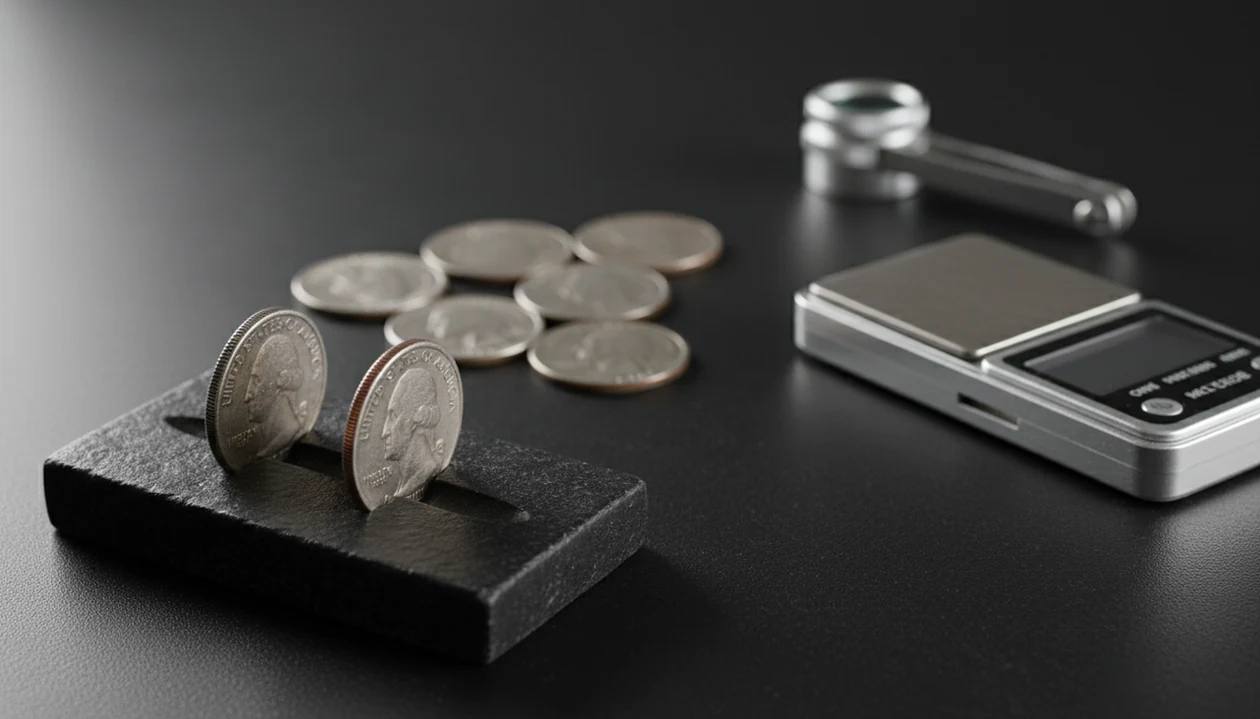


A silver quarter identifier starts with the date: regular U.S. Washington quarters dated 1964 or earlier are 90% silver, while standard 1965 and later circulation quarters are copper-nickel clad. Confirm the result by checking the edge for no copper stripe, weighing the coin at about 6.25 grams, and checking the mint mark for special 40% silver collector issues.
A silver quarter identifier is a date, mint mark, edge, weight, and design-checking method used to tell whether a U.S. quarter contains silver and whether it may have collectible value beyond melt.
- Washington quarters dated 1932–1964 are generally 90% silver, including the common 1964 quarter silver issue.
- A 90% silver quarter weighs about 6.25 grams and has a solid silver-colored edge instead of a copper stripe.
- Most Bicentennial quarters are clad, but some 1776–1976 S-mint collector quarters contain 40% silver.
Silver quarter identifier facts for Washington quarters
A fast silver quarter check works because Washington quarter composition follows a clear date break, with a few collector exceptions. Use these five facts before you worry about rarity, grade, or selling.
- Regular Washington quarters dated 1932 through 1964 are 90% silver and 10% copper.
- Regular circulation quarters dated 1965 and later are copper-nickel clad, not silver.
- A solid silver-colored edge supports a silver identification; a visible copper stripe points to clad composition.
- A 90% silver Washington quarter weighs about 6.25 grams, while a clad quarter weighs about 5.67 grams.
- Some 1776–1976 S-mint collector quarters contain 40% silver, so Bicentennial quarters need mint mark and packaging checks.
Sources: NGC Coin Explorer lists Washington quarters from 1932–1964 as 90% silver with a 6.25 g standard weight (https://www.ngccoin.com/coin-explorer/united-states/quarters/washington-quarters-1932-1998/), and the U.S. Mint lists the modern clad quarter standard at 5.67 g (https://www.usmint.gov/learn/coin-and-medal-programs/coin-specifications).
We usually start with the obverse date, then turn the coin sideways under a desk lamp. Desk lamp glare across shiny copper can exaggerate color, so edge and weight matter more than a quick shine check.
Small checks prevent bad calls.
How silver quarter identification works
Silver quarter identification works by using the date as a legal-composition shortcut, then checking the coin’s physical construction. The date tells you what the Mint normally made for circulation, but it does not prove authenticity, rule out errors, or settle every collector-only exception.
A 90% silver Washington quarter is a silver-copper alloy, meaning the metals are mixed throughout the coin, so it weighs about 6.25 grams and usually shows a solid silver-colored edge. A copper-nickel clad quarter is layered construction: pale outer faces bonded around a copper core. That is why edge color is often more useful than surface shine. A polished clad quarter can look bright on the face, while the edge still exposes the copper stripe. Mint mark and packaging can override a simple date rule when the coin is a proof, a Bicentennial S-mint collector issue, or another non-circulation product. In those cases, treat the date as the first clue, not the final answer, and compare the edge, weight, mint mark, and original holder before calling it silver.
Before you start: tools and handling
Before you start, set up a simple, clean workspace so the coin stays safe and the clues are easy to read. The goal is not to make the quarter look better; it is to handle it gently and measure it consistently.
- Use a calibrated digital scale. Choose a scale that reads in grams and can distinguish small differences, because a silver Washington quarter and a clad quarter are separated by less than one gram.
- Hold the coin by the edge. Keep fingertips off the faces so you do not add oils, haze, or new fingerprints to a coin that may already have collectible value.
- Check it under neutral light. Place the quarter on white paper or a white napkin, then inspect the date, edge, and mint mark without colored reflections from wood, fabric, or warm bulbs.
- Leave better coins protected. If a coin looks like a proof, has mirrorlike fields, or appears high grade, keep it in its holder or flip while you inspect it. Removing it for a clearer look can create the very marks you are trying to avoid.
Washington quarter composition change after 1964
The date is the first filter because regular U.S. quarter composition changed after 1964. The Coinage Act of 1965 moved regular-issue quarters away from 90% silver and into a copper-nickel clad structure.
How silver quarter identification works: the date points to the legal composition, while edge color, weight, and sound reflect the coin’s actual metal layers. A 90% silver quarter has a heavier silver-copper alloy. A clad quarter has copper-nickel outer layers bonded to a copper core, which is why the edge often shows a copper band.
A photo-identification app can support the photo-first check by saving images, likely matches, rarity notes, and grade hints, but physical tests still matter when a date is worn, toned, or partly hidden.
A good ai coin identification, rarity lookup, and collection value estimation app for collectors and beginners gives likely ID clues and organized notes, not instant certified grades or guaranteed resale prices.
5-step silver quarter identifier workflow at home
Use this home workflow to check a quarter without scratching, rubbing, or cleaning it. Do not clean the coin before identification, even if dust is sitting on a cardboard 2x2 flip.
- Read the date on the obverse. Start with the obverse portrait side and look for 1964 or earlier.
- Check the mint mark and design type. Note Philadelphia, Denver, or San Francisco marks, and separate regular Washington quarters from Bicentennial and proof issues.
- Inspect the edge for a copper stripe. Hold the quarter sideways against a white napkin and look for a solid silver-colored edge.
- Weigh the coin on a gram scale. A 90% silver Washington quarter should be near 6.25 grams; a clad quarter should be near 5.67 grams.
- Photograph or scan the coin in an app. Compare date, mint mark, type, grade hints, and value clues against a trusted reference.
For larger mixed lots, a broader silver coin identifier can help separate quarters from dimes, halves, and world silver before you build collection notes.
Silver quarter identifier by year and quarter silver content
Year is the quickest way to sort quarter silver content, but it is not the only clue. The table below maps the date ranges most people ask about, including the late-1960s misconception.
| Date range or issue | Likely composition | Silver content | Identification note |
|---|---|---|---|
| 1932–1964 Washington quarters | Silver alloy | 90% silver | Includes the regular 1964 quarter silver issue. Confirm with edge and 6.25 gram weight. |
| 1965 onward regular circulation quarters | Copper-nickel clad | No silver | Standard 1965, 1967, and other late-1960s quarters are not silver. |
| 1776–1976 S-mint collector quarters | Special collector alloy | Possible 40% silver | Check the S mint mark, packaging, edge, and weight. Most Bicentennial quarters are clad. |
| Modern silver proof quarters | Collector silver issue | Varies by proof program | Treat these as collector-only issues, not pocket-change assumptions. |
For year-based sorting, date plus edge is often easier than appearance because bright clad quarters can look deceptively “white.”
Late-1960s shine fools people.
1964 quarter silver clues and Washington silver quarter mintage
Is a 1964 quarter silver? Yes, a regular 1964 Washington quarter is 90% silver, whether it came from Philadelphia or Denver.
The U.S. Mint produced roughly 1.26 billion Washington quarters in 1964 across Philadelphia and Denver, according to published mintage references such as PCGS CoinFacts (https://www.pcgs.com/coinfacts/category/washington-quarter/112). That large mintage means many 1964 silver quarters are common circulation finds, not rare coins. The silver content gives them melt value, but numismatic value depends on more specific factors.
Check condition, mint mark, errors, and uncirculated surfaces before assuming a premium. A seller weighing a silver half dollar may use the same logic: metal content gives a baseline, while collector demand decides the extra value. For a plain 1964 quarter, the key question is often the melt value vs collector value difference, not whether it contains silver.
Silver quarter edge, weight, and sound tests
Edge and weight tests are more reliable than shine, and sound is only a supporting clue. Use all three when a coin is worn, darkly toned, or photographed under poor lighting.
- Edge test: A silver quarter usually shows a solid silver-colored edge. A clad quarter usually shows a copper stripe from the copper core.
- Weight test: A 90% silver Washington quarter should weigh about 6.25 grams on a calibrated digital scale.
- Clad comparison: A regular clad quarter weighs about 5.67 grams, so compare against a known modern quarter from your pocket.
- Sound test: Silver often rings differently than clad metal, but sound depends on surface, drop height, and hearing.
- Scale check: For questionable coins, weight beats the “ping” test because it gives a repeatable number.
A quarter balanced on a white napkin is easier to read than one sitting on a dark wooden table, where copper cents and toned silver can both look warmer than they are.
Common mistakes when identifying silver quarters
The most common silver quarter mistakes come from trusting one clue too much. A bright face, a nice ring, or a Bicentennial date can point you in the wrong direction unless you confirm the coin with date, edge, weight, and mint mark together.
Use a quick mistake check before you sort, sell, or clean anything:
- Separate shiny coins from silver coins in your mind. A polished or lightly circulated Bicentennial quarter can look white and fresh, but most 1776–1976 quarters are still clad.
- Confirm a “ping” with physical clues. Sound can support an answer, but it should not overrule a copper-striped edge, the wrong date, or a weight near a modern clad quarter.
- Resist cleaning a dark or gray quarter. Toning can be normal on silver, and wiping it may leave hairlines that hurt collector value before you even know what you have.
- Check S-mint and proof issues separately. Some collector quarters were made in silver even when regular circulation quarters were not, so mint mark, finish, and original packaging matter.
Special 40% silver quarters and collector-only silver issues
Are Bicentennial quarters silver? Most 1776–1976 Bicentennial quarters are copper-nickel clad, but some S-mint collector quarters contain 40% silver.
This is where date alone can fail. A Bicentennial quarter from circulation is usually clad, while a collector issue may have different packaging, a San Francisco mint mark, a different edge appearance, and a different weight. If you inherited a coin jar, separate the 1776–1976 quarters and check each one individually.
Later silver proof quarters also exist as collector products. They are not safe pocket-change assumptions, even when the surface looks mirrorlike. Proof-like shine can come from lighting, polishing, or plated novelty pieces, so compare the mint mark and issue type before assigning silver content.
If you want a photo-first second opinion after the physical checks, an app that tells if coin is silver can help organize likely matches and follow-up notes.
Silver quarter value, melt value, and collectible premium
Melt value is the value of a coin’s silver content based on the current silver spot price. For a 90% silver Washington quarter, the usual silver-content figure is about 0.1808 troy ounces of pure silver.
That number gives a baseline, not a final selling price. Collectible premium depends on date, mint mark, grade, demand, strike quality, and variety. A common worn 1964 quarter may trade close to silver value, while a better-date coin in high grade can sell for more because collectors want the coin, not just the metal.
Cleaned, damaged, bent, or heavily worn coins can lose collectible premium even when their melt value remains. We have seen beginners wipe a gray quarter “to make the silver show,” then regret the hairlines under angled light. Don’t do that.
For beginners, melt value is often the safest starting estimate because it separates metal content from collector assumptions.
Limitations
A silver quarter identifier narrows the answer, but it cannot settle every question about authenticity, condition, or value. Use it as a first pass before paying for grading or making a sale decision.
- Date-based rules can miss rare error coins, off-metal strikes, and unusual mint mistakes.
- Sound tests and tissue tests are subjective, so they should not be used alone.
- AI photo identification may struggle with worn dates, scratches, heavy toning, dirt, glare, or weak mint marks.
- A silver identifier cannot determine cleaning, damage, or authenticity by itself.
- Melt value changes with silver spot price and does not equal final resale value.
- A coin can be silver and still be common, especially many circulated Washington quarters.
- Uncertain or high-value finds should be checked by a reputable coin dealer or grading service.
Photo tools can help you save images, likely types, and collection notes, but a professional opinion matters when the coin may be rare, altered, or expensive.
FAQ
Are 1964 quarters silver?
Yes. Regular 1964 Washington quarters are 90% silver, and you can confirm them by checking for a solid silver-colored edge and a weight near 6.25 grams.
Are 1965 quarters silver?
Standard 1965 circulation quarters are copper-nickel clad, not silver. A normal 1965 quarter should show a clad edge and weigh about 5.67 grams.
Which quarters are silver?
Regular U.S. Washington quarters dated 1932–1964 are 90% silver. Some 1776–1976 S-mint collector quarters and later silver proof quarters also contain silver.
What is a silver quarter edge?
A silver quarter edge appears solid silver-colored without the copper stripe seen on clad quarters. Edge color is a useful clue, but weight and date should confirm it.
How much does a silver quarter weigh?
A 90% silver Washington quarter weighs about 6.25 grams. A later copper-nickel clad quarter weighs about 5.67 grams.
Are Bicentennial quarters silver?
Most Bicentennial quarters are copper-nickel clad. Some 1776–1976 S-mint collector quarters contain 40% silver, so mint mark and issue type matter.
Are silver quarters rare?
Silver quarters are not automatically rare. Many silver Washington quarters are common unless they are key dates, high-grade examples, errors, or desirable varieties.