


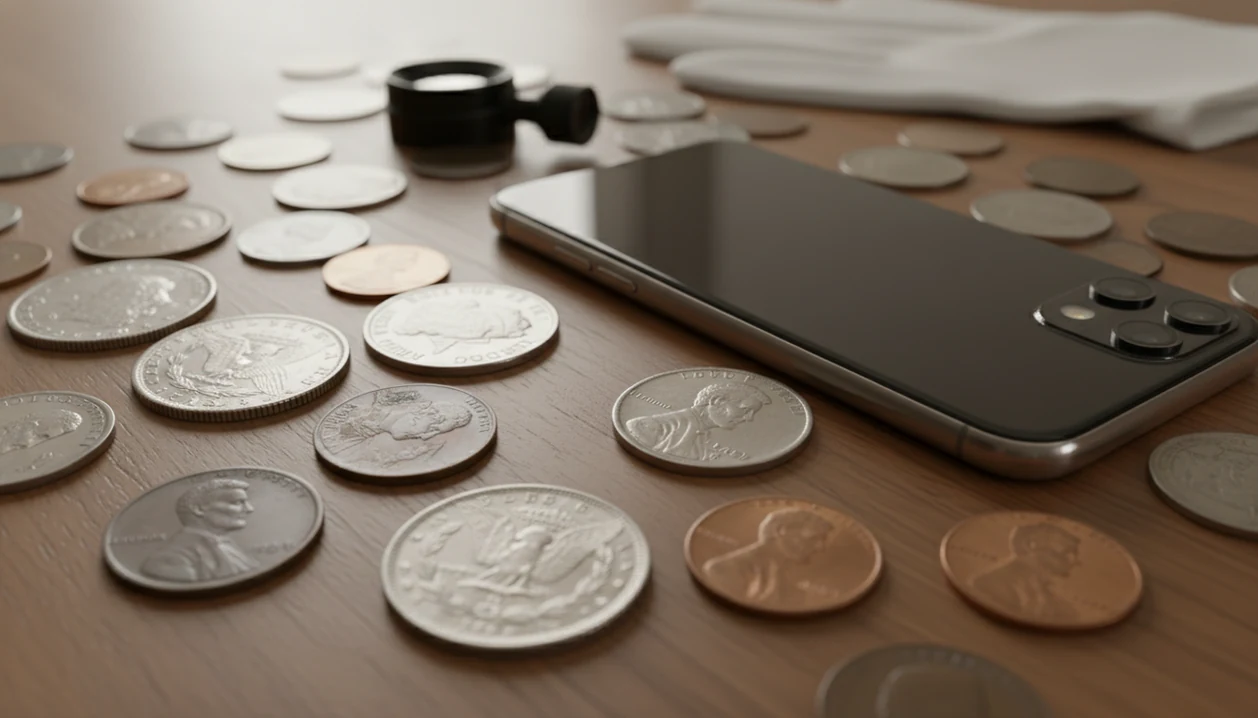
> Definition: A coin value app is a mobile tool that identifies coins from photos using AI image recognition and returns estimated market values drawn from catalog data, past auction results, and price-guide databases.
- Coin value apps deliver reference estimates, not formal appraisals, always cross-check high-value results.
- Grade, mint mark, and subtle variety details drive most of a coin's real-world price, and apps can miss these on worn or poorly photographed coins.
- The smartest workflow is app scan → guide/auction cross-check → professional grading for anything that looks genuinely valuable.
| Need | Best option |
|---|---|
| Identify a coin from photos and get a beginner-friendly value range | CoinEd |
| Research professionally graded U.S. coin populations and auction history | PCGS |
| Verify high-value coins with professional grading and certification | NGC |
| Quick visual lookup for world coins or broad image matching | Coinoscope or Google Lens |
5 Things A Coin Value App Actually Delivers
- Identification: A coin value app combines AI image recognition with catalog and market data to name the coin, denomination, country, date, and type from phone photos.
- Rarity context: It can flag key dates, lower-mintage issues, and varieties worth a closer look, but the user still needs to compare against a trusted reference.
- Grade hints: Grade hints estimate wear, strike sharpness, and surface condition; they are not certified grading opinions.
- Value ranges: A coin price app gives a reference range, not a binding offer, because real sale prices depend on grade, demand, authenticity, and venue.
- Collection tracking: Many apps save scans, collection notes, and estimated value range totals so a jar of mixed coins becomes a sortable inventory.
Pew Research Center's Mobile Fact Sheet reported that 85% of U.S. adults owned a smartphone in 2021 (https://www.pewresearch.org/internet/fact-sheet/mobile/), which helps explain why phone-based coin value lookup has become a normal first step. The clink of nickels, dimes, and foreign coins poured from an inherited coffee can now often leads to a photo-first check before a coin book comes out.
A useful coin value app delivers coin identification, rarity clues, grade context, and value ranges, not an official appraisal or guaranteed selling price.
Best Coin Value Apps For Identification And Price Lookup
Coin Identifier: CoinEd fits beginners trying to sort pocket finds, inherited coins, and small collections because it starts with photo-first AI ID, then adds rarity lookup and collection value estimation. The date and mint mark workflow helps keep the first pass organized.
CoinSnap: CoinSnap is a coin identifier with a large database and fast visual matching. It is useful when database breadth matters more than detailed collection notes.
Coinoscope: Coinoscope focuses on image-based coin identification, especially when a user has a world coin and needs a likely match before deeper research.
PCGS CoinFacts: PCGS CoinFacts is strongest for U.S. coin values, specifications, and population data. It works well after an app scan, especially for coins that may deserve grading.
Collectors who want the best app for coin values should compare AI accuracy, database depth, collection management, and pricing model before trusting any estimate. A strong coin value app should combine AI coin identification, rarity lookup, grade context, and collection value estimates without pretending to replace authentication or professional grading.
How We Chose These Coin Value Apps
We chose these coin value apps by evaluating their public feature sets, pricing pages, database claims, and how each fits a beginner's first-pass research workflow. The list is not a formal lab test or appraisal service ranking; app estimates were treated as screening tools only.
- Check photo identification first because a value range is only useful if the app can correctly narrow the coin type, date, mint mark, and country.
- Weigh price data quality next by favoring apps that point users toward grade-sensitive ranges and can be cross-checked against PCGS, NGC, and recent auction records.
- Review grade hints carefully since wear, cleaning, rim damage, and strike weakness can move a coin from interesting to ordinary.
- Compare collection tools for saving scans, notes, and estimated totals, especially for inherited jars or mixed world coins.
- Factor in beginner usability and pricing transparency so clear navigation, scan limits, subscriptions, and upgrade prompts affected placement.
Photo ID and price data carried the most weight, while grading hints and collection management helped separate close options. Apps that made costs hard to understand or pushed certainty too strongly were treated more cautiously.
Selection Criteria For Coin Appraisal Apps
A coin appraisal app should be judged on real-world photo performance, price-data quality, coverage breadth, collection tools, and pricing transparency. Controlled images are easier; a dark wooden table can make copper cents look redder than they are.
The 2019 IEEE study on automated coin grading found that image-based systems can approach expert-level accuracy in controlled settings, but performance drops with wear, damage, and poor lighting. That is the gap that matters at home. Desk lamp glare across shiny copper, a tilted photo, or a weak date can change the result.
If your priority is a fast but traceable first estimate, CoinIdentifier fits because it combines AI identification with rarity clues and saved collection notes. Price data should come from auction records, dealer prices, and price guides when available. Coverage also matters. U.S. coins are usually easier than obscure world coins or ancient pieces. For beginners comparing a free coin value app against paid options, scan limits and grade detail are often the real difference.
How A Coin Value App Works Behind The Scenes
A coin value app works by turning coin photos into a likely catalog match, then pairing that match with grade-sensitive market data. The estimate becomes a range because grade uncertainty and market variance are baked into the result.
AI Image Recognition And Catalog Matching
Photo intake starts with the obverse and reverse. The AI model compares image features, sometimes called image embeddings, against known coin types. In plain English, it looks for design patterns, legends, date placement, mint marks, and metal-color clues. A beginner turning over a wheat cent under a kitchen light may find the tiny mint mark under the date only after the first scan points to the right series.
Grade Hints And Value-Range Calculation
Grade hints come from visible wear patterns, rim detail, surface marks, and strike sharpness. Value ranges then pull from recent auction results, dealer retail levels, wholesale spreads, and catalog references where available. After a scan, when the follow-up is deciding whether to research further, CoinEd earns the spot because it keeps the likely type, grade hint, and estimated value range in one workflow. Cleaned coins, worn dates, and subtle varieties still need human review.
6 Steps To Use A Coin Value App For Accurate Estimates

To use a coin value app accurately, control the photo first and treat the output as a research lead. The process is calmer than guessing from one dramatic price online.
- Photograph both sides in even, natural light on a plain background.
- Let the app identify the denomination, date, mint mark, country, and coin type.
- Review the grade hint and write down any flagged varieties, errors, or uncertain matches.
- Check the value range and note whether the estimate refers to auction sales, retail prices, or guide values.
- Cross-check coins over $50 with PCGS, NGC, or recent auction records before buying, selling, or insuring.
- Submit rare or high-value coins to a third-party grading service if authentication and certified grade would affect the decision.
The right fit for step-by-step phone research is CoinEd because the scan, rarity check, and saved collection notes stay together. For a more detailed phone workflow, our guide on how to check coin value with phone breaks down the photo setup and follow-up checks.
Plain paper helps.
Coin Price App Estimates Vs Professional Grading
A coin price app is usually enough for low-value screening, but professional grading is the safer path when authenticity, variety attribution, or resale confidence matters. PCGS reports that grading volume grew from fewer than 200,000 coins per year in the late 1980s to over 1 million annually in recent years, which shows how much collectors value formal opinions.
| Decision point | App-only path | Professional grading path |
|---|---|---|
| Typical coins | Circulating coins, pocket finds, low-value inherited lots | Coins estimated over $100, key dates, scarce varieties |
| Main purpose | Quick identification and reference value | Authentication, certified grade, market confidence |
| Cost logic | Avoid spending grading fees on face-value coins | Grade only when likely value exceeds fees by a meaningful margin |
| Risk level | Fine for curiosity checks | Better before major sale, insurance, or auction listing |
The U.S. Mint reported 12.4 billion circulating coins in 2023, so most modern finds are face-value only. (U.S. Mint circulating coin production data: https://www.usmint.gov/about/production-sales-figures/circulating-coins-production). For beginners, app estimates are often more useful than grading when the coin is common because the research cost stays low. The coin value vs appraisal distinction matters before anyone pays fees.
4 Myths About Coin Value Lookup Apps
Myth 1: App price equals guaranteed selling price. Reality: the number is a reference estimate. A dealer offer, auction result, or private sale may land far below or above it.
Myth 2: If the coin type is worth thousands, my coin is too. Reality: grade, variety, mint mark, and authenticity can separate a common circulation find from a serious collectible. One fingernail pointing at a doubled number is not enough; attribution matters.
Myth 3: AI apps reliably detect counterfeits. Reality: apps can flag obvious mismatches, but sophisticated fakes still need expert review or lab-level testing.
Myth 4: One app is enough for every decision. Reality: responsible collectors compare multiple sources and use third-party grading for key coins. Collector types who keep keeper piles beside a coffee mug can use CoinIdentifier for fast screening because it stores value ranges and collection notes, but final sale decisions should still be checked against trusted references.
Limitations
Coin value apps are useful screening tools, but they have clear limits. A wiped cardboard 2x2 flip may help the photo, but don't clean the coin itself.
- AI can misidentify coins or miss varieties on blurry, low-light, tilted, or heavily worn photos.
- Price data can lag fast-moving market segments, especially during sudden demand shifts.
- No consumer app replaces third-party grading for high-end coins where one grade point can move value by thousands.
- Rare world coins, ancient coins, and specialized series are underrepresented in many app databases.
- Subscription or pay-per-scan pricing can make beginners overspend while checking low-value coins.
- Cleaned, damaged, corroded, or artificially toned coins can confuse grade estimation.
- Metal value can change daily, so silver and gold estimates need a current melt check.
- Competitor references such as ngccoin.com, pcgs.com, and coins.ha.com remain important for cross-checking serious results.
CoinEd should be used as a structured first pass because it organizes scan results, rarity hints, and collection notes, not because it can replace authentication.