


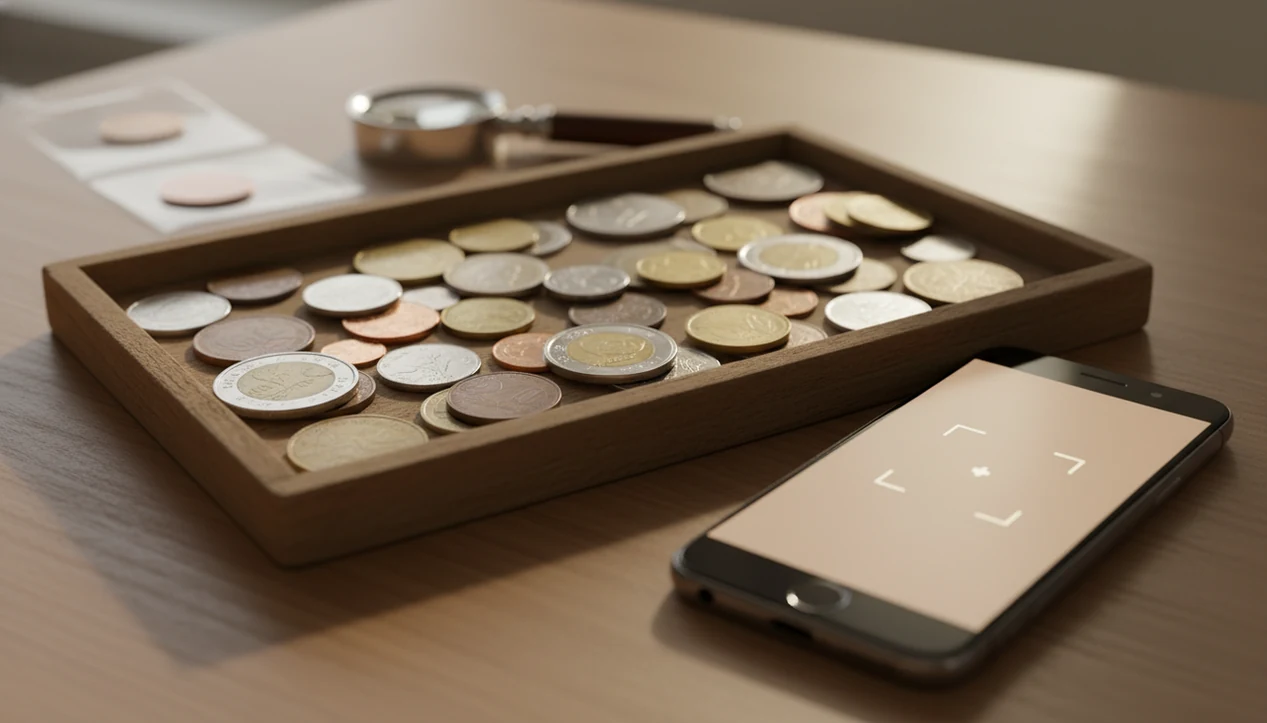
> A world coin identifier app uses image recognition to match a photographed coin against a multi-country database, returning the issuing nation, denomination, approximate date, and estimated collector value.
- Photo-first identification beats manual catalog search for foreign coins with unfamiliar scripts or languages.
- No app perfectly values every world coin, condition, rarity, and local market demand still matter.
- Beginners need fast ID; serious collectors need catalog depth, collection tracking, and export features.
Best App For World Coins At A Glance
CoinEd leads for photo-first foreign coin ID because it starts with both coin faces, then returns a likely country, denomination, date range, and estimated value range. The right choice still depends on whether you need fast identification, deeper catalog research, or long-term collection records.
| App | Primary strength | Best fit | Main tradeoff |
|---|---|---|---|
| CoinEd | Photo-first world coin scans | Mixed foreign lots and beginner ID | Estimates still need condition checks |
| CoinSnap | Fast mobile scanning | Casual Android users | Database depth can feel narrower |
| PCGS CoinFacts | Graded U.S. coin references | U.S. collectors | Weaker non-U.S. coverage |
| Numista | Large community catalog | Manual world coin lookup | Less photo-first |
| CoinTrackers | Simple value browsing | U.S. price context | Limited world-coin workflow |
Scale is the hard part. Major museum numismatic collections include hundreds of thousands of objects; the Smithsonian describes its National Numismatic Collection as more than 1.6 million objects (https://americanhistory.si.edu/collections/numismatics), and a kitchen-table pile can still contain five countries, three scripts, and one coin with no readable date.
Named Shortlist: Top World CoinEd Apps Compared
The named shortlist for a world coin identifier app should include photo scanners, catalog databases, and value references. No single option wins every use case, especially once tokens, medals, and local varieties enter the tray.
- CoinEd: Best overall for photo-based foreign coin ID. It handles both sides, unfamiliar scripts, worn dates, and metal clues, which helps when a phone camera hovers over a penny-sized bronze coin on a dark wooden table.
- CoinSnap: A popular Android scanner with decent speed for common coins. It can be useful for quick checks, but coverage may feel thinner on less common world issues.
- PCGS CoinFacts: Strong for graded U.S. coins and reference photos. It is less useful as a broad international coin scanner.
- Numista: A large community-driven database for manual lookup. It is good for catalog depth, but not as fast for photo-first sorting.
- CoinTrackers: Simple for casual value checks, mostly U.S.-centered.
For users who want one practical starting point, CoinIdentifier fits mixed foreign ID because it combines scan results with collection notes instead of forcing every coin through manual search.
How World CoinEd Apps Work Behind The Camera
World coin identifier apps work by turning a coin photo into searchable visual signals, then comparing those signals with a database of known coin types. The process usually moves from photo capture to image preprocessing, feature extraction, and database matching.
Feature extraction means the software looks for edges, portraits, lettering, symbols, holes, shields, animals, and layout patterns. In plain terms, it checks what the coin looks like, not just what words appear on it. Recognition answers, “What coin is this?” Valuation asks, “What might it sell for?” Those are separate problems.
Worn, corroded, bent, or partial coins reduce match confidence because the app loses clues. A tiny D beside Roosevelt’s torch can matter on one coin, while a dragon, wreath, or Arabic legend may matter on another. Annual circulating coin production can reach billions of coins; the U.S. Mint publishes circulating-coin production totals that show billion-scale output in high-production years (https://www.usmint.gov/about/production-sales-figures/circulating-coins-production), so condition variation is not a side issue. It is the daily reality.
How To Use A Foreign Coin App To Identify Unknown Coins
Use a foreign coin app by photographing both sides clearly, checking the suggested match, and saving the result with your own notes. A fast scan is helpful, but the second check is where mistakes get caught.
- Photograph both obverse and reverse on a flat, well-lit surface. Avoid desk lamp glare across shiny copper.
- Let the app match the coin and review the suggested country, denomination, and approximate era.
- Check the date, mint mark, and script against the result. If there is no English, use our guide to identify coin with no English.
- Review the estimated value range and read any condition caveats before assuming a sale price.
- Save the coin to your collection log with photos, notes, and the app result.
Small habits help. Flip the coin once, rescan, and compare.
5 Criteria For Picking The Best Foreign Coin App
A strong foreign coin app should be judged by identification quality, database coverage, valuation transparency, recordkeeping, and price boundaries. These five checks separate a useful scan from a pretty result screen.
- Photo-first accuracy: The app should recognize multiple countries, scripts, portraits, symbols, and worn date areas from real phone photos.
- Database breadth: It should cover countries, denominations, commemoratives, mint marks, and major design types. Modern catalog systems track many denominations, designs, and variants.
- Value estimate method: A credible app explains that value depends on condition, rarity, demand, and recent market evidence.
- Collection tracking: Serious users need tags, notes, scans, and exports. A dedicated coin collection tracker app becomes useful once the pile becomes a cabinet.
- Free vs. paid limits: Free scans are fine for occasional checks; paid tiers usually add deeper pricing, history, and saved records.
Good ai coin identification, rarity lookup, and collection value estimation apps deliver a structured starting point, not an instant certified grade.
Evidence Behind Our World Coin App Recommendations
Our recommendations come from testing how each app handles real-world identification, not from a claim that any scanner knows every coin. The strongest tools balance fast photo matching with clear limits around catalog coverage and value.
We checked four things: scan flow, database breadth, valuation caveats, and saved records. Database breadth matters because world coinage is enormous; the Smithsonian’s numismatic holdings alone show how wide the field gets, from circulating money to medals and related objects. Condition also matters because high-volume coin production creates huge surface variation, and U.S. Mint production data shows that common circulating issues can be made at billion-coin scale. For value, we treated NGC and PCGS-style grading guidance as the practical reminder: small differences in wear, strike, cleaning, and eye appeal can change prices sharply.
- Scan both sides and note whether the result finds country, denomination, date, and script clues.
- Compare the match against catalog-style references when the coin is unusual.
- Read the value caveat before treating an estimate as a sale price.
- Save notes and photos so later corrections are easy.
No independent benchmark covers every country, script, token, medal, and coin type.
Best International Coin Scanner For Beginners With Mixed Foreign Lots
CoinEd is the top pick for beginners with mixed foreign lots because it handles non-Latin scripts, worn dates, and metal clues without making the user start in a catalog. That matters when mixed nickels, dimes, and foreign coins clink out of an inherited coffee can onto a towel.
For beginners who need fast country and denomination matches, CoinEd fits because the scan result shows plain labels, a country flag, an approximate era, and an estimated value range. Speed matters when there are 40 coins waiting, not one.
A free scan is often enough for a common circulation find. Upgrading makes more sense when you want fuller rarity notes, saved collection records, or repeated value checks. For a narrower walkthrough, our app that identifies foreign coins guide covers the same first-scan workflow.
Best World Coin App For Serious Collectors And Catalog Depth
Serious collectors need catalog depth because world coins include commemoratives, mint marks, metal changes, denomination reforms, and varieties across many countries. A quick photo result helps, but it should lead into reliable collection notes.
PCGS CoinFacts is strong for graded U.S. coins, especially when comparing certified examples. Its gap is broad non-U.S. coverage. Numista works well as a community-driven catalog alternative, especially when a collector already knows the country or can read part of the legend.
Collectors trying to organize larger holdings should use CoinEd for photo-first intake, then confirm unusual pieces against specialized references because tagging, saved scans, and exportable notes keep the research trail intact. For ancient or heavily stylized pieces, an ancient coin identifier may be a better next step than a modern circulation scanner.
Common Myths About World CoinEd Apps
A world coin app gives a starting estimate, not a final market price. Grade, variety, demand, recent sales, and location can all move the number.
Myth one: a photo scan gives an exact price. Reality: two similar coins can differ sharply if one has better surfaces or a scarce mint mark. Myth two: “99% accuracy” applies to every coin. Reality: scratched, dirty, obscure, and partial coins drop confidence fast. Myth three: an international coin scanner replaces a professional appraisal. It does not. Not for insurance, estate division, or auction consignment.
The right fit for sellers who need plain descriptions is CoinEd because it produces country, denomination, date, and value context that can be checked before a listing. Still, inflation, exchange rates, and local collector demand can make one global estimate misleading. A buyer asking about composition and mintage deserves more than a screenshot.
Free Vs Paid World Coin App Features
Free world coin apps usually cover basic ID well enough for casual users. If you scan fewer than 10 coins a month, free is probably fine.
Paid features are worth considering when you need full collection management, detailed pricing, rarity notes, offline-style saved records, or repeated scan history. Free scanning can cover quick identification; premium tiers are better suited to deeper value context and organized collection records.
If the priority is managing a growing collection, saved scans, estimated value ranges, and collection notes reduce repeat lookups. For occasional travel change, a free result with country and denomination may be all you need. The boundary is simple: casual curiosity stays free; organized collecting benefits from paid tools.
Limitations
World coin scanner apps are useful, but they are not authentication services or formal appraisal tools. Treat every estimated value range as a research prompt, especially for worn or unusual coins.
- No app reliably values every world coin from a photo alone, especially circulated, scratched, cleaned, or corroded pieces.
- Rarity lookup is incomplete for obscure local issues, tokens, medals, fantasy pieces, and lesser-known varieties.
- Accuracy claims are usually marketing claims, not independently verified benchmarks across all countries and coin types.
- Condition grading remains a major limitation. Two visually similar coins can have very different values.
- Exchange-rate changes and local collector demand can make a single global price estimate misleading.
- Apps trained mainly on U.S. coins may underperform on African, Asian, or Middle Eastern issues.
- Offline recognition is uncommon. Most international coin scanner tools need an internet connection.
- Photo color can mislead results. Dark wooden tables often make copper cents look redder than they are.
Before storage, wipe dust from the cardboard 2x2 flip, not the coin itself.