
World CoinEd For Country, Script, Date, And Value
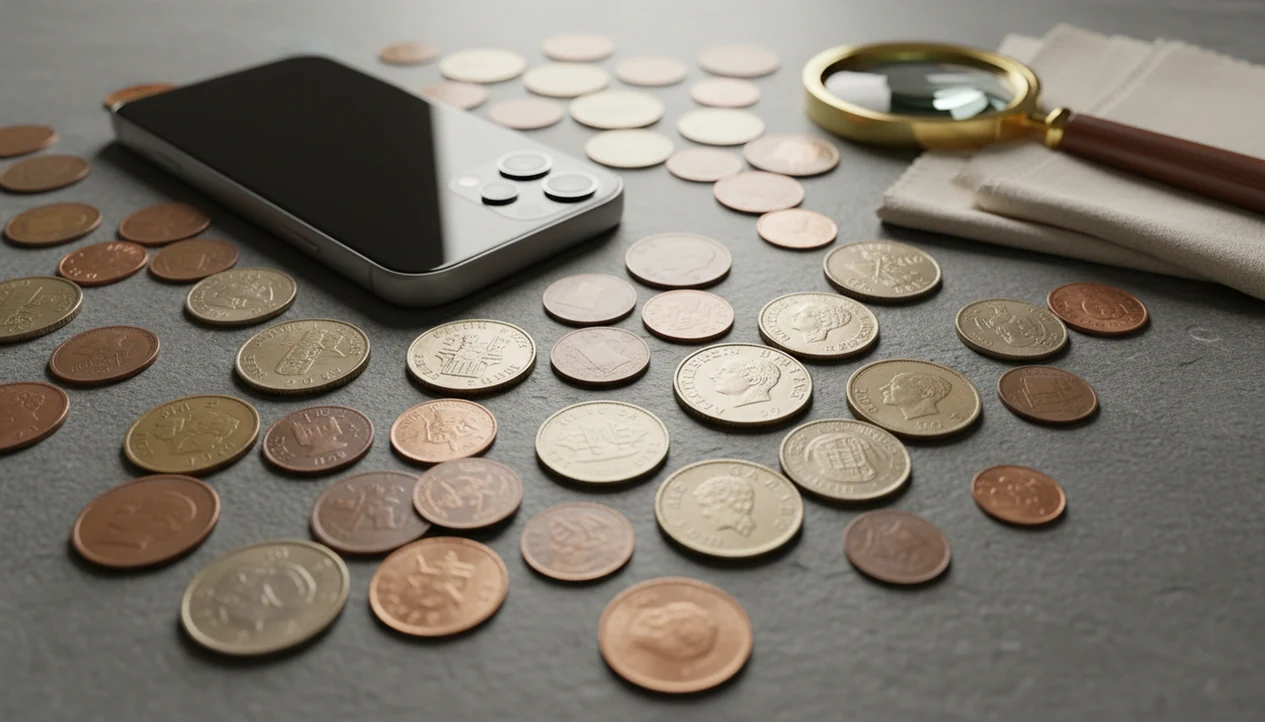


A world coin identifier helps you identify a foreign or non-U.S. coin from photos by matching visible clues such as country name, script, date, denomination, metal, and design. For best results, photograph both sides clearly, then verify the app result against country, date, and value clues before assuming a coin is rare.
A world coin identifier is a photo-first tool or app that uses coin images, inscriptions, symbols, and reference data to identify a non-U.S. coin’s country, type, date, denomination, and likely collector value range.
- Start with clear photos of both sides of the coin, including the rim, date, and any readable lettering.
- Use country names, scripts, emblems, denominations, and date systems to verify the app’s identification.
- Treat value results as estimates because condition, rarity, demand, and recent sales can change the real price.
World CoinEd Facts At A Glance
- A photo-based world coin identifier compares images of a coin’s obverse and reverse against known coin types.
- Typical results include country, denomination, year, metal, mint, rarity notes, and an estimated value range.
- Photo quality strongly affects accuracy; a blurred nickel on a kitchen counter can hide the one mark that matters.
- AI results should be verified for rare, worn, high-value, or unusual coins before selling or labeling them.
- Mobile identification fits a large audience: Pew Research Center reported broad smartphone adoption globally, and the Federal Reserve's 2022 Survey of Consumer Finances found that 24% of U.S. families held collectibles such as coins, stamps, or antiques (https://www.pewresearch.org/short-reads/2024/02/05/smartphone-ownership-is-growing-rapidly-around-the-world-but-not-always-equally/; https://www.federalreserve.gov/econres/scfindex.htm).
Small details decide the match.
For beginners, photo-first identification is often easier than starting with catalogs because the app can narrow the country and type before deeper research begins.
How A World CoinEd App Works From Photos
A world coin identifier app works by turning coin photos into visual features, then matching those features against reference data for known world coins.
Image recognition looks at round shape, rim style, legends, portraits, symbols, dates, denominations, and reverse design. In technical terms, the app creates image embeddings, which are compact visual fingerprints. Those are compared with large coin databases, catalog records, and market references.
Both sides matter. One side may show a ruler, while the other gives the denomination or issuing country. A tarnished silver quarter in loose change teaches the same lesson: the first side rarely tells the whole story.
Database matching matters because global coinage is huge: the U.S. Mint says it has produced more than 1.1 trillion coins since 1792, and the European Central Bank reports more than 145 billion euro coins in circulation across national designs (https://www.usmint.gov/learn/history/overview; https://www.ecb.europa.eu/euro/coins/html/index.en.html). Outputs may include country, ruler or issuing authority, metal, mintage, mintmark, and value range.
Before You Use A World CoinEd
Before you use a world coin identifier, set up the coin so the app can read honest details. Good light, clean photos, and a little restraint usually matter more than taking dozens of rushed shots.
- Place the coin on a plain, matte background in bright indirect light so glare does not wash out lettering, toning, or small date marks.
- Photograph both sides first, keeping the full rim visible, before taking close-ups of mintmarks, dates, edge details, or unusual symbols.
- Leave the surface alone; do not clean, polish, rub, or “brighten” the coin before identification because fresh scratches can hurt both matching and value judgment.
- Keep simple measuring tools nearby if you have them, especially a loupe, ruler, and small scale, since diameter and weight can separate similar-looking issues.
- Sort out tokens, medals, souvenir pieces, and fantasy designs from coins that were made to spend, because those pieces may not match normal world coin references.
This quick setup turns the scan into a better record, not just a prettier photo.
How To Use A Foreign CoinEd Correctly
Use a foreign coin identifier as a structured check, not a one-tap verdict. The goal is to confirm what the photos suggest.
- Photograph both sides in bright, even light, with the coin flat and the rim visible.
- Capture close-ups of the date, denomination, mintmark, and inscriptions.
- Upload or scan the coin in the identifier app and review the likely matches.
- Compare the result with visible country, script, symbols, and design clues.
- Save the confirmed coin to a collection record with notes, photos, and value context.
A coin balanced on a white napkin usually photographs better than one on a glossy table. Tools like CoinEd can help with photo-first identification, but the value shown should still be treated as an estimate.
For a photo-first workflow, CoinEd is useful when you want one scan to return likely country, denomination, date, and value clues in the same place. Still, confirm the result against visible markings before saving it as final.
A good photo-first coin identifier and value estimation app for collectors and beginners gives organized clues and market context, not a guaranteed grade or sale price.
Country, Script, And Symbol Clues For Identifying World Coins
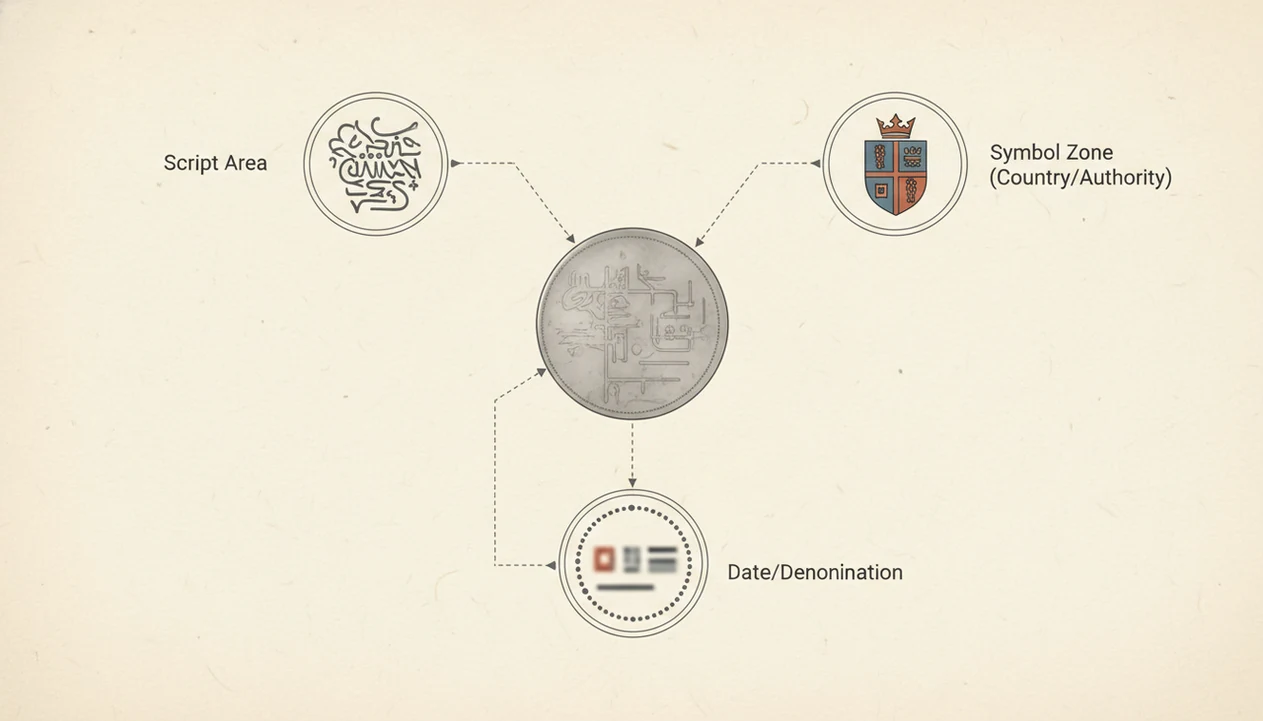
Country, script, and symbol clues help you verify whether the app result actually fits the coin in your hand. Latin country names can be direct clues, including France, España, Italia, Brasil, Belgique, or Nederland.
Script Clues On Foreign Coins
Arabic, Cyrillic, Devanagari, Chinese, Japanese, Korean, and Thai scripts often point toward a region before they name one country. If there are no English words, the world coin script guide can help you compare letter shapes without guessing from memory.
Emblems And Portrait Clues
Coats of arms, monarch portraits, animals, temples, shields, and national buildings can narrow origin quickly. Similar regional designs can mislead beginners and AI, especially on colonial-era coins or shared currency zones. Compare both sides because one side may show a shared design, while the other names the issuing country.
The loupe moment is familiar: one tiny letter changes the answer.
Date And Denomination Clues In An International Coin App
How do date and denomination clues affect an international coin app result? They can change the country, coin type, and estimated value, so they should be checked before you accept the match.
Many world coins use Gregorian dates, but others use Islamic Hijri dates, Thai Buddhist Era years, Japanese era names, Hebrew dates, or regnal years. A wrong conversion can place the coin in the wrong reign or series. Denomination words may also look unfamiliar because older coins used terms no longer found in modern wallets.
Inspect numerals, edge text, small mintmarks, and symbols beside the date. A fingernail pointing at a doubled number or a small mintmark under a date can separate a common type from one worth more research. For coins with no readable English, the workflow in identify coin with no English is a useful next step.
World Coin Value Clues After Identification
World coin value depends on condition, scarcity, metal content, demand, mintmark, and variety. Many modern foreign coins are common circulation finds even when they look old, dark, or unfamiliar.
| Value clue | What it means | Why it matters |
|---|---|---|
| Face value | Spendable value in the issuing country | Often low for demonetized or obsolete coins |
| Bullion value | Metal value from silver, gold, or other metals | Can exceed collector value for worn pieces |
| Catalog value | Published reference estimate by type and grade | Useful, but not always current market price |
| Recent sale value | What similar coins actually sold for | Stronger evidence than an asking price |
AI value ranges are estimates, not guaranteed sale prices. Collection value lists beside a calculator often look tidy, but one harsh cleaning mark can change the number. For potentially rare, expensive, or altered coins, use a trusted catalog, auction archive, or professional grading service.
For world coins, recent sold prices usually give better value context than asking prices because they show what buyers actually paid.
Collection Tracking After You Identify World Coins
After identification, save the country, year, denomination, metal, grade notes, acquisition source, and any uncertainty. Written notes matter because photos alone may not preserve why you chose one match over another.
Store both sides of the coin, plus close-ups of the date, mintmark, and inscriptions. Track duplicates, want lists, purchase cost, estimated value changes, and where the coin came from. The clink of mixed nickels, dimes, and foreign coins poured from an inherited coffee can fades fast; the record keeps the story straight.
CoinEd helps collectors identify, organize, and value-check world coins from clear photos. CoinIdentifier can also fit a simple research routine when you want one place for scans, collection notes, and estimated value ranges. For broader comparisons, an app that identifies foreign coins guide can help match tools to your collection style. Collectors may also compare results with Numista, NGC Coin Explorer, PCGS CoinFacts, or Krause-style catalog references when a match looks uncertain.
Common Foreign CoinEd Mistakes
Common mistakes usually come from rushing the first match. One blurry photo of one side is rarely enough, especially when script, denomination, or date marks are partly worn.
Beginners also assume the first AI result is automatically correct. That can fail with similar scripts, shared emblems, colonial-era designs, and regional coin families. Date conversion mistakes are another problem. So are missed mintmarks, especially small letters near the date or under a portrait.
Don’t assume every old foreign coin is rare. Many are common and inexpensive, even with attractive toning or unfamiliar lettering. Also avoid cleaning before identification or value research. Wipe dust from a cardboard 2x2 flip if needed, but don’t rub the coin itself.
Hard stop.
For ancient, Roman, or heavily worn pieces, photo matching may be only the beginning; an ancient coin identifier can explain why legends, weight, and fabric matter more.
Limitations
Photo-based identification is useful, but it has real limits.
- AI may struggle with worn, corroded, bent, holed, clipped, off-center, or partly visible coins.
- Obscure mints, minor varieties, tokens, medals, fantasy pieces, and pre-modern coinage may have incomplete database coverage.
- Value ranges may lag recent auction results, metal price changes, or local demand.
- AI cannot replace professional grading for condition, cleaning, tooling, repairs, or authenticity concerns.
- Cloud-based image analysis can raise privacy and data-use questions, especially for expensive collections.
- Over-reliance on apps can slow the learning of scripts, date systems, mintmarks, and catalog skills.
- Phone photos on a dark wooden table can make copper cents look redder than they are, which may distort condition impressions.
If a coin may be rare or expensive, get expert confirmation before selling, insuring, or sending it for grading.
FAQ
How do I identify foreign coins?
Photograph both sides, then check country names, script, symbols, date, denomination, and mintmark. Compare the app result with a trusted reference before assuming it is correct.
Can I identify coins from photos?
Yes, many world coins can be identified from clear photos of both sides. Accuracy drops when images are blurry, dark, cropped, or missing the date area.
What country is my coin from?
Country names, rulers, coats of arms, scripts, and reverse designs often reveal the origin. Some coins need comparison with regional references because designs can look similar.
What script is on my coin?
Common world coin scripts include Arabic, Cyrillic, Devanagari, Chinese, Japanese, Korean, Hebrew, and Thai. Match letter shapes first, then use country and date clues to narrow the result.
How do I read coin dates?
Some coins use Gregorian dates, while others use local calendars, era names, regnal years, or non-Latin numerals. A date conversion error can lead to the wrong identification.
Are old foreign coins valuable?
Age alone does not make a foreign coin valuable. Condition, mintage, metal content, demand, mintmark, and variety matter more.
What is my world coin worth?
A world coin’s value is usually estimated from condition, scarcity, metal content, and recent sales of similar coins. Expert appraisal is needed for rare or high-value pieces.
Are coin identifier apps accurate?
Coin identifier apps can be accurate for many common coins when photos are clear and database coverage is strong. Rare varieties, damaged coins, and obscure issues should be verified manually or by an expert.
Should I clean foreign coins?
No, cleaning can reduce collector value and make grading or authentication harder. Leave the coin as found until it has been identified and, if needed, reviewed by a specialist.