
Silver Dime Identifier for Mercury and Roosevelt Dimes
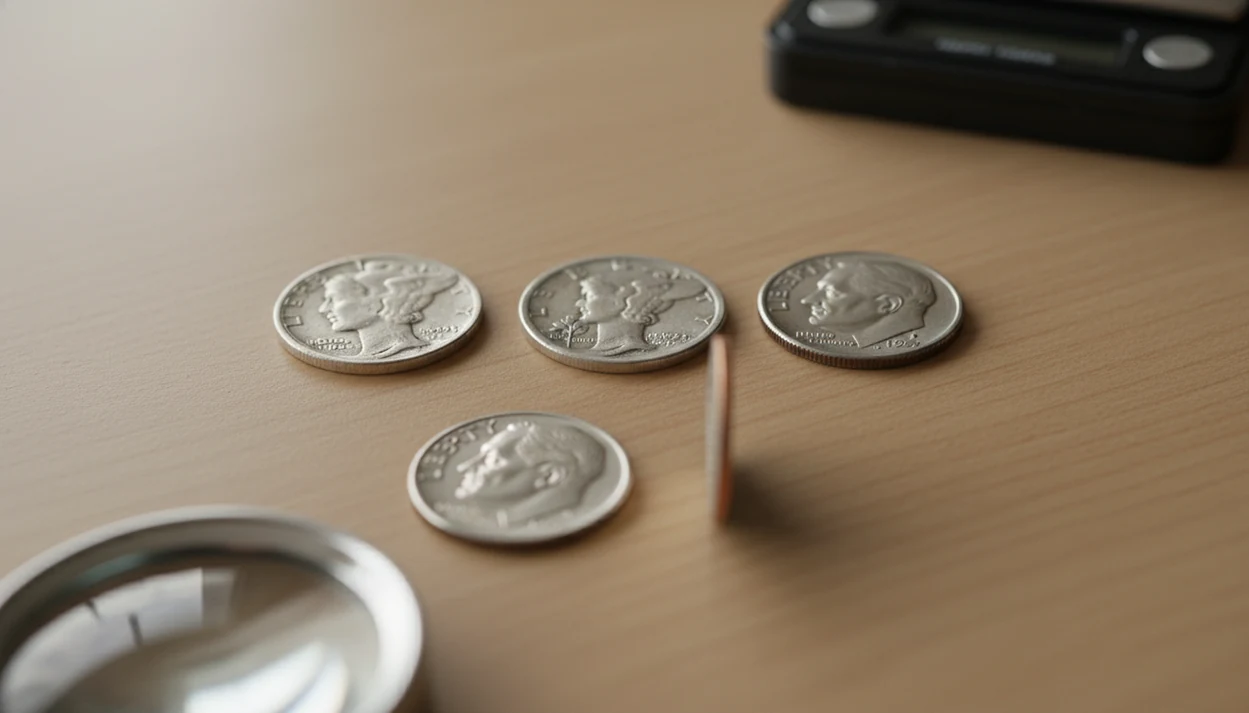


A silver dime identifier starts with the date: regular U.S. dimes dated 1964 or earlier are 90% silver, while most 1965 and later dimes are copper-nickel clad. After the date, check the design, mint mark, edge color, weight, and condition to decide whether the dime is worth only melt value or has collector premium.
Definition: A silver dime identifier is a date, design, mint mark, edge, weight, and value-check workflow used to confirm whether a U.S. dime contains silver and whether it has numismatic value beyond melt.
- Roosevelt, Mercury, Barber, and earlier regular-issue U.S. dimes dated 1964 or earlier are 90% silver.
- A typical 90% silver dime contains about 0.0723 troy ounces of silver, so melt value changes with the silver spot price.
- Common circulated silver Roosevelt and Mercury dimes often trade near melt, while key dates, rare mint marks, errors, and high grades can bring collector premiums.
Silver Dime Identifier Facts for U.S. Dimes
- Date cutoff: Regular-issue U.S. dimes dated 1964 or earlier are 90% silver. That includes silver Roosevelt dime, Mercury dime silver, Barber dime, and earlier dime designs.
- Modern composition: Circulating dimes dated 1965 and later are normally copper-nickel clad, even when they look gray, dull, or heavily worn.
- Design matters: Roosevelt dimes began in 1946, Mercury dimes ran from 1916 to 1945, and Barber dimes ran before that.
- Silver-content rule: Most 90% silver U.S. dimes contain about 0.0723 troy ounces of silver before adjustment for heavy wear.
- Value rule: A silver dime’s value is usually the higher of melt value or collector value.
A beginner turning over a wheat cent under a kitchen light often learns the same habit here: start with the date, then find the tiny mint mark.
How Silver Dime Identification Works
Silver dime identification works because U.S. dime composition follows a date-based rule more reliably than surface appearance. Color can shift from wear, toning, lighting, cleaning, or dirt, but the date and design place the coin inside or outside the silver era.
The workflow uses attribution, which just means matching the coin to its correct type. Roosevelt dimes belong to the 1946-and-later design, Mercury dimes to 1916-1945, and Barber dimes to the earlier series, so the design helps confirm whether the date range makes sense. Mint marks can change rarity and collector demand, but they do not change the basic 90% silver rule for regular pre-1965 U.S. dimes. Edge color and weight are confirmation tools: a copper stripe or an off-weight reading can warn you when a date is worn, damaged, plated, or suspicious. Keep the metal question separate from the price question. First decide whether the dime is silver; then estimate collector value from date, mint mark, condition, variety, and market demand.
6 Silver Dime Identifier Checks for Silver vs. Clad Dimes
A reliable silver dime check follows this order: read the date, identify the design, locate the mint mark, inspect the edge, check the weight, then compare melt value with collector value. That order keeps you from making a fast guess from color alone.
The Coinage Act of 1965 is the key cutoff: the U.S. Mint explains that dimes and quarters moved away from 90% silver circulation coinage beginning in 1965 (https://www.usmint.gov/learn/history/historical-documents/coinage-act-of-1965).
How silver dime identification works is simple: design recognition narrows the type, composition rules narrow the metal, and market comparison narrows the value. Photo-first AI coin apps can help read dates, reverse designs, and mint marks, but worn digits still need manual verification. A dark wooden table can make copper cents look redder, and it can make dime surfaces look stranger too.
For dimes, date-first checking is usually better than color-first checking because the 1964 cutoff is clearer than surface tone.
Before You Start: Tools for Checking a Silver Dime
Before checking a silver dime, set up a clean, well-lit workspace and gather a few simple tools. Good light, clear photos, magnification, and a current silver price make the identification more reliable before you start judging value.
- Use bright indirect light and a plain background so the date, rim, and edge do not disappear into glare or pattern. A phone camera is enough if the coin fills the frame and both sides are sharp.
- Keep a small digital scale nearby for dimes with weak dates, odd surfaces, or possible alteration. Weight is not the first test, but it is useful when the date is hard to trust.
- Inspect mint marks, flattened digits, and worn design details with a magnifier. Tiny marks can change the collector side of the answer even when the silver rule is already clear.
- Check the current silver spot price before estimating melt value, because the 0.0723-ounce figure only becomes a dollar estimate when paired with today’s market.
- Avoid cleaning, polishing, rubbing, or “brightening” the dime before identification. Leave dust and toning alone until you know what you have.
6-Step Silver Dime Identifier Workflow for One Coin
Use this workflow when one dime looks old, bright, gray, or worth a closer look.
- Photograph both sides on a plain surface, with the obverse and reverse filling the frame.
- Read the date first, since 1964 or earlier regular U.S. dimes are the main silver group.
- Locate the mint mark and record whether it is Philadelphia, Denver, San Francisco, or absent.
- Inspect the edge for a copper stripe, but do not rely on edge color by itself.
- Weigh the dime if the date is unclear or the coin looks altered.
- Compare melt value against collector value using the date, mint mark, condition, and recent market context.
Tools like CoinEd can support this photo-first check with identification, rarity lookup, grade hints, and collection organization. A good ai coin identification, rarity lookup, and collection value estimation app for collectors and beginners gives structured clues and saved notes, not instant authentication or a guaranteed sale price.
For higher-confidence checks, compare the result against references such as PCGS CoinFacts, NGC Coin Explorer, or the current Guide Book of United States Coins before assuming a premium value.
The pocket check is real.
Silver Roosevelt Dime Year and Mint Mark Checks
Does a Roosevelt dime contain silver? Roosevelt dimes dated 1946 through 1964 are 90% silver, so a 1964 dime silver check is usually positive for regular issues.
A 1965 Roosevelt dime is normally copper-nickel clad, not silver. That surprises people because 1965 dimes can still look worn, gray, or “old enough.” The date matters more than the general look.
PCGS CoinFacts lists the 1964 Philadelphia Roosevelt dime mintage at 929,360,000, so a no-mint-mark 1964 dime is common, not automatically rare (https://www.pcgs.com/coinfacts/coin/1964-10c/5150). No mint mark on many U.S. coins usually points to Philadelphia, especially on ordinary circulation pieces.
If you find a 1964 dime in a desk drawer, check condition next. Brightness alone is not grade. A soft gray coin with honest wear may still be mainly a silver-value piece, while a sharp uncirculated example deserves a closer reference check with a silver coin identifier.
Mercury Dime Silver Design and Date Checks
Mercury dimes dated 1916 through 1945 are 90% silver, but the design name can confuse new collectors. The obverse shows Liberty wearing a winged cap, not the Roman god Mercury. The reverse has a fasces, a bundled-rod design, with an olive branch beside it.
Start with the obverse. Read the date, then turn the coin over to check the mint mark on the reverse. Heavy wear can flatten the date area, and rim damage can reduce collector interest even when the coin is silver.
Common circulated Mercury dimes often sell near melt value. Key dates, scarcer mint marks, strong strikes, and better grades can be worth much more. That is why “Mercury dime silver” is only the first answer, not the full value answer.
Do not clean it. Wiping dust from a cardboard 2x2 flip is fine, but rubbing the dime itself can leave hairlines that lower collector value.
Silver Dime Melt Value Formula and Collector Premium
The base melt formula for most 90% silver U.S. dimes is 0.0723 troy ounces × current silver spot price. That gives the silver-content baseline before retail spreads, dealer margins, condition premium, or rare-date demand.
NGC's U.S. coin melt-value reference lists pre-1965 90% silver dimes at about 0.07234 troy ounces of silver, which supports the 0.0723 rounded figure used here (https://www.ngccoin.com/price-guide/coin-melt-values.aspx).
| Value term | What it means | What to remember |
|---|---|---|
| Melt value | Silver content multiplied by spot price | Base bullion value, not a sale guarantee |
| Retail price | What a buyer may pay from a shop or marketplace | Often above melt for convenience or demand |
| Dealer buy offer | What a dealer may offer to purchase it | Usually below retail |
| Collector premium | Extra value from rarity, grade, errors, toning, or demand | Can exceed melt by a lot on better coins |
Heavy wear may slightly reduce silver weight, especially in large groups. For one dime, the formula is still a practical estimate.
Online estimates and AI values are approximations, not guaranteed sale prices. The melt value vs collector value debate matters most when a coin has a scarce date, strong condition, or possible error.
Bulk Silver Dime Identifier Method for Jars and Rolls
For jars and rolls, sort first and research second. Put dimes dated 1964 or earlier in one pile, then place 1965-or-later dimes in another. The first pile is the likely 90% silver group. The second pile is normally clad.
A simple bulk estimate uses face value. Ten silver dimes equal $1 face value, and silver buyers often quote 90% U.S. coin lots as a multiple of face value. According to a National Bureau of Standards study, a $1,000 face-value bag of pre-1965 90% silver U.S. dimes, quarters, and halves contains about 715 troy ounces of pure silver after typical wear.
Scale that idea down carefully. A $10 face-value group is not a promise of an exact payout, but it gives a working estimate before individual checks.
The clink of mixed nickels, dimes, and foreign coins poured from an inherited coffee can onto a towel is familiar. After sorting, photograph the sharper dates one by one with CoinIdentifier or another reference tool.
Silver Dime Identification Mistakes That Lower Value
- The old-looking dime mistake: Not every worn or dark dime is silver. A 1965 or later dime is normally copper-nickel clad, even if it looks older than a bright 1964 coin.
- The every-silver-dime-is-rare mistake: Most common circulated silver Roosevelt and Mercury dimes trade close to melt unless date, mint mark, grade, or variety adds demand.
- The cleaning mistake: Cleaning can remove original surface character and add scratches. A brighter dime is not automatically a more valuable dime.
- The edge-only mistake: Edge color helps, but plated, altered, or damaged coins can mislead. Date, design, weight, and reference comparison still matter.
- The no-expert-needed mistake: Suspicious, damaged, or valuable-looking dimes may need expert testing or professional grading.
A small label reading “possible error coin” is useful only if the next step is verification. For metal questions beyond silver dimes, a tool that can check coin metal can help frame what to test next.
Limitations
A silver dime guide, photo app, or at-home checklist can narrow the answer, but it cannot guarantee authenticity, grade, or final sale value. Use the result as a practical identification step, not a formal appraisal.
- AI tools can misread worn, corroded, damaged, or weakly struck dates and mint marks.
- Grade, cleaning, hairlines, and subtle surface problems are difficult to judge from photos alone.
- Melt values depend on the current silver spot price and the coin’s actual remaining silver weight.
- Price guides and app estimates may differ from realized sales, local demand, or dealer buy offers.
- At-home identifiers cannot reliably authenticate counterfeits, plated coins, or altered coins.
- Professional grading or expert authentication may be needed for rare, expensive, or suspicious dimes.
- A no-mint-mark dime is not automatically rare, especially for common Philadelphia issues.
If the coin might be valuable, slow down. Compare against a trusted reference, photograph both sides, and avoid cleaning before getting another opinion through an app that tells if coin is silver or a specialist.
FAQ
What dimes are silver?
Regular-issue U.S. dimes dated 1964 or earlier are 90% silver. This includes Roosevelt, Mercury, Barber, and earlier U.S. dime designs.
Is a 1964 dime silver?
A regular 1964 Roosevelt dime is 90% silver. Most common circulated examples are valued mainly for silver unless condition, variety, or error features add premium.
Are 1965 dimes silver?
Circulating 1965 dimes are normally copper-nickel clad, not silver. The silver composition for regular U.S. dimes ended after 1964.
What is a Mercury dime?
A Mercury dime is a U.S. dime issued from 1916 through 1945 with the Winged Liberty Head design. Regular Mercury dimes are 90% silver.
Where is the dime mint mark?
On Roosevelt dimes, check near the date on many later issues and on the reverse for earlier silver Roosevelt dimes. On Mercury dimes, check the reverse near the bottom; no mint mark commonly means Philadelphia.
How much silver is in a dime?
Most 90% silver U.S. dimes contain about 0.0723 troy ounces of silver. Heavy circulation wear can slightly reduce the actual remaining silver weight.
Should I clean silver dimes?
No, you should not clean silver dimes. Cleaning can damage surfaces, leave hairlines, and reduce collector value even if the coin looks brighter.