
European CoinEd For Euro, Pre-Euro, And Country Clues
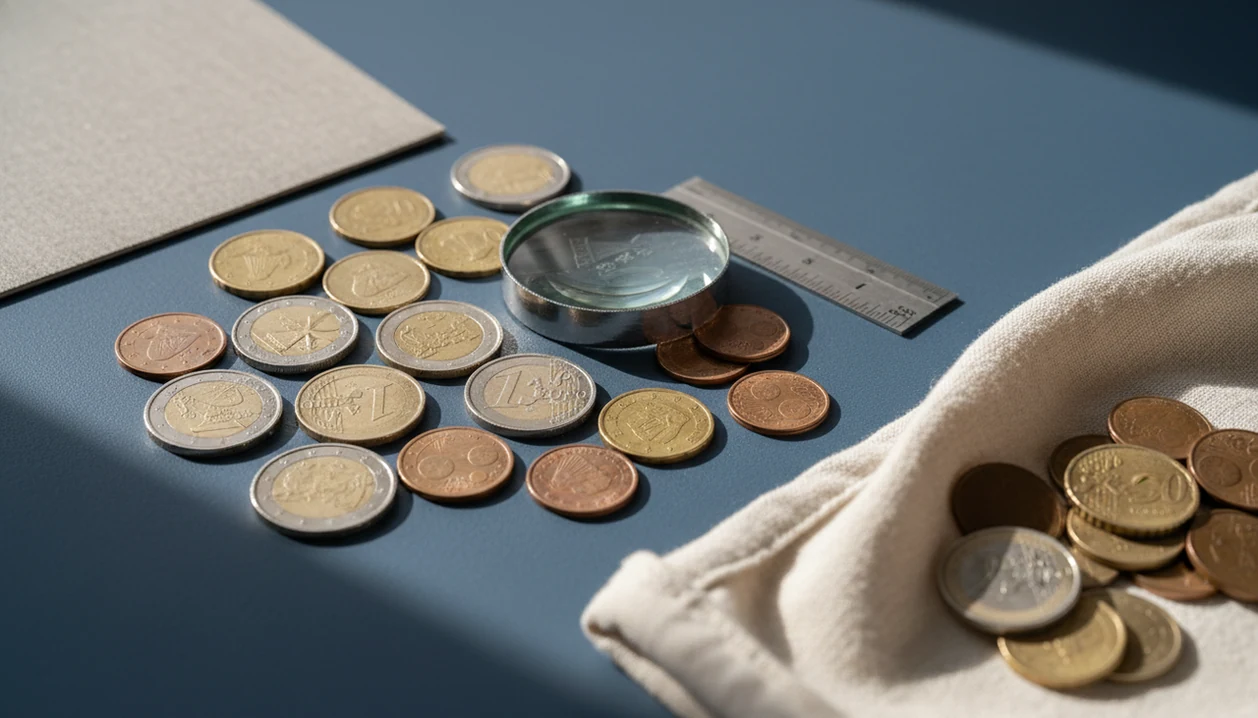


A European coin identifier helps you match a coin to its country, denomination, date, and issue type by comparing photos with design details, legends, mint marks, and denomination symbols. Start with both sides of the coin, then separate modern euro coins from pre-euro national issues before checking value or rarity.
Definition: A European coin identifier is a photo-first lookup method or app workflow for identifying European coins by country, currency, denomination, year, design, text, and variety clues.
TL;DR
- Euro coins have a shared common side and a country-specific national side, so both sides matter.
- Pre-euro coin lookup often depends on old currency names, portraits, coats of arms, language, and partial inscriptions.
- Any value estimate is only a starting point until condition, rarity, variety, and market comparisons are checked.
European coin identifier basics for country, date, and denomination clues
A European coin identifier combines photo recognition with visible coin clues: legends, dates, mint marks, portraits, symbols, shields, and denomination text. The first job is not value. It is attribution.
Start with the obverse, then turn the coin over and photograph the reverse design. A beginner often finds the answer only after moving the coin under a kitchen light, where a tiny mint mark or partial date finally appears. Euro coins need both the common side and the national side checked. Pre-euro national coins may use francs, marks, lire, pesetas, schillings, guilders, escudos, or drachmas.
Tools like CoinEd can help with photo-first identification, rarity hints, grade context, and estimated value ranges. That result is a starting point, not a formal appraisal.
Before You Start Identifying a European Coin
Before you identify a European coin, set up a clean, steady workspace and record the basic physical clues. Good preparation prevents glare, lost details, and accidental damage before the first match is even checked.
- Choose bright, indirect light near a window or lamp, then place the coin on a plain, non-reflective background so the rim, color, and inscriptions stand out.
- Gather a ruler, scale, magnet, and soft towel before you start. The towel keeps the coin from sliding and softens the drop if it slips from your fingers.
- Photograph the coin in its holder first if it came in a flip, capsule, envelope, or album page. Labels, old handwriting, and original storage can be useful clues.
- Avoid cleaning, polishing, or rubbing the surface, even if dirt hides part of the design. A quick shine can turn an interesting coin into a damaged one.
- Record diameter, weight, edge type, and visible lettering before searching. Write down whether the edge is plain, reeded, patterned, or lettered, and copy partial text exactly as seen.
How a European coin identifier works from photos
A European coin identifier works by comparing image features from your coin with reference patterns from known European issues. The system looks for busts, shields, maps, stars, wreaths, edge patterns, metal color, coin shape, and spacing around the rim.
Photo matching is only one layer. Text recognition reads visible legends, denomination words, dates, and mint marks, then catalog-style filters narrow the result by country, denomination, year, and variety. A dark wooden table can make copper cents and bronze coins look redder than they are, so lighting changes the match quality.
For beginners, photo-first checking is often easier than starting with a catalog because the design narrows the search before the wording is fully understood. The strongest result comes from image matching, user-entered clues, and value context, not one photo alone.
Euro coin identifier clues on common and national sides
Euro coin identification depends on both sides because the shared denomination side does not prove the issuing country. The national side carries the country-specific design, portrait, symbol, or inscription.
- Euro coins in circulation have 8 denominations: 1, 2, 5, 10, 20, and 50 cent, plus 1-euro and 2-euro coins, according to the European Commission source.
- Euro coins have a common side and a national side, so the same value can show different country designs.
- Twenty EU countries currently use the euro, and the ECB maintains country-by-country information on euro coin national sides and issuing authorities source.
- Common searches include “1 euro coins by country” and “50 cent euro coins by country.”
The eagle side, the map side, or the stars may feel decisive. Flip it anyway.
How to use a European coin identifier app
Use a European coin identifier app by photographing both sides, recording the text, and verifying the result against country and denomination clues. Clear focus matters more than a dramatic angle.
- Photograph both sides in steady light, with the coin flat and the full rim visible.
- Crop the coin closely, but do not cut off edge lettering, dates, or small symbols.
- Record visible text exactly, including partial words, accents, numbers, and mint marks.
- Check country and denomination before reading value, especially on euro coins with national-side designs.
- Compare varieties by date, mint mark, edge pattern, portrait, and reverse design.
- Save the result with notes, photos, and an estimated value range in CoinEd or a coin collection tracker app.
Wipe dust from a cardboard 2x2 flip if needed, but do not clean the coin itself. If the surface looks dirty, leave it alone; NGC warns that cleaning can permanently reduce a coin’s collectible value source.
Pre-euro coin lookup for francs, marks, lire, pesetas, and drachmas
“How do I identify an old European coin that is not a euro?” Start with the currency word, country name, portrait, coat of arms, language, script, and date.
Pre-euro coin lookup often includes francs, marks, lire, pesetas, schillings, guilders, escudos, drachmas, and smaller subunits. Denomination alone is rarely enough. Several countries used similar values, monarch portraits, republic figures, Latin-style legends, and heraldic shields. A “10” on one coin may be a common pocket piece; on another, it may belong to a different country and century.
When the coin is worn, search by partial text. Type the letters you can see, then add the metal color, size, and any remaining design. If the inscription is not in English, our guide to identify coin with no English is useful for narrowing scripts and symbols.
If only two or three letters remain, pair them with measurable clues: diameter in millimeters, weight in grams, metal color, edge type, and whether the portrait faces left or right.
European coin identifier comparison table for euro and pre-euro issues
Different European coins reward different first clues. Euro identification leans on the national side, while pre-euro lookup leans more on inscriptions, currency names, portraits, and heraldry.
| Coin type | Best first clue | Secondary clue | Common problem | Next verification step |
|---|---|---|---|---|
| Modern euro circulation coins | National-side design | Denomination and year | Common side mistaken for country | Compare national symbols and mint mark |
| Euro commemoratives | 2-euro national design | Edge lettering | Similar anniversary themes | Match year, country, and inscription |
| Pre-euro national coins | Currency name or legend | Portrait, shield, or coat of arms | Same denomination used by many countries | Search partial text and date range |
| Older or worn European coins | Remaining portrait or heraldry | Metal color, size, edge pattern | Date or country hidden by wear | Compare against a world coin identifier workflow |
A small label reading “possible error coin” is fine for sorting. It is not proof.
European coin value checks after identification
European coin value depends on condition, rarity, year, mint mark, mintage, variety, metal content, and collector demand. Identification tells you what the coin is; valuation asks how desirable that exact example is.
One photo usually cannot determine a final value, especially for worn, cleaned, damaged, proof, error, or scarce variety coins. Phone glare across shiny copper can hide scratches. A flat photo can also miss rim dents, cleaning lines, or edge lettering.
Use the identifier result as a starting point, then compare similar sold examples and grade ranges. For cross-checking, compare the attribution and price range against references such as Numista, the NGC World Coin Price Guide, PCGS CoinFacts, and recent sold auction listings. CoinEd can provide value context and grade hints, but scarce coins still deserve specialist review. A good photo-first coin identifier and value estimation app for collectors and beginners gives structured clues and ballpark context, not guaranteed prices or certified grades.
Common mistakes when you identify European coins
Most European coin mistakes come from stopping too early. Turn the coin over, check the rim, and write down the small details before deciding.
- The euro common side is not the issuing country; the national side carries that clue.
- Edge lettering, edge pattern, mint marks, small dates, designer initials, and national-side symbols can change the attribution.
- Not every coin with European imagery is a euro coin; older national currencies and commemoratives may look modern.
- A ballpark app value is not a final appraisal, especially without grade and market comparison.
- Worn coins should be narrowed with partial text, metal color, size, edge clues, and remaining design, not discarded as impossible.
The inherited coffee can sound is familiar: nickels, dimes, and foreign coins clinking onto a towel, all mixed together.
Limitations
Photo identification is useful, but European coins include too many periods, languages, mints, and varieties for every result to be final. Treat uncertain matches as leads to verify.
- Low-quality, blurry, cropped, dark, or angled photos can produce weak matches.
- Worn, dirty, damaged, corroded, or heavily circulated coins may hide key text or design clues.
- Rare varieties, off-metal errors, proofs, patterns, and edge inscriptions may require specialist references.
- AI may confuse countries with shared languages, similar portraits, or similar heraldic designs.
- Pre-euro lookup can be difficult when only the denomination is visible.
- Value estimates are ballpark figures, not auction-grade appraisals or guaranteed sale prices.
- Ancient or heavily patinated pieces may need a separate ancient coin identifier approach.
If the match feels too neat, slow down.
FAQ
How do I identify European coins?
Photograph both sides, record the denomination, date, visible text, mint mark, and country symbols, then compare the design against a catalog or photo-based identifier.
What country is my euro coin?
Use the national side, not the common denomination side, to check country symbols, portraits, coats of arms, inscriptions, and mint marks.
Are all euro coins different?
Euro denominations share a common side, but each issuing country uses its own national-side designs.
How many euro coin denominations exist?
There are 8 circulating euro coin denominations: 1, 2, 5, 10, 20, and 50 cent, plus 1-euro and 2-euro coins.
How do I identify pre-euro coins?
Use old currency names, portraits, coats of arms, language, scripts, dates, and partial inscriptions to narrow the issuing country and type.
Can worn coins be identified?
Many worn coins can still be narrowed down using partial legends, metal color, size, edge details, date traces, and remaining design elements.
Do European coins have mint marks?
Many European coins have mint marks or small symbols, but placement and meaning vary by country, mint, and time period.
Can one photo show coin value?
One photo can suggest a starting estimate, but final value depends on condition, rarity, variety, metal content, and comparable market sales.