
Identify a Coin With No English Words Using Script Clues
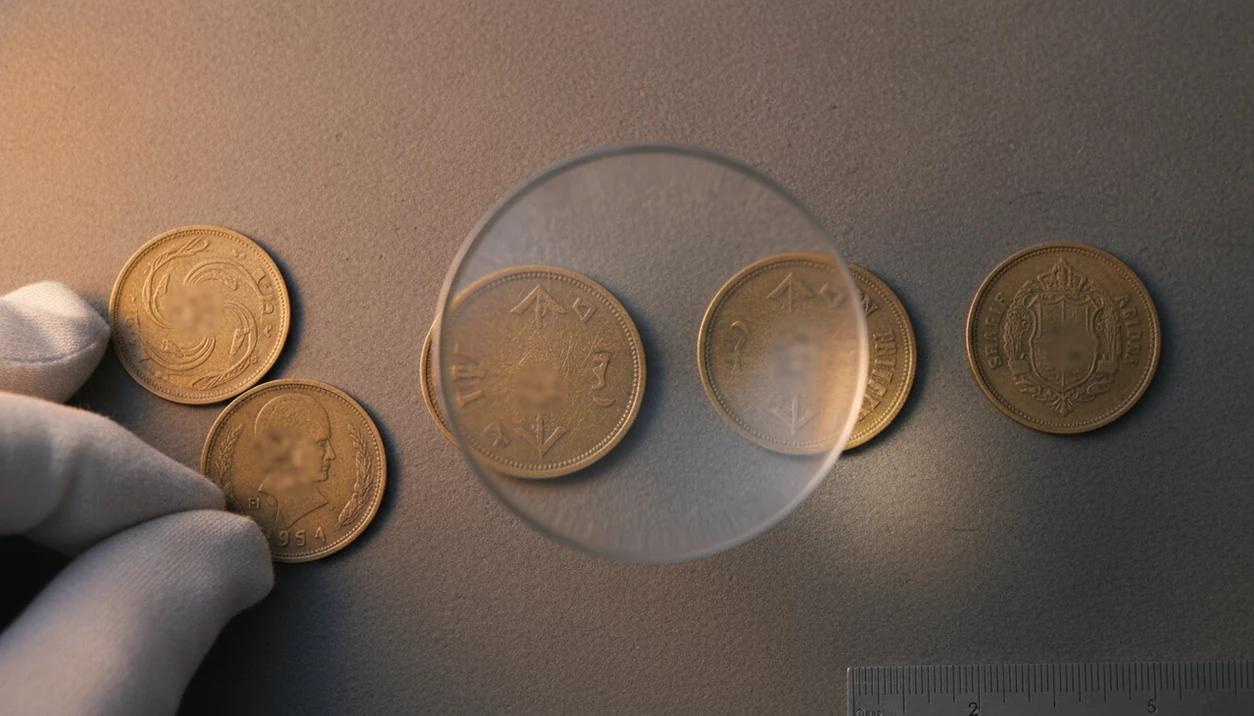


To identify coin with no English, start with a clear photo of both sides, then match the script, numerals, symbols, portrait, denomination, metal, and date style to a country and coin type. A photo-first coin identifier app can narrow the result quickly, but you should verify the year, variety, grade, rarity, and recent sale prices before assuming value.
Definition: A coin with no English words is usually identified by visual evidence first: script family, numerals, national emblems, ruler portraits, denomination marks, calendar system, metal, size, and edge details.
TL;DR
- Use both sides of the coin: one side may show the country, the other may show denomination, date, ruler, or emblem.
- Script clues such as Arabic, Chinese, Japanese, Cyrillic, Hebrew, Thai, or Devanagari can narrow the country list fast.
- Value depends on exact type, date, mint mark, grade, rarity, metal, and real market prices, not just the fact that the coin has no English.
No-English Foreign Coin Identification Facts
- A coin with no English text is not automatically old, rare, or valuable.
- The five first clues are script, numerals, symbols, portrait, and denomination or date.
- World coin references cover hundreds of thousands of types, so large catalog databases matter.
- AI photo identification is useful for narrowing matches, but it is not final proof.
- Value comes after identification, grade, rarity, metal content, and market checks.
Start with the obverse, then turn the coin over under steady light. We often see beginners find the “country” only after flipping to the reverse design. A crescent, dragon, monarch portrait, or national crest can say more than a full line of unreadable text.
The pocket check is real.
For a broad first pass, a world coin identifier can help organize likely countries before you compare smaller details.
How Coin Script Identifier Clues Work
A coin script identifier works by classifying the writing system first, then checking symbols, dates, rulers, and denomination marks to confirm the coin.
You do not need to translate every word. Visual classification starts with alphabet shape: Arabic-style curves, East Asian characters, Cyrillic letters, Hebrew forms, Thai script, or Indic scripts such as Devanagari. That first sort narrows geography, but it does not finish the job. Arabic-style script appears across many countries. Chinese characters can appear on Chinese, Japanese, Korean, and regional issues.
Look for the second clue immediately. A chrysanthemum points differently than a dragon. A double-headed eagle points differently than a lion or crescent. Some dates use local calendars, and some rulers are named by era rather than by full year.
For beginners, script family is often easier than translation because letter shape survives even when the coin is worn.
How to Use a Photo App to Identify an Unknown Foreign Coin
Use a photo app as a first sorting tool, then verify the match against the coin in your hand.
- Photograph both sides in bright, even light, including the obverse and reverse.
- Place the coin straight-on on a plain background with no glare or fingers covering details.
- Capture close-ups of the date, denomination, mint mark, and any unusual edge lettering.
- Compare the app result against visible script, numerals, symbols, metal color, and design layout.
- Save notes on country, denomination, date conversion, and value evidence before selling or labeling it.
A photo app can be a useful first-pass sorter, but it should not be treated as authentication. Compare results from CoinEd, CoinSnap, Numista, and a printed or dealer-backed catalog when the coin may be rare, ancient, counterfeit, or valuable.
Before You Start: What You Need to Identify a Coin With No English
Before you start, gather a phone camera, a plain background, a ruler, and a gram scale that can measure small weights accurately. The goal is to record the coin without changing it, then keep it separate until the country, date, and type are confirmed.
- Handle the coin by the edges so skin oils do not smear the surface, and do not clean, rub, polish, or scrape it to make the writing easier to see.
- Photograph both sides on a white or gray card in steady light, then add close-ups of the rim, reeds, holes, mint marks, and any unusual edge lettering.
- Measure the coin by writing down its diameter, weight in grams, magnetic response, and visible metal color, such as copper, brass, silver-gray, aluminum, or bimetallic.
- Keep the coin separate in a small envelope, tray, or holder until the identification is stable, especially if it came from a mixed jar or inherited lot.
- Label your notes lightly with “possible” country, date, and denomination until the photos, measurements, and catalog match agree.
Step 1: Photograph the Foreign Coin With No English Clearly
Blurry or angled photos cause wrong matches because the app may read a worn emblem as a different design. AI image-recognition systems can perform well on known image classes when photo quality is high, but accuracy varies by model, lighting, wear, and similar designs. For image recognition generally, the National Institute of Standards and Technology notes that test conditions, image quality, and algorithm choice can materially affect performance: https://www.nist.gov/programs-projects/face-recognition-vendor-test-frvt.
Use a neutral background. A dark wooden table can make copper cents look redder than they are, so gray paper or a white card is safer. Photograph both sides, then add the edge if it has lettering, reeds, holes, or an unusual shape. Take close-ups of dates, mint marks, and small symbols.
No heavy filters.
Keep fingers away from the rim and center design. If the coin sits in a cardboard 2x2 flip, wipe dust from the holder, but do not clean the coin itself. Scratches from “helpful” cleaning can matter later.
Step 2: Match the Coin Script, Numerals, and Symbols
Match the most distinctive script or symbol first, not every letter. Numerals may be Arabic-Indic, Eastern Arabic-Indic, Chinese characters, Thai numerals, Hebrew letters, or a local date form.
Common Non-Latin Coin Scripts
| Script clue | Where it may point | What to check next |
|---|---|---|
| Arabic-style script | Middle East, North Africa, South Asia | Crescent, ruler, date system |
| Chinese characters | China, Japan, Korea, regional issues | Hole, dragon, republic marks |
| Japanese characters | Japan | Chrysanthemum, era date |
| Cyrillic | Russia, Balkans, Central Asia | Eagle, denomination, ruler |
| Hebrew | Israel and older Jewish issues | Hebrew date, menorah, denomination |
| Thai | Thailand | Thai numerals, monarch portrait |
| Devanagari and Indic scripts | India, Nepal, South Asia | Denomination, emblem, calendar |
National Symbols That Narrow the Search
Search the standout symbol: crescent, star, dragon, chrysanthemum, double-headed eagle, lion, monarch portrait, or national crest. A Chinese coin identifier is more useful once you know the characters and shape point toward Chinese-style issues.
Step 3: Convert No-English Coin Dates and Calendars
“Why does the date on my coin not look like a normal year?” The visible date may not be Gregorian, and that changes the identification.
Some coins use Hijri dates. Others use Solar Hijri, Hebrew calendar years, Japanese era years, Thai Buddhist Era years, or local systems tied to rulers and reigns. A coin may show “year 5” of a reign instead of a full calendar year. That is common enough to slow down new collectors.
Date conversion affects type, rarity, and value. The same design may be common in one year and scarcer in another. A sticky note marking a possible key date beside the coin is fine, but confirm it before writing a value in your collection notes.
For ancient or ruler-dated pieces, an ancient coin identifier can help separate calendar reading from portrait and legend matching.
Step 4: Confirm the Foreign Coin Type, Denomination, and Metal
A likely country is not enough; confirm the exact type by denomination, weight, diameter, metal color, shape, and edge details. Numista catalogs more than 200,000 coin types, which is why small design differences matter (source: https://en.numista.com/catalogue/index.php?ct=coin).
Compare the denomination mark first. Then measure diameter and weight if you can. A kitchen scale is not a grading tool, but it can flag a replica, token, or wrong metal. Edge lettering, reeds, center holes, scalloped shapes, and bimetallic rings all help separate similar coins.
Tokens, medals, replicas, and commemoratives can look official. Some are not circulating money at all. Catalog databases help because a tiny mint mark, modified portrait, or changed reverse design can split one “same-looking” coin into several cataloged types.
Exact matching matters most when the coin looks ordinary.
Step 5: Estimate No-English Foreign Coin Value
Foreign coin no English value depends on exact type, date, mint mark, grade, rarity, metal, and demand. Check auction records, sold listings, catalog ranges, and app estimates before assuming a coin is scarce.
Use a market checklist:
- Confirm the country, denomination, and calendar year.
- Check mintage, key-date notes, and known varieties.
- Compare wear, scratches, corrosion, cleaning, and rim damage.
- Review recent sold prices, not only asking prices.
- Separate collector premium from silver or gold melt value.
Many high-mintage coins have little premium even when they look unusual to an English-speaking collector. The clink of mixed nickels, dimes, and foreign coins poured from an inherited coffee can onto a towel feels exciting, but most pieces still need ordinary catalog work.
Value is evidence, not a hunch.
Common Mistakes With a Foreign Coin With No English
Mistake 1: “No English means ancient.” Many modern circulating coins use no English at all. A current Thai, Japanese, Israeli, or Middle Eastern coin may look mysterious but be common.
Mistake 2: Trusting one app result. Apps can suggest a match, but compare script, date, denomination, and design details before saving it.
Mistake 3: Treating similar scripts as one country. Arabic-style script, Cyrillic, and Chinese characters cross borders and eras.
Mistake 4: Cleaning the coin. Polishing, rubbing, dips, and abrasives can reduce collector value, especially on older surfaces. Professional numismatic guidance commonly warns against cleaning coins because surface alteration can reduce collector value; see the American Numismatic Association’s handling advice: https://www.money.org/collector/coin-care/.
Mistake 5: Assuming silver color means silver. Nickel, cupronickel, aluminum, steel, and plated metals can all look bright. The common question, “Is this silver or just old?” needs a date, metal test context, and reference check.
Verification Checklist for an Unknown Foreign Coin
Verify the identification in a fixed order before you sell, trade, or label the coin. A good checklist prevents one attractive photo from becoming a wrong collection record.
- Country or issuing authority
- Denomination mark
- Date and calendar conversion
- Mint mark or mint city
- Diameter and weight
- Metal or magnetic response
- Edge type, lettering, or shape
- Obverse and reverse design match
- Grade notes: wear, scratches, corrosion, cleaning
- Value evidence from sold prices and catalog context
Save both photos and notes in one record. CoinEd helps organize photo-based identifications and value context, while a coin collection tracker app is useful when the same inherited lot turns into dozens of entries.
Ask for expert review on rare, expensive, ancient, or possibly counterfeit coins. CoinIdentifier can help with first-pass organization, not formal authentication.
Limitations
No guide, app, or image search can solve every foreign coin with no English text.
- Worn, corroded, dirty, bent, or low-detail coins can be misidentified.
- AI may confuse similar scripts, rulers, eras, or design varieties.
- Value estimates can differ from local market prices and current demand.
- Rare coins, counterfeits, tokens, medals, and local issues may require expert review.
- No online tool covers every world coin, especially private issues and regional tokens.
- Calendar conversion can be wrong if the coin uses a regnal year or partial date.
- Dark photos, glare, filters, and cropped rims hide identification clues.
- App estimates are not formal appraisals and should not replace auction evidence.
If a coin appears unusually valuable, slow down. Get sharper photos, compare trusted references, and consider a dealer or grading-service opinion.
FAQ
What country is my coin from?
Use script, symbols, portraits, denomination marks, and date style to narrow the issuing country. Confirm the match against both sides of the coin.
Can an app identify foreign coins?
Photo-based apps can suggest likely matches for foreign coins. Verify the result against visible script, date, denomination, metal, and design details.
Is my no-English coin valuable?
Value depends on exact type, year, mint mark, grade, rarity, metal, and recent sold prices. No-English text alone does not make a coin valuable.
How do I read coin dates?
Some coins use Hijri, Solar Hijri, Hebrew, Japanese era, Thai Buddhist, or other calendars. Convert the date before checking rarity or value.
Is this an Arabic or Persian coin?
Arabic-style script appears on coins from many countries. Use symbols, dates, denomination marks, and national emblems to confirm the issuer.
Are Chinese coins easy to identify?
Chinese-character coins can often be identified by characters, denomination, ruler or republic marks, shape, and era. Similar designs still need careful comparison.
Should I clean an unknown coin?
Do not clean an unknown coin. Scratches, polishing, and chemical damage can reduce collector value.
What if no app finds it?
Take better photos, compare manual catalogs, ask collector forums, or seek expert review. Tokens, medals, rare coins, and worn pieces may not match app databases.