
Key Date Coin Guide for Date and Mint Mark Checks
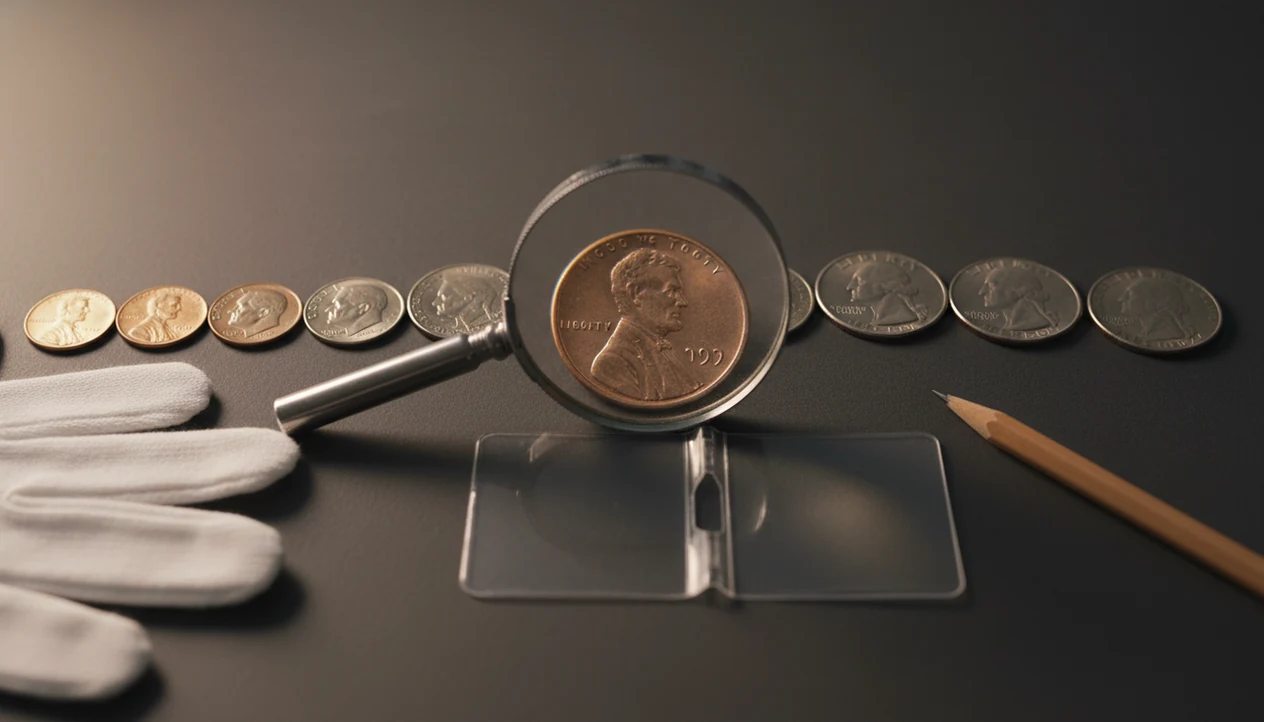


A key date coin guide helps you spot the scarce date-and-mintmark combinations that collectors need to complete a coin series. The main lesson is simple: the date, mintmark, survival rate, and condition matter more than age alone.
Definition: A key date coin is a specific date-mintmark combination in a coin series that is unusually difficult to find because of low mintage, low survival, strong collector demand, or condition rarity.
- Key date coins are the hardest regular issues to find in a series, while semi key date coins are the next tier of difficult dates.
- A rare date coin lookup must check the date and mintmark together because the same year can be common from one mint and scarce from another.
- Condition can turn a coin from ordinary to important because some dates are common worn but rare in collectible grades.
Key Date Coin Guide Definition for Beginners
A key date coin is series-specific: it belongs to a named coin series, such as Lincoln cents, Mercury dimes, Buffalo nickels, or Morgan dollars. Age alone does not make a coin a key date. A worn 1940s cent may be old to a new collector, but it is not automatically scarce.
Key dates usually come from low original mintage, low survival, strong collector demand, or a mix of all three. The 1909-S VDB Lincoln cent is a classic example, with a reported mintage of 484,000 coins (NGC Coin Explorer). The 1916-D Mercury dime is another, with an original mintage of 264,000 pieces (NGC Coin Explorer).
Start with the obverse. A beginner turning over a wheat cent under a kitchen light should check the date first, then look under the date for the tiny mintmark.
How Key Date Coin Rarity Works
Key date coin rarity works by matching supply against collector demand inside one specific series. The lookup is useful because it checks the exact date and mintmark first, then asks how many coins were made, how many likely survived, and what condition they are in now.
Mintage is the starting supply, but survival rate is the real-world remainder after loss, melting, damage, and heavy circulation. Demand then adds pressure: a popular series with many collectors can make a scarce date harder to buy than the raw numbers suggest. The same year can be common or scarce because different mints often struck very different quantities, so a no-mintmark coin, a D coin, and an S coin may not belong in the same rarity bucket. Condition rarity is another layer. A date may be easy to find worn smooth but difficult with sharp details, original surfaces, and strong luster. That is different from basic low mintage, because the coin is not rare in every grade. For higher-value matches, watch for counterfeit coins and altered mintmarks, especially added, removed, or reshaped letters that turn an ordinary coin into a supposed key date.
6 Key Date Coin Rarity Factors at a Glance
Date and mintmark must be read together because one year can include both common and scarce issues. Modern U.S. Mint circulation production often reaches hundreds of millions or billions, so true key dates are exceptions, not normal finds.
For U.S. coins, confirm official production figures against U.S. Mint annual reports (https://www.usmint.gov/learn/history/historical-documents/annual-reports) or major reference databases such as PCGS CoinFacts and NGC Coin Explorer before treating a date-mint pair as rare.
| Rarity factor | What to check | Why it matters |
|---|---|---|
| Date | The year on the coin | Places the coin inside a series timeline |
| Mintmark | Letter, or no letter, from the striking mint | Separates common and scarce issues from the same year |
| Mintage | Number originally struck | Low production can create fundamental rarity |
| Survival rate | How many likely remain collectible | Melting, loss, and wear reduce real supply |
| Condition | Wear, marks, cleaning, corrosion | High-grade survivors may be much scarcer |
| Demand | Collector interest in that series | Popular sets create stronger competition |
For beginners, date-plus-mintmark checking is often better than judging by age because it matches how coin series are actually collected.
Five Facts About Key Date Coins and Semi Key Date Coins
- Key dates are usually the hardest regular coins to obtain in a series, and they often anchor a complete set.
- Semi key date coins are the next rarity tier below key dates, but they can still carry meaningful premiums over common dates.
- Mintage is important, but it is not the whole story because surviving examples may be damaged, cleaned, or heavily worn.
- Survival rate and condition rarity can make one date-mint combination harder to find in collectible grade than its mintage suggests.
- AI photo lookup can help flag possible key date coins, but the result should be verified against a trusted reference before money changes hands.
A good ai coin identification, rarity lookup, and collection value estimation app for collectors and beginners delivers faster sorting and clearer next checks, not instant certified grades or guaranteed sale prices.
3 Key Date Coin Rarity Drivers
Key date scarcity works through three main drivers: fundamental rarity, survival rarity, and condition rarity. Fundamental rarity starts with low original mintage. If the mint struck far fewer coins for one date and mintmark, collectors have fewer examples to chase.
Survival rarity comes later. Coins get melted, lost, damaged, holed for jewelry, or worn down in circulation. A biscuit tin of inherited foreign coins may sound full, but the useful survivors are the ones with readable dates and identifiable designs.
Condition rarity is different again. Some dates are available in Good or Very Good but become difficult in Mint State. That is why a low-mintage coin is not automatically more valuable than every higher-mintage coin. Demand, grade, and actual survivor quality still decide the market.
Before You Start a Rare Date Coin Lookup
Before you start a rare date coin lookup, set up the coin so you can read it clearly without harming it. A few minutes of careful handling can prevent scratches, bad photos, and mistaken date or mintmark calls.
- Choose bright indirect light near a window or lamp, then angle the coin until the date is readable without a hard white glare across the surface.
- Prepare a magnifier, soft surface, and clean hands before handling anything. A folded towel or clean pad is safer than a bare table if a coin slips.
- Photograph both sides first while the coin is still in its holder, flip, or album opening. Those first images preserve the original storage context and reduce unnecessary handling.
- Avoid cleaning, rubbing, or testing the coin even if it looks dark, dirty, or spotted. Cleaning can erase surface originality and make a scarce date less desirable.
- Separate uncertain finds in a labeled holder or small envelope until the date, mintmark, and series are verified. Do not mix them back into a jar or roll too soon.
How to Use a Key Date Coin Guide for Rare Date Coin Lookup
Use a key date coin guide as a sorting tool, not as a final appraisal. The aim is to decide whether a coin deserves closer research, safer storage, or professional review.
- Read the date under good light, and do not guess if the last digit is weak.
- Locate the mintmark using the correct position for that coin series.
- Identify the series before comparing rarity lists, since each series has its own key dates.
- Compare key and semi-key lists to see whether the date-mint pair is scarce.
- Check condition for wear, scratches, cleaning, corrosion, and readable design details.
- Use photo recognition only as a first pass, then verify important matches against a trusted printed or grading-service reference.
If you are using your phone for sorting, the related guide on how to check coin value with phone explains photo setup and value context.
Date and Mint Mark Checks for Key Date Coins
Does mintmark change whether a coin is a key date? Yes. A mintmark is the small mark showing which mint struck the coin, and it can turn the same year from common to scarce.
Many Philadelphia coins have no mintmark, depending on the series and period. That absence matters. A 1909 Lincoln cent from Philadelphia is different from a 1909-S Lincoln cent from San Francisco, and the 1909-S VDB is different again because of the designer initials on the reverse.
Tiny details decide the answer. A Philadelphia coin with no mint mark should not be “upgraded” in your notes because the blank space looks unusual. Worn, filled, added, or altered mintmarks also cause mistakes, especially when two fingers are pinching a dark, worn cent for a quick photo.
Semi Key Date Coins Versus Common Date Coins
Semi-key dates are the second tier of scarcity within a coin series. They are usually easier to find than the main key dates, but they may still cost far more than common dates in the same grade.
| Label | Meaning | Beginner expectation |
|---|---|---|
| Key date | Hardest major date-mint issue in the series | Often expensive and commonly authenticated |
| Semi-key date | Next tier below the main keys | More realistic collecting target |
| Better date | Scarcer than average, but not a major key | Worth checking carefully |
| Common date | Readily available in most grades | Usually modest value unless high grade or unusual |
Semi-key coins are often more realistic for new collectors because they teach the same date and mintmark discipline without the same price pressure. For estimated value ranges, a coin value app can help organize first-pass notes before deeper research.
Condition Rarity in a Key Date Coin Guide
Condition rarity means a coin is not extremely rare in all grades, but it becomes scarce in high collectible condition. In plain terms, plenty may exist worn flat, while sharp examples with original surfaces are hard to locate.
Grade and surface quality can matter as much as the date-mint combination. Cleaned, scratched, bent, stained, or corroded coins often lose value, even when the date is desirable. Wipe dust from a cardboard 2x2 flip if needed, but do not clean the coin itself.
Tools such as CoinEd can connect photo-first identification with grade hints and value context. Still, a phone photo on a dark wooden table can make copper cents look redder than they are. For the formal boundary, read the coin value vs appraisal explanation.
CoinEd Workflow for Key Date Coin Checks
CoinEd can be useful as a first-pass sorter: upload clear photos, confirm the series, and compare the date-mintmark result with key-date references before making any value decision.
The workflow is simple: photograph both sides, confirm the series, check the date and mintmark, then compare the result with key and semi-key references. For many beginners, photo-first lookup is faster than manually searching long tables because the app narrows the likely coin type first.
However, high-value matches should be verified by professional authentication. The app can help you decide what is worth a closer look, but it should not replace a grading service. If you need a broader picture-based tool, an app that tells coin value guide can help compare expectations.
Common Key Date Coin Lookup Mistakes
Beginners usually make the same lookup errors, especially when sorting a jar or bank roll quickly. Slow down before labeling a coin rare.
- Old equals key date: An old coin may be interesting, but key date status depends on the exact series, date, and mintmark.
- Date without mintmark: Checking only the year misses the difference between common and scarce mint issues.
- Mintage alone: Low mintage helps, but survival rate, condition, and collector demand complete the picture.
- Estimate equals sale price: App values and guide prices are context, not guaranteed offers from buyers.
- Errors versus key dates: Error coins, varieties, key dates, and semi-key dates are related collecting categories, but they are not the same.
The pocket check is real. A silver edge flashing in a roll is worth pausing for, but it still needs identification.
Limitations
A key date coin guide is useful for screening coins, but it cannot settle every question. Treat it as the first layer of research.
- A guide cannot replace professional authentication for expensive or frequently counterfeited coins.
- AI tools can misread worn dates, small mintmarks, glare, toning, or damaged surfaces.
- Counterfeit and altered key dates are common enough that valuable matches deserve caution.
- Estimated values change with grade, demand, recent sales, and auction results.
- Not every coin series has a universally agreed key date or semi-key date list.
- Rare date coin lookup alone can mislead if the coin is cleaned, scratched, corroded, or bent.
- A photo cannot always show luster, hairlines, rim damage, or subtle surface alteration.
For U.S. coin sorting by denomination, a US coin identifier can help with the basic series call before rarity research.
FAQ
What is a key date coin?
A key date coin is a scarce date-mintmark combination within a specific coin series. It is usually difficult to find because of low mintage, low survival, strong demand, or condition rarity.
What are semi key dates?
Semi key date coins are important scarce issues just below the main key dates in a series. They are often more available than key dates but still harder to find than common dates.
Does mintmark affect coin rarity?
Yes, the mintmark can make the same year common from one mint and scarce from another. Always check the date and mintmark together.
Are old coins always key dates?
No, old coins are not automatically key dates. A coin must match a scarce date-mintmark combination within its series.
How do I find mintmarks?
Check a reference for the coin series because mintmark placement varies by design and year. Many U.S. coins place the mintmark near the date or on the reverse.
Can condition change key date value?
Yes, grade, cleaning, damage, corrosion, and surface quality can strongly affect value. Some key dates are available worn but much scarcer in higher grades.
Can apps identify key date coins?
Photo-based apps such as CoinEd can help flag possible key date coins. Important or valuable matches should still be verified with trusted references or professional authentication.
Should key dates be authenticated?
Key dates should be authenticated when the coin appears valuable, altered, or commonly counterfeited. Professional grading is especially useful before selling or insuring an expensive coin.