
Chinese CoinEd For Characters, Holes, Dates, And Cash Coins
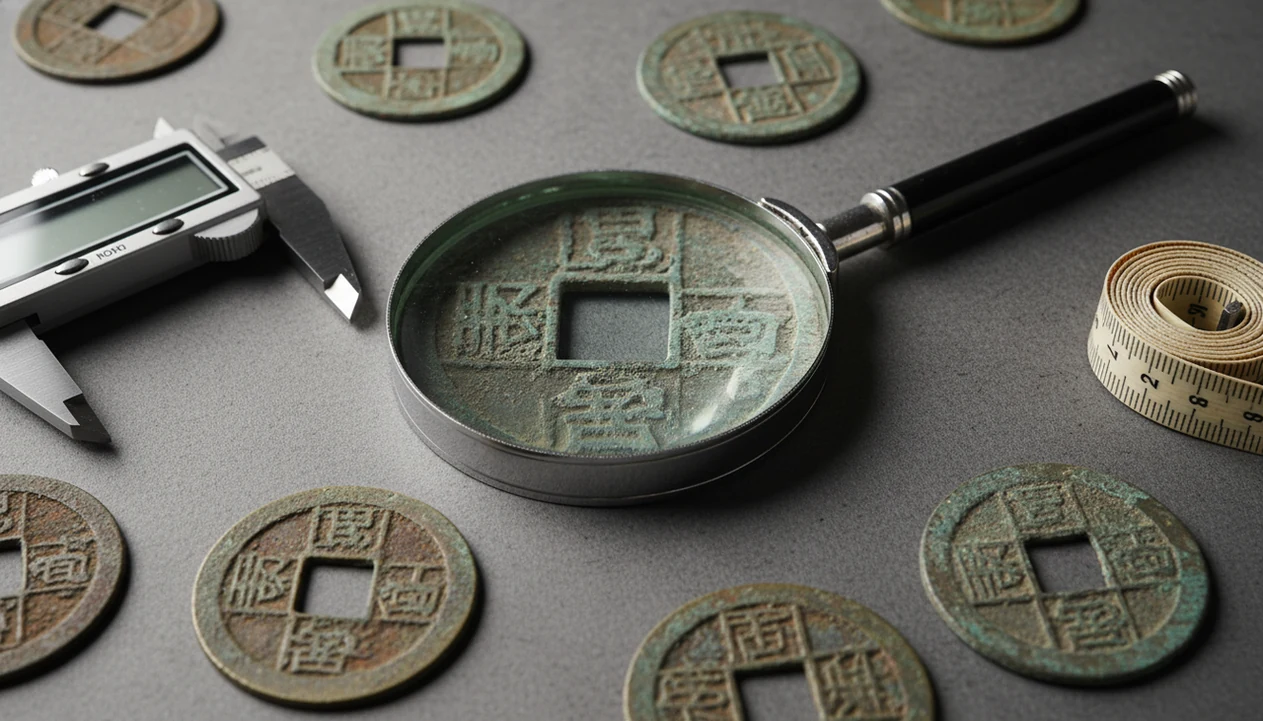


A Chinese coin identifier helps you triage a coin by matching its photo, square-hole shape, Chinese coin characters, metal, and visible date or reign title to known types. Treat the result as a first-pass identification, not proof of authenticity or guaranteed value.
> Definition: A Chinese coin identifier is a photo-first tool or research method that helps match Chinese coins, especially cash coins, to inscriptions, dynasties, mints, dates, and value context while flagging when expert authentication is needed.
- Most traditional Chinese cash coins are identified from the four obverse characters, usually a reign title plus a currency phrase such as tongbao.
- Photo matching and OCR can narrow the search quickly, but worn characters, seal script, corrosion, and replicas can mislead both apps and beginners.
- Common Qing and late-imperial cash coins are often low value, while rare reigns, mints, varieties, or authenticated pieces may require specialist review.
Chinese coin identifier meaning for cash coins and modern coins
A Chinese coin identifier is a triage method for matching a coin to likely country, dynasty, denomination, reign title, mint, and date range. It can use photo matching, character reading, metal color, hole shape, size, weight, edge style, and visible date clues.
Old Chinese cash coins were usually cast, often with a square center hole and four characters around it. Modern Chinese coins are usually struck, with clearer dates, Arabic numerals, denomination text, and machine-made rims. That difference matters before any value estimate.
Start with the obverse, then compare the reverse design or mint marks. A match is useful, but it is not authentication. We have seen beginners line up three similar Qing cash coins on a desk and get three different app guesses because one character was weak.
Five facts every cash coin identifier result needs
- Photo matches are suggestions, not proof. AI can find similar catalog examples, but it cannot guarantee a coin is genuine, unaltered, or correctly attributed.
- Most cash coins need character order. Traditional square-hole coins are usually read from four obverse characters in a set order, often a reign title plus tongbao-style wording.
- Common does not mean fake. Many Qing and late-imperial cash coins survive in large numbers and are common circulation finds for world-coin collectors.
- Replicas are a real part of the market. Fantasy pieces, souvenir copies, cast replicas, and altered coins are common enough that expensive matches need caution.
- OCR can stumble badly. Worn, stylized, seal-script, or corroded Chinese coin characters may be misread by translation tools and beginners alike.
A sticky note marking a possible key date is fine. A purchase decision needs stronger evidence.
How a Chinese coin identifier works from photos and characters
A Chinese coin identifier works by comparing visible coin features against known examples, then narrowing the likely type through inscription and reference checks. Photo systems look at image embeddings, which are mathematical summaries of shape, texture, layout, and visual similarity.
The camera step matters. Indirect light helps the app see edge shape, hole shape, inscription layout, corrosion, and surface texture. Dark wooden tables can make copper coins look redder than they are, so retake the photo on neutral paper if the match seems odd.
Character lookup adds a second filter. The system or reader checks reign title, tongbao-style wording, reading order, reverse mint marks, and catalog images. Pew Research Center reported in 2019 that 81% of U.S. adults owned a smartphone (https://www.pewresearch.org/internet/fact-sheet/mobile/), and Pew reported in 2023 that 58% of U.S. adults had heard at least a little about AI in daily life (https://www.pewresearch.org/short-reads/2023/08/28/growing-public-concern-about-the-role-of-artificial-intelligence-in-daily-life/). That helps explain why camera-based coin ID is now common. Still, obscure reigns and rare varieties may be under-represented in training data.
Chinese coin characters on square-hole cash coins
What do the Chinese coin characters on a square-hole cash coin mean? They usually name a reign period and a currency phrase, but they do not automatically prove age, mint, rarity, or authenticity.
The obverse is the main face with the primary inscription. The reverse is the other side, which may be blank or may show mint marks, numerals, or other control marks. Most cash coins have four characters around the square hole. Beginners often turn the coin like a clock, trying every direction until one inscription resembles a reference photo.
For example, 康熙通寶 (Kangxi tongbao) points to the Kangxi reign, while 乾隆通寶 (Qianlong tongbao) points to Qianlong. Those inscriptions identify the reign title; they do not automatically prove rarity, age, or value.
Reign title clues
A reign title points to an emperor’s period, not always to an exact year. The same inscription can appear across many cast varieties.
Reading order problems
Reading order can be top-bottom-right-left or another catalog convention. Translation alone is thin evidence, especially when tiny calligraphy differences affect attribution. For broader script problems, our guide to identify coin with no English is useful.
Photo triage checklist to identify Chinese coins
To identify Chinese coins safely, use photos first, then measurements, then reference comparison. The most reliable beginner workflow is slow and repeatable, not a single app result.
- Photograph both sides in indirect light with the coin flat, fully visible, and uncropped.
- Record diameter, weight, magnet response, metal color, hole shape, and edge condition before you search values.
- Run a photo-first identifier and compare several visual matches instead of trusting the first result.
- Check the inscription against reference images and mark any character you cannot read with a question mark in your collection notes.
- Escalate rare, expensive, or suspicious matches to an experienced dealer, numismatist, PCGS, NGC, or another reputable authentication route.
For beginners, a photo-first check is often easier than catalog browsing because square-hole coins can look alike until the characters are separated. If your coin came from a mixed world lot, a world coin identifier can help sort the non-Chinese pieces first.
Chinese cash coin identifier clues for rarity and value
Chinese cash coin value depends on exact attribution, condition, and proof of authenticity. Old-looking metal alone does not make a coin rare or valuable.
| Clue | Why it matters | Beginner caution |
|---|---|---|
| Dynasty and reign title | Narrows the historical period | A reign title may cover many cast types |
| Mint and variety | Small marks can change attribution | Worn reverse marks are easy to misread |
| Metal and size | Helps separate types and copies | Weight varies on cast coins |
| Calligraphy | Tiny style differences may identify varieties | AI may miss subtle script changes |
| Condition | Clear characters usually matter | Corrosion can hide detail |
| Provenance and authentication | Supports confidence for costly pieces | A story is not proof |
Many low-value Qing cash coins survive in large numbers, while rare varieties require deeper attribution. App values are ballparks based on comparable listings or market data, not sale guarantees. For collection tracking, a coin collection tracker app can keep photos, notes, and estimated value ranges together.
Common myths about Chinese coin characters and replicas
A high app estimate does not mean a Chinese coin is real or worth that amount. It means the photo resembles an example that may have a recorded price, sometimes under different condition, variety, or authenticity assumptions.
Another myth is that all square-holed Chinese coins are rare antiques. Many are common. Some are replicas. Some are modern fantasy pieces that were never official money. A translated inscription only tells you what the characters may say; it does not prove the coin’s age or origin.
Counterfeit risk is not theoretical. Chinese government enforcement reports have described large seizures of counterfeit cultural relics, and ICOM’s Red Lists warn that Chinese archaeological objects, including coins, can appear in illicit trade (https://icom.museum/en/resources/red-lists/red-list-of-chinese-cultural-objects-at-risk/). AI can assist with rarity lookup and collection value estimation, not replace authentication, provenance research, or a specialist’s judgment.
Where CoinEd fits in Chinese coin research
Tools like CoinEd fit best at the first-pass research stage. CoinEd is the photo-first coin identifier and value estimation app that identifies coins from photos, shows rarity and grade hints, and helps beginners and collectors estimate coin value.
For a second opinion, compare any app match with independent references such as Numista, Zeno.ru, NGC World Coin Price Guide, PCGS resources, or a specialist Chinese-cash catalog before treating the attribution as settled.
For Chinese coins, that means you can organize obverse and reverse photos, compare possible matches, review rarity and grade hints, and keep notes on uncertain characters. If you later ask a dealer for help, those labeled photos are easier to discuss than loose screenshots.
CoinIdentifier supports the research workflow, but it does not replace specialist authentication for high-value Chinese cash coins, suspected replicas, or rare varieties. No consumer app should be treated as a grading certificate. If your broader tray includes Japanese, Korean, Vietnamese, or European pieces, an app that identifies foreign coins may help with first sorting.
Limitations
Photo identification has real limits, especially with cast cash coins. A correct-looking match can still be the wrong variety, a replica, or an altered piece.
- AI datasets may under-represent obscure reigns, local mints, rare varieties, and unusual cast types.
- Worn surfaces, corrosion, off-center casting, glare, poor lighting, and cropped photos can distort Chinese coin characters.
- Consumer apps cannot reliably authenticate high-grade forgeries, fantasy issues, altered coins, or deceptive replicas.
- Value estimates may not reflect exact variety, condition, provenance, buyer demand, or current auction results.
- A correctly read inscription may not provide a precise date because cash coins were cast, copied, or restruck across long periods.
- Legal and cultural-property concerns may apply to archaeological objects, so suspicious provenance should be handled carefully.
- Cleaning can remove patina, scratch surfaces, and make authentication harder.
Wipe dust from a cardboard 2x2 flip if you need to read the label. Don’t clean the coin itself.
How to Identify a Chinese Coin From a Picture
Photograph both sides straight on, capture the square or round hole if present, and keep character strokes sharp enough to compare. Orient four-character cash inscriptions correctly before searching, and compare lookalike Japanese, Korean, Vietnamese, charm, and replica pieces.
Ming and Qing reign titles, bagua tokens, and modern PRC coins require different checklists. For broader Asian context beyond China, use Asian coin identification and the world coin script guide.
FAQ
How do I identify Chinese coins?
Photograph both sides, record size and weight, read the visible characters, then compare the result with trusted reference images. Treat the match as identification triage, not authentication.
What do Chinese coin characters mean?
Chinese coin characters often show a reign title and a currency phrase such as tongbao. Translation is only part of identification because mint, variety, condition, and authenticity still matter.
Are square-hole Chinese coins valuable?
Many square-hole Chinese coins are common and low value. Rare reigns, mints, varieties, or authenticated pieces can be worth expert review.
Can AI identify Chinese cash coins?
AI can narrow matches from photos and visible characters. It can misread worn inscriptions, seal script, rare varieties, and replicas.
How are Chinese cash coins dated?
Chinese cash coins are usually dated by reign title, dynasty, mint clues, and catalog attribution. Precise dating can be difficult because types were cast or copied across long periods.
Are Chinese replica coins common?
Yes, replicas, fantasy pieces, and deceptive copies are common enough to require caution. Expensive or suspicious coins should be reviewed by a specialist.
Should I clean Chinese coins?
No, cleaning Chinese coins can damage patina, scratch surfaces, and reduce collectibility or value. Store the coin safely and photograph it as found.
Who authenticates Chinese coins?
Experienced numismatists, reputable world-coin dealers, and professional grading services authenticate Chinese coins. Use expert review for rare, costly, or suspicious examples.