
World Coin Script Guide For Matching Letters, Numerals, And Symbols
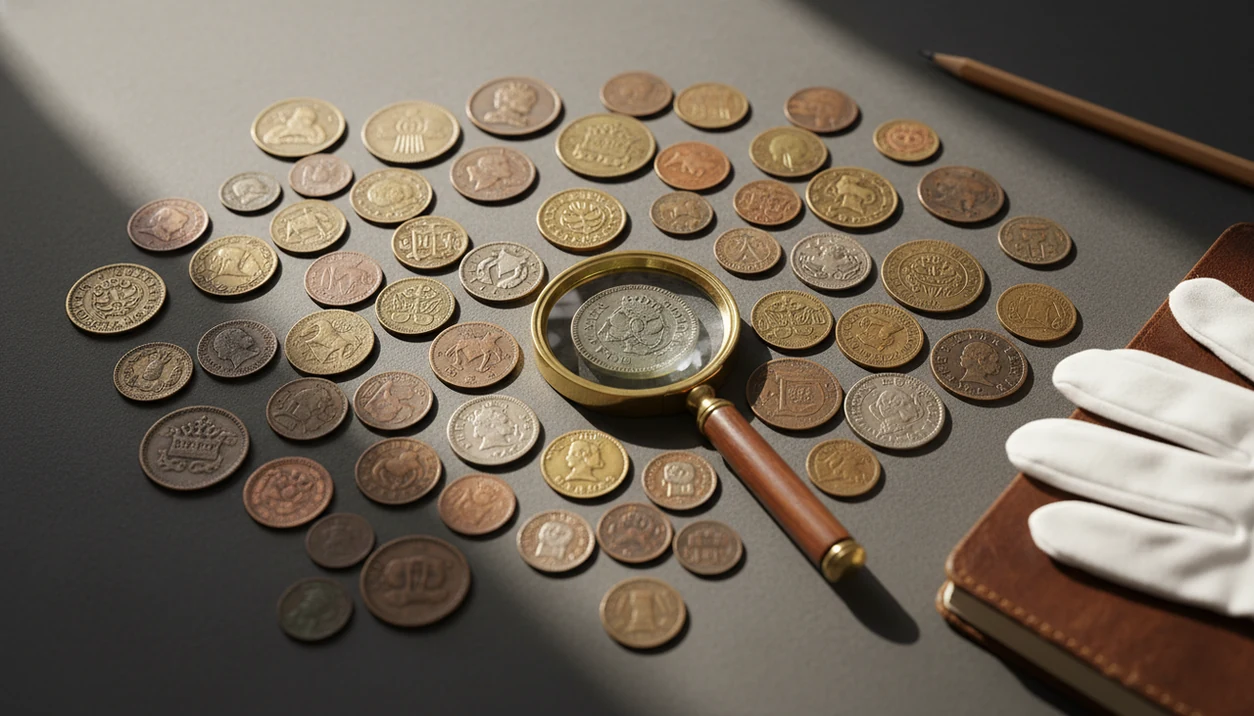


A world coin script guide helps you identify a foreign coin by matching its letters, numerals, calendar clues, and symbols to a likely country, date, and denomination. Use it before checking value references, because a single wrong numeral or script family can point you to the wrong coin.
Definition: A world coin script guide is a practical reference for recognizing foreign coin letters, numeral systems, calendar dates, country names, and symbols so a collector can identify a coin more accurately.
TL;DR
- Start with the script family first: Latin, Arabic, Cyrillic, Chinese-derived characters, Devanagari, Thai, or another writing system.
- Translate the numerals and calendar date before researching rarity or value, because many coins do not use Western 0–9 digits or Gregorian years.
- Use photo identification and human script clues together; a clear coin scan can suggest likely matches while your script notes refine the country, date, and denomination.
How World Coin Script Identification Works
A world coin script guide works by grouping visible letter shapes into writing families before trying to translate the whole inscription. That matters because many coin IDs begin with shape recognition, not language fluency.
Collectors usually combine script, numerals, symbols, denomination words, portraits, maps, mintmarks, and metal. A copper coin with Arabic script, Eastern Arabic numerals, and a crescent points a different direction than a silver-colored coin with Cyrillic letters and a double-headed eagle. According to the U.S. Census, about 6,000 to 7,000 languages are spoken globally (https://www.census.gov/library/stories/2022/12/languages-we-speak-in-united-states.html), and roughly 4,000 have writing systems. Unicode encodes more than 159 modern and historic scripts (https://www.unicode.org/standard/supported.html), so coins can carry far more variety than a simple alphabet chart suggests.
Photo-first AI matching improves when you add readable text, a possible country, or a date clue. The dark wooden table photo problem is real; copper cents can look redder than they are.
Foreign Coin Letters And Numerals To Check Before Value Lookup
Check the coin’s script, numerals, and date before using a catalog, app, or price reference. Value lookup comes later, after the coin is actually identified.
- Photograph both sides under steady light, and do not clean the coin; wipe dust from a cardboard 2x2 flip if needed, not the surface.
- Record every visible letter, symbol, numeral, mintmark, and edge inscription, even if the mark looks decorative.
- Separate country clues from denomination words, mottoes, ruler names, bank names, and commemorative text.
- Convert the date before checking rarity, especially when the coin may use Hijri, Buddhist Era, Japanese era, or regnal dating.
- Review condition after identification, because wear, corrosion, and scratches can change the estimated value range.
For beginners, script and date conversion are often better first steps than price searching because they prevent wrong-country matches. If the coin has no readable English, our guide to identify coin with no English covers the next narrowing steps.
Before You Start Identifying A Foreign Coin
Before you identify a foreign coin, protect the surface and set up a repeatable way to capture clues. The goal is to preserve evidence first, then sort facts from guesses.
- Handle the coin with clean, dry hands or cotton gloves, holding it by the edge when possible. Oils from fingers can leave marks, especially on copper, prooflike surfaces, or coins with old toning.
- Set the coin on a plain neutral background with indirect light. Avoid harsh flash, patterned fabric, and shiny tabletops that can hide fine letters or make color look wrong.
- Stabilize your phone or camera so both sides are photographed straight on, with the full rim visible. If the coin has edge lettering, take a separate edge photo or write the words down.
- Keep the obverse, reverse, edge notes, and diameter or size estimate together. A small notebook entry or one photo folder prevents later mix-ups.
- Avoid cleaning the coin before identification or value research. Also keep your ID notes separate from early hunches about rarity or price, so a hopeful guess does not steer the comparison.
Step 1: Match The Coin Script Family
Match the broad script family before guessing the country. Many foreign coin letters look unfamiliar at first, but their shape patterns are consistent enough for a first pass.
Latin, Cyrillic, And Greek Letter Shapes
| Script family | Visual clues on coins | Common ID note |
|---|---|---|
| Latin | A, B, C, R, S shapes | Common across Europe, the Americas, Africa, and colonial issues |
| Cyrillic | Д, Ж, И, Я shapes | Often seen on Russian, Soviet, Balkan, and Central Asian coins |
| Greek | Λ, Ω, Σ, Ε shapes | Appears on Greek coins and some classical-style inscriptions |
| Hebrew | Blocky right-to-left letters | Common on Israeli coins and related issues |
Arabic, Chinese, And Indic Script Shapes
| Script family | Visual clues on coins | Common ID note |
|---|---|---|
| Arabic | Connected flowing letters | Used by over 20 countries as an official writing system, per the CIA |
| Chinese characters | Square, compact logographs | Common on China and historically influenced East Asian issues |
| Japanese | Kanji plus kana or era names | May include Chinese-derived characters and local date systems |
| Devanagari | Horizontal headline across letters | Seen on Indian and Nepalese coins |
| Thai | Rounded loops and stacked marks | Common on Thai modern coinage |
Step 2: Translate Coin Numerals And Calendar Dates
Translate the visible numerals before treating them as a catalog year. A coin numerals guide keeps you from reading a non-Western date as random ornament.
Common Coin Numeral Systems
| System | Digits for 1, 2, 3 | Where collectors often see it |
|---|---|---|
| Western Arabic | 1 2 3 | Many modern world coins |
| Eastern Arabic | ١ ٢ ٣ | Middle East and parts of Asia |
| Persian | ۱ ۲ ۳ | Iran and related issues |
| Devanagari | १ २ ३ | India and Nepal |
| Thai | ๑ ๒ ๓ | Thailand |
| Chinese | 一 二 三 | China, Japan, and related historical issues |
Calendar Dates On World Coins
The visible year may use Hijri, Buddhist Era, Japanese era names, regnal years, or a local calendar. For many modern Thai coins, Buddhist Era minus 543 gives the Gregorian year. So BE 2566 often corresponds to 2023.
Confirm the rule by country and series. Calendar shortcuts are useful, but they are not universal.
Step 3: Use Country Names, Symbols, And Denomination Words
When script recognition is not enough, use symbols, denomination words, and both sides of the coin to narrow the match. The largest inscription may be a motto, ruler name, bank title, or denomination rather than a country name.
- Republic and kingdom words: Terms meaning republic, kingdom, empire, or state can point to a government type, but not always a single country.
- Bank and denomination words: “Bank,” “piastre,” “dirham,” “rupee,” “yen,” and similar words often identify the monetary system.
- Coats of arms and animals: Eagles, lions, dragons, and shields are useful clues, but several countries reuse similar designs.
- Maps, stars, crescents, and wreaths: These symbols help, especially when paired with script and date.
- Edge text: The edge may carry a motto, mint clue, or security inscription.
Lookalikes happen. A monarch portrait can appear across colonies, territories, and shared reigns, so compare obverse, reverse design, and edge together.
How To Use A World Coin Script Guide With Coin Photos
Use a script guide and coin photos as two checks on the same identification, not as competing answers. A photo-identification app can suggest likely matches from the coin image, while your notes about script, numerals, and date clues help confirm or reject the result.
- Photograph the obverse and reverse straight on, with the rim visible and glare reduced.
- Match the script family first, using the clearest letters rather than the most decorative text.
- Translate the numerals and calendar date before entering the year into a reference.
- Enter visible clues, including possible country, denomination, mintmark, ruler, and edge text.
- Review rarity, grade hints, and value context only after the app result and your script reading agree.
A good ai coin identification, rarity lookup, and collection value estimation app for collectors and beginners should deliver likely ID clues and value context, not a guaranteed rare coin or formal appraisal. For a photo-first workflow, an app that identifies foreign coins can help organize those clues.
Common Coin Script Identification Mistakes
The most common mistake is treating unfamiliar text as unreadable instead of sortable. You do not need to know the language to identify many coins; you need enough script, numeral, and symbol clues to compare against a trusted reference.
Do not assume all numbers are Western 0–9 digits. Do not assume decorative text is the country name. On some coins, the largest inscription is a motto, ruler’s name, bank name, or denomination.
AI readings also need a second look. Wear, glare, stylized calligraphy, and partial inscriptions can shift a result toward the wrong country or date. A quarter flipped for the eagle side is easy; a worn copper coin with half a date is not.
Script identification is not value identification. Rarity, date, mint, grade, authenticity, and demand still matter. For inventory and later comparison, a coin collection tracker app is more useful after the ID is stable.
Limitations
A script guide narrows identification, but it cannot solve every world coin. Some pieces need specialist catalogs, auction records, or professional review.
- Heavily worn, corroded, cleaned, or damaged coins may hide the letters and numerals needed for identification.
- Some countries changed scripts, spellings, calendars, rulers, or country names over time.
- Stylized calligraphy, ligatures, and decorative fonts can mislead both people and AI systems.
- Obscure regional issues, tokens, local coinage, and fantasy pieces may not appear in general guides.
- A script guide does not determine market value by itself; rarity, condition, mint, authenticity, and demand must be checked.
- Ancient coins may use abbreviated legends, worn portraits, and local types that need a more specialized ancient coin identifier.
No shortcut replaces careful comparison. The clink of mixed nickels, dimes, and foreign coins from an inherited coffee can is fun, but every coin still needs its own ID path.
Arabic, Persian, and Indian Scripts on Coins
Arabic-derived scripts appear on Middle Eastern, North African, Ottoman, Persian, and some South Asian coins. Indian coins may combine Devanagari, Urdu, Persian, Bengali, and English on the same piece.
Use dedicated workflows for depth: Arabic script coin identification, Indian coin identification, and Asian coin identification.
FAQ
What script is on my coin?
Compare the letter shapes to major families such as Latin, Cyrillic, Greek, Arabic, Chinese characters, Devanagari, Thai, Hebrew, or Japanese. Start with the clearest inscription, not the largest one.
How do I read Arabic coin dates?
First match the digits to Eastern Arabic or Persian numerals, then check whether the coin uses a Hijri date. Some modern coins also include a Gregorian date, so compare both sides.
Are Chinese coin characters country names?
Chinese characters may show a country name, reign period, denomination, mint, or historical inscription. Do not assume every large character group is the issuing country.
What are Eastern Arabic numerals?
Eastern Arabic numerals are digits such as ١, ٢, and ٣ used on many coins from the Middle East and parts of Asia. They must be translated before date or denomination lookup.
Do foreign coins use different calendars?
Yes, some foreign coins use Hijri, Buddhist Era, Japanese era, regnal, or local calendar systems. Convert the date before checking rarity or value.
Can AI read foreign coin letters?
AI can help read foreign coin letters, especially from clear photos. Apps such as CoinIdentifier may struggle with wear, glare, stylized calligraphy, or partial text.
Is the largest text on a coin the country name?
No, the largest text may be a motto, denomination, ruler name, bank name, or commemorative phrase. Check both sides and the edge before deciding.
Does a coin script identify its value?
No, script helps identify the coin, but value depends on rarity, date, mint, grade, authenticity, and demand. CoinEd can provide value context, not a formal appraisal.