
Ancient Coin Authentication Limits for Photo Apps
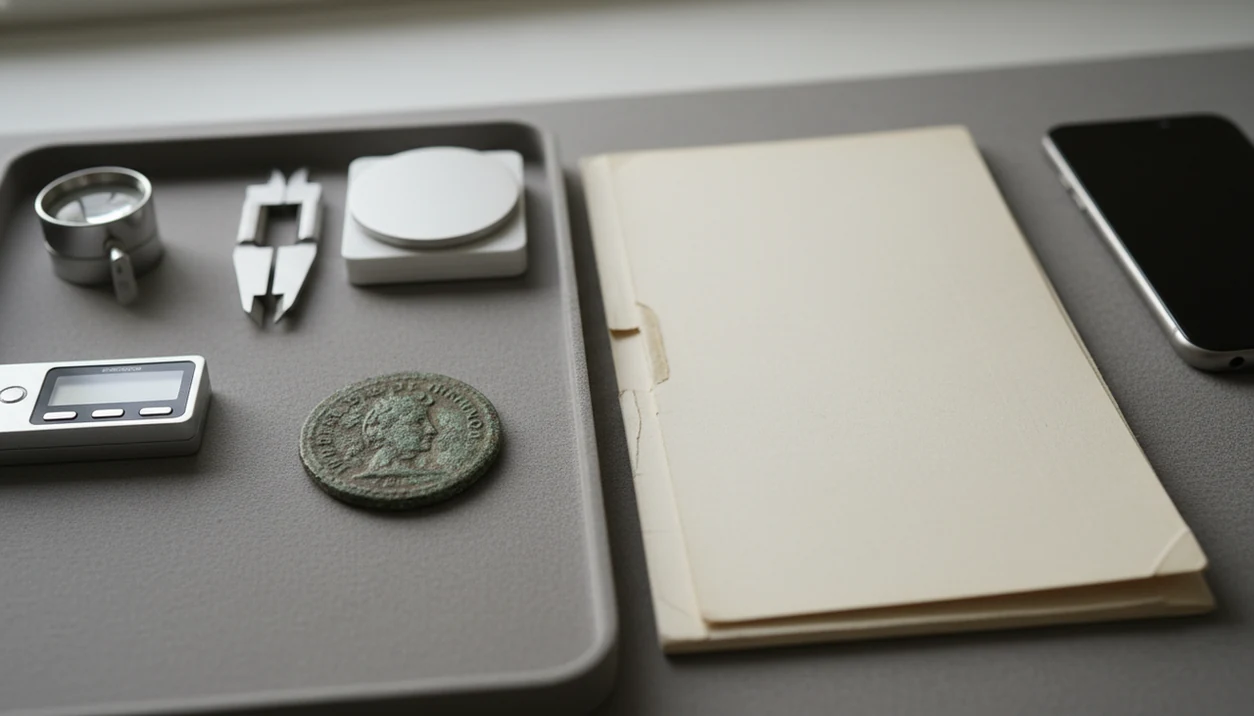


Ancient coin authentication limits mean a photo app can help identify a coin type, flag visible fake signs, and give value context, but it cannot prove authenticity, lawful provenance, metal content, or surface integrity from images alone.
Definition: Ancient coin authentication is a confidence-based expert opinion that weighs style, fabric, metal, weight, surfaces, die evidence, provenance, and market context rather than a single perfect proof.
TL;DR
- No photo, certificate, app result, or expert opinion can prove an ancient coin is genuine with absolute certainty.
- AI tools are useful for triage: type matching, rarity context, visible red flags, and collection organization.
- Ancient coins need provenance caution because authenticity, ownership history, export rules, and import rules are separate questions.
Ancient coin authentication limits at a glance
Image-based identification is not full authentication. It can suggest what an ancient coin resembles, but authenticity, provenance, legality, grade, and value are separate judgments.
A confident match to a Roman denarius, Greek bronze, or Byzantine follis does not prove the object is ancient. The coin still needs checks for metal, weight, edge, surfaces, tooling, deposits, and ownership history. A photo can miss all of those, especially when the image is taken on a dark wooden table that makes copper and bronze look warmer than they are.
Photo-based coin tools can identify coins from images, show rarity and grade hints, and help beginners and collectors estimate value. For ancient coins, any app result should be treated as photo-first triage, not a final authentication opinion.
Scope: what this guide can and cannot decide
This guide is educational only. It can help you understand the limits of photo-based ancient coin review, but it is not legal advice, customs advice, investment advice, or a formal authentication opinion.
Identification is the narrowest task: matching a coin to a likely ruler, type, denomination, mint, or era. Authenticity asks whether the object itself is ancient and unaltered enough to be described that way. Ownership and import-law questions are separate again, because a genuine coin can still have weak paperwork, disputed title, or export and import problems.
When the result matters, treat the next step as a decision path:
- Use the page or app result to organize likely identification, photos, measurements, and visible concerns.
- Consult a specialist dealer, auction house, museum numismatist, or grading service when authenticity, value, sale, insurance, or donation is at stake.
- Ask a lawyer or the relevant customs or cultural-property authority before relying on provenance, export, or import claims.
- Expect revisions, because app matches and expert opinions can change when better photos, in-hand review, new die evidence, or stronger paperwork appears.
Five facts about ancient coin authentication limits
- No method can trace most ancient coins directly from an ancient mint to a modern owner through an unbroken chain of custody.
- Professional services may reject obvious counterfeits, or return “no decision” when the evidence is too mixed.
- Ancient coin fake signs are red flags, not proof by themselves; casting bubbles or odd surfaces still need context.
- Provenance helps, but it can be missing, incomplete, copied from older errors, or forged.
- Cultural-property compliance is separate from visual authenticity; a genuine coin can still raise export, import, or ownership questions.
That last point catches beginners off guard. The coin may look right, match a catalog type, and still need paperwork review before sale or donation. Good photo-based triage tools deliver organized evidence and cautious context, not a guarantee that an ancient coin is genuine, legal, or safe to buy.
How ancient coin authentication works
Ancient coin authentication works by comparing a coin’s style, fabric, metal, weight, axis, edge, surfaces, die evidence, and market context against known genuine and false examples.
“Fabric” means the physical character of the coin: how the blank was made, struck, worn, corroded, and handled. Experts look at portrait style, lettering, reverse design, flan shape, edge breaks, surface deposits, and die links. They also check weight and diameter against the expected range. A beginner using a Roman coin identifier can start with portrait and legend matching, but that is only the first pass.
In-hand review matters because tilt, weight, edge texture, and surface chemistry are hard to judge from a flat image. Lab testing can support an opinion, especially for metal composition, but it is not a universal answer. Authentication is usually a probability judgment, not a binary scientific proof.
Ancient coin fake signs visible in photos
Photo review can flag visible ancient coin fake signs before expert review, but no single visible sign is conclusive alone.
- Casting clues: bubbles, pits, soft rims, or seam lines may suggest a cast fake rather than a struck coin.
- Style problems: mushy details, wrong portrait style, or lettering that does not match the type are worth a closer look.
- Surface concerns: artificial patina, harsh smoothing, tool marks, or modern scratches can hide repairs.
- Measurement mismatches: wrong weight, wrong diameter, or a strange edge should be recorded if you have a scale.
- Duplicate matches: a suspicious identical match to another coin online may indicate a copied fake.
Photograph the obverse, reverse, edge, scale, and weight label if available. A quarter flipped for the eagle side is easy; ancient coins need the same discipline, plus edge views. Skilled forgers can imitate wear, corrosion, and patina.
Ancient coin expert review versus photo app results
A photo app can organize the first look, while expert in-hand review tests the evidence that images cannot settle.
| Review path | What it can reasonably do | What it cannot guarantee |
|---|---|---|
| Photo app result | Suggest type, ruler, denomination, era, rarity range, and visible warnings | Authenticity, metal content, legal title, export history, or final market value |
| Collector checklist | Compare date range, portrait, reverse design, legends, and obvious fake signs | Hidden casting, altered surfaces, modern tooling, or forged paperwork |
| Professional review | Examine weight, metal, edge, fabric, surfaces, deposits, style, tooling, and provenance | Absolute certainty for every coin |
| Grading-service submission | Provide an expert opinion and may reject or decline uncertain coins | A universal guarantee across all ancient material |
A confident app match is still a match to an image pattern. Professional services, including NGC Ancients and specialist dealers, work from the object itself. NGC describes its ancient-coin service as an expert attribution and opinion process, not an absolute guarantee for every ancient coin source.
Coin provenance caution for ancient collectors
Does provenance prove an ancient coin is safe to buy? No. Provenance is documented ownership history, not merely a seller story, and it does not automatically prove authenticity or legal status.
Many ancient coins lack paperwork because they circulated in old collections before modern recordkeeping. Some documents are also weak: a vague “old European collection” note is not the same as a named auction, dated receipt, or export record. Worse, paperwork can be forged or repeated from earlier mistakes.
The caution is not theoretical. A study in Antiquity found that over 70% of Classical and pre-Classical antiquities sold online lacked stated provenance source. Interpol has also estimated that up to 80% of antiquities on the market may be of illicit origin source. Source-country laws, export rules, and import restrictions can matter even when the coin itself is genuine.
Common myths about ancient coin authentication limits
- Myth: a certificate or app result guarantees genuine. Safer belief: certificates and app results are evidence to weigh, not final proof.
- Myth: crude, corroded, or worn coins must be ancient. Safer belief: modern fakes can be made rough, dark, and damaged on purpose.
- Myth: good provenance automatically proves legality and authenticity. Safer belief: provenance helps, but documents and legal rules still need separate review.
- Myth: high-resolution photos are enough for every coin. Safer belief: photos support triage, but many ancient coins need in-hand inspection.
Small details matter here. A loupe pressed close to a quarter can reveal a mint mark, but ancient authenticity often turns on edge fabric, deposits, and weight in the hand.
What photo apps can and cannot guarantee for ancient coins
Photo apps can help identify coins from photos, show rarity and grade hints, and estimate value ranges when the image and reference match are strong. For ancient coins, that usually means a likely type, era, ruler, denomination, and market context, not proof of authenticity.
CoinEd can be used as a record and research aid. Save obverse and reverse photos, weights, seller names, receipts, and collection notes in one place before asking for expert review.
Still, no app can guarantee authenticity, ownership title, lawful export, lawful import, or investment outcome. Before purchase, sale, insurance, donation, or legal reliance, escalate to ancient coin expert review.
How to escalate ancient coin expert review
Use ancient coin expert review when the coin is valuable, legally sensitive, newly purchased, inherited without records, or intended for sale, insurance, or donation.
- Photograph both sides in clear light, including obverse, reverse, and any visible legend.
- Add edge and scale images so the reviewer can judge thickness, seam concerns, and relative size.
- Record measurements including weight, diameter, and die axis if you know how to measure it.
- Save seller information such as receipts, auction listings, import records, and prior collection notes.
- Ask for in-hand review from a specialist dealer, museum numismatist, auction house, or grading service.
- Avoid cleaning or testing the coin before review, including polishing, repair, acids, or chemical dips.
Wipe dust from a cardboard 2x2 flip if needed. Not the coin itself.
Limitations
Ancient coin authentication has real limits, even when the reviewer is careful and experienced.
- No ancient coin authentication method gives absolute proof for every coin.
- Photos cannot reliably verify metal composition, density, internal casting, edge structure, or surface chemistry.
- AI results depend on training data, image quality, lighting, and whether the coin type appears in strong references.
- Professional authenticators can disagree, revise an opinion, or issue no decision.
- Provenance may be absent, incomplete, copied from earlier errors, or forged.
- Legal status can depend on country, export date, import date, documentation, and current restrictions.
- Value estimates can change after in-hand review, cleaning detection, tooling detection, or provenance concerns.
For beginners, a photo-first check is often easier than catalog work because it narrows the likely type quickly. It should be followed by specialist review when money, legality, or public claims are involved.
FAQ
Can photos authenticate ancient coins?
Photos can support triage by showing type, style, visible damage, and some fake signs. They cannot provide final authentication because metal, edge, fabric, surfaces, and provenance need deeper review.
Are ancient coin apps reliable?
Ancient coin apps can be useful for identification, rarity context, and collection notes. They can still misclassify fakes, unusual types, poor photos, and coins outside their reference coverage.
What are ancient coin fake signs?
Common visible red flags include casting bubbles, seam lines, mushy details, wrong style, wrong weight, artificial patina, tool marks, and suspicious identical matches. None proves a coin is fake by itself.
Can NGC guarantee ancient coins?
NGC Ancients and similar services provide expert opinions based on professional review. They may reject obvious counterfeits or decline uncertain coins rather than guarantee every submission.
Does provenance prove authenticity?
Provenance helps establish ownership history, but it does not automatically prove genuineness or legality. Documents can be incomplete, mistaken, or forged.
Is a corroded coin real?
Corrosion can appear on genuine ancient coins and on modern fakes made to look old. Surface condition must be judged with style, metal, weight, and provenance.
When is expert review needed?
Expert review is needed before purchase, sale, insurance, donation, high-value claims, or legal reliance. It is also wise when an app result and the coin’s measurements do not agree.
Can ancient coins be illegal?
Yes, ancient coins can be affected by export, import, and cultural-property rules. A coin may be genuine but still have legal or ownership-history problems.