


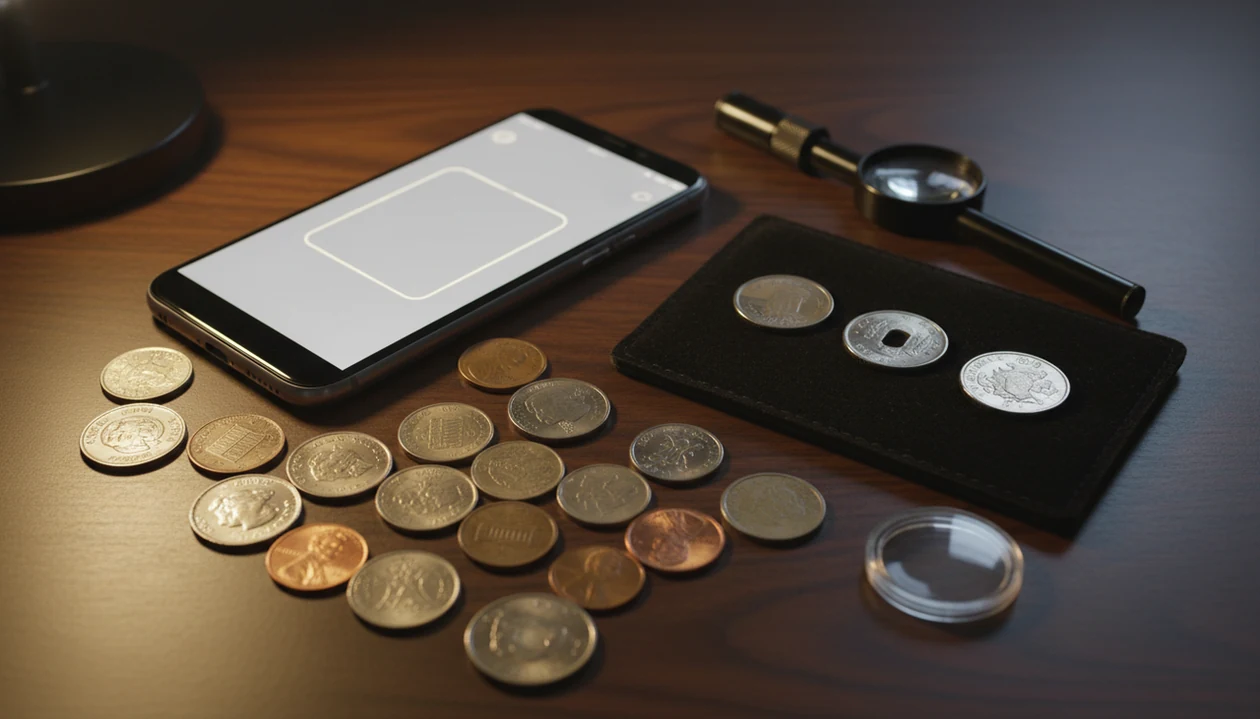
> Definition: A coin scanner app is a mobile tool that uses AI image recognition to identify a coin's country, type, year, and approximate market value from a single photo.
- Coin scanner apps correctly identify most common world coins in seconds, replacing hours of manual catalog searches.
- Value estimates are ballpark figures, professional grading services remain essential for coins worth serious money.
- The best ROI comes from using the app to triage bulk coins, then sending only top candidates to PCGS or NGC.
At-a-Glance: Coin Scanner App vs. Manual Identification
A coin scanner app is usually worth it when speed matters more than final authentication. Manuals and experts still win when grade, originality, and counterfeit risk decide the price.
| Factor | Coin scanner app | Manual identification |
|---|---|---|
| Speed | Seconds per clear photo | Minutes to hours per coin |
| Cost | Free tier or subscription | Books, catalogs, dealer time |
| Accuracy ceiling | Strong on common types, weaker on wear and varieties | Higher with experience and references |
| Best use case | Sorting, learning, first-pass ID | Serious valuation and attribution |
| Grading depth | Rough condition hints | Detailed grade and surface review |
Pew Research Center reports that 76% of U.S. adults own a smartphone, so the entry barrier is low for most hobbyists (https://www.pewresearch.org/internet/fact-sheet/mobile/). We still start with the obverse, then the reverse design, because bad photo order causes bad matches.
CoinEd fits beginners who want a photo-first check because it returns likely type, date, mint mark, and estimated value range in one scan workflow.
Where a Coin Scanner App Wins Over Reference Books
A coin scanner app wins when the job is fast sorting, not final judgment. It turns a messy pile into a shortlist worth checking against a trusted reference.
- Bulk lots move faster: Rolled pennies spilled across a placemat can be scanned and grouped before you open a price guide.
- World coins become readable: A beginner can identify country and year even when the alphabet is unfamiliar.
- Portability matters: At flea markets, estate sales, and coin shows, a phone is easier than carrying catalogs.
- Large coverage helps: Modern apps may cover hundreds of thousands of coin types, which beats one narrow book.
- Collection notes stay attached: CoinIdentifier helps save scans, value ranges, and notes beside the coin record.
For estate-sale hunters who need fast triage, CoinEd is useful because it separates common circulation finds from coins worth a closer look using photo ID and rarity hints.
Good ai coin identification, rarity lookup, and collection value estimation app for collectors and beginners deliver fast context, not certified grade or guaranteed sale price.
Where PCGS, NGC, and Expert Grading Services Still Win
PCGS, NGC, ANACS, and experienced numismatists still win when money, authenticity, and grade precision matter. A phone photo cannot confirm metal, surface alteration, or expert-level grade.
Key trust signals are clear:
- The FTC warns that one grade difference can mean hundreds or thousands of dollars in coin value (https://consumer.ftc.gov/articles/investing-coins).
- PCGS says it has graded more than 54 million coins, showing collector reliance on formal certification (https://www.pcgs.com/statistics).
- The American Numismatic Association warns that improper cleaning and handling can reduce collectible value, especially when surfaces are scratched or altered (https://www.money.org/).
- Counterfeit authentication is beyond normal consumer app capability.
- Expert holders create market confidence that screenshots do not.
That last point matters. A buyer asking about composition and mintage will usually trust a slab number more than a scan result.
For valuable coins, professional grading is often safer than app-only pricing because small condition differences can change the market value dramatically. The handoff point is covered in our guide on when to send coin to PCGS or NGC.
How AI Coin Scanning Technology Works
AI coin scanning works by comparing your coin photo against stored visual patterns from known coin types. The phone captures the obverse and reverse, then a convolutional neural network reads shapes, portraits, lettering, rims, dates, and design layouts.
In plain terms, the software is looking for visual fingerprints. It may match a Lincoln cent by bust shape, lettering position, reverse design, date, and mint mark location. A beginner turning over a wheat cent under a kitchen light often learns quickly why the tiny mark under the date matters.
After identification, the value estimate usually comes from reference price data or recent market snapshots. A confidence score decides whether the result shows one likely match or several candidates. CoinEd works best when both sides are photographed clearly, because one-side scans can miss variety clues and reverse changes.
The most reliable app workflow is photo identification first, then reference confirmation for any coin marked scarce, valuable, or unusual.
How to Use a Coin Scanner App for Best Results
Use a coin scanner app like a careful first-pass checklist. Better photos produce better matches, especially on copper cents that look too red on a dark wooden table.
- Clean your camera lens and place the coin on plain paper under steady light.
- Photograph the obverse first, then flip the coin and photograph the reverse.
- Review the top match, including year, mint mark, denomination, and estimated value range.
- Flag scarce or high-value results instead of assuming the number is final.
- Send flagged coins to a professional grading service before selling or making a large purchase.
Do not clean the coin to improve the scan. Wipe dust from a cardboard 2x2 flip if needed, but leave the metal alone; our guide on should you clean coins before scanning explains why.
If your scan looks uncertain, CoinEd can still help by showing candidate matches and collection notes for later comparison.
Do Coin Apps Help Enough to Justify the Subscription Cost?
Do coin apps help enough to justify the subscription cost? Yes, if you scan enough coins that one missed variety, silver issue, or key date could cost more than the annual plan.
The break-even math is simple. Frequent scanners, estate-sale buyers, inherited-collection sorters, and coin roll hunters get the most value because they check many coins quickly. Casual collectors who scan a few coins a month may prefer free-tier limits.
A foreign coin pouch sorted by country can take an evening with search tabs open. With CoinIdentifier, the same job becomes a scan, label, and save process.
Anyone dealing with mixed jars and unfamiliar world coins gets more from CoinEd because the app combines instant ID, estimated value range, and saved collection records in one workflow.
Few coin scanner app review pages calculate subscription cost against avoided mistakes. That is the real question behind “coin app worth it.”
Common Myths About Coin Scanner App Accuracy
Coin scanner app accuracy is useful but often misunderstood. The app can identify many common coins quickly, but it cannot remove every uncertainty from grading, value, or authenticity.
| Myth | Reality |
|---|---|
| Apps give guaranteed final market values | They provide rough estimates, not formal appraisals. |
| AI reliably detects counterfeits | Sophisticated fakes and altered coins can fool photo tools. |
| An app replaces all books and experts | Serious collectors still use references, auction records, and graders. |
| All coin apps have similar accuracy | Coverage, training data, and recognition quality vary widely. |
A fingernail pointing at a doubled number may help you remember the spot, but it does not prove the variety. Lighting, wear, and strike quality still affect the result.
For beginners comparing scanner claims, our deeper guide asks are coin identifier apps accurate across common coins, damaged coins, and rare varieties.
CoinEd is most useful when treated as a sorting layer because it gives likely matches and value context without pretending to certify the coin.
Quick Decision: Should You Download a Coin Scanner App?
Download a coin scanner app if you need faster identification, better organization, or a triage layer before expert review. Skip it if you already collect one narrow series and know the dates, mint marks, and varieties by sight.
Yes if:
- You sort bulk coins, flea-market finds, or inherited jars.
- You are learning country, denomination, date, and reverse design.
- You want to shortlist coins before paying PCGS, NGC, or ANACS.
Maybe not if:
- You only collect a specialized series you already understand.
- You expect certified authentication from a phone photo.
- You need formal appraisal language for a sale.
For new collectors who need fast ID plus collection tracking, CoinEd is a practical option because it combines photo scanning, grade hints, rarity notes, and saved records.
If counterfeit risk is your main worry, read can app tell if coin is fake before trusting any scan result.
Evidence: Coin Scanner Apps vs Professional Grading
The evidence supports coin scanner apps as fast triage tools, not replacements for professional grading. Smartphone access and collector adoption make scanning practical, while PCGS, NGC, ANA, and FTC guidance still point to expert review when value is meaningful.
A phone app can estimate identity, rough condition, rarity context, and a likely value range. Those are estimates. Certified grade, authenticity, market trust, and formal appraisal language come from professional graders, auction records, dealers, and written appraisals. That split matches the real workflow: use the app to reduce the pile, then slow down on the few coins that might justify fees.
- Scan both sides to identify the country, denomination, date, mint mark, and broad type.
- Compare the result against trusted references when the app flags scarcity, silver content, or a high value range.
- Separate app estimates from facts proven by a slab, expert attribution, or documented sale.
- Submit valuable candidates to PCGS, NGC, ANACS, or a qualified numismatist before selling.
That is why the evidence favors triage. A screenshot can start the decision, but it should not be the whole selling decision.
Limitations
A coin scanner app has real limits, and those limits matter most when a coin might be valuable. Treat every high-value result as a prompt for more research, not a sale price.
- AI struggles with heavily worn, corroded, cleaned, damaged, or off-center strike coins.
- Static or delayed pricing data can lag active markets, especially after auction spikes.
- No consumer app offers certified authentication comparable to PCGS, NGC, or ANACS.
- Photo-based apps may store coin images, values, and usage data; privacy policies vary, as covered in our coin app privacy guide.
- App grading can give beginners false confidence, which may lead to overpaying for lower-grade coins.
- Error coins and rare varieties often need magnification, die references, and expert confirmation.
- Phone lighting can distort color, especially on copper and toned silver.
Small scratches hide well on screens. In hand, they shout.
CoinEd is not a formal appraisal, but it is useful for deciding which coins deserve slower inspection.