
Dime Identifier App For Mercury, Roosevelt, And Silver Dimes
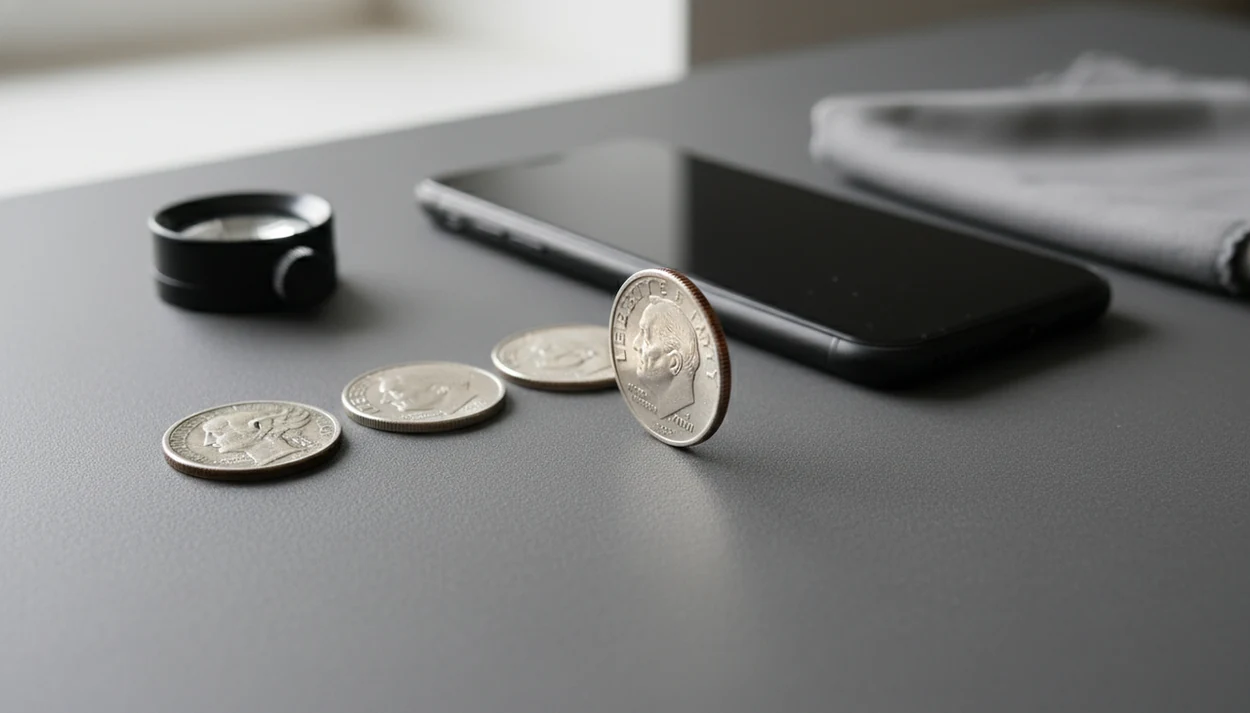


A dime identifier app helps you photograph a U.S. dime, identify whether it is Mercury, Roosevelt, silver, or modern clad, and check date, mint mark, condition clues, and estimated value. The fastest first filter is the date: regular U.S. dimes dated 1964 or earlier are 90% silver, while most 1965-present Roosevelt dimes are common clad coins.
Definition: A dime identifier app is a mobile coin identification tool that uses coin photos, date and mint mark recognition, and reference data to classify U.S. dimes and estimate their likely value range.
- Regular U.S. dimes dated 1964 or earlier are 90% silver and should be separated from modern clad dimes.
- The app should distinguish Mercury dimes from Roosevelt dimes, then flag key dates, mint marks, and major errors.
- Photo-based estimates are useful for sorting, but expensive dimes still need professional authentication and grading.
Dime Identifier App Definition For U.S. Dime Types
A dime identifier app identifies U.S. dimes from photos and lookup data, then returns a likely type, date, mint mark, composition, and value range. It is a sorting tool, not a final grading opinion.
A good silver dime identifier should separate Mercury dimes, silver Roosevelt dimes, and modern clad Roosevelt dimes. A Mercury dime lookup should notice the Winged Liberty Head design before it tries to price the coin. A Roosevelt dime app should check whether the date falls before or after the 1965 composition change.
Use a dime identifier app as a first-pass sorter: it should identify the design from photos, show rarity and grade hints, and help beginners estimate a value range. App results are still estimates. Expensive, altered, or suspicious dimes need expert review.
Silver Dime Identifier Facts Before You Scan
Before scanning, use the date as your first filter because it rules out many false alarms. A dime pulled from a dusty mason jar from grandpa’s closet may look old, but the date still matters most.
- Fact 1: All regular U.S. dimes minted 1964 and earlier are 90% silver.
- Fact 2: Mercury dimes were issued from 1916 to 1945, and Roosevelt dimes began in 1946.
- Fact 3: Roosevelt dimes from 1946 to 1964 are 90% silver and contain about 0.0723 troy ounces of pure silver, per the U.S. Mint.
- Fact 4: Most 1965-present clad Roosevelt dimes are worth face value unless key varieties or mint errors are present.
- Fact 5: Lighting, wear, toning, and weak photos can cause misreads, so verify important finds manually.
The pocket check is real.
For other denominations, a broader US coin identifier can help keep pennies, nickels, quarters, and dimes in the same collection notes.
Before You Scan A Dime: Setup Checklist
Set up the dime scan like a small photo session before you open the app. Better light, a quiet background, and a clean camera lens prevent many wrong dates, fake mint marks, and noisy value guesses.
- Choose bright indirect light, such as a shaded window or soft desk light, and move the coin until glare is gone. Harsh reflections can hide a worn 6, 8, or tiny mint mark.
- Place the dime on a plain matte surface, not wood grain, glossy plastic, patterned cloth, or a shiny countertop. The app should read the coin, not the table.
- Clean the phone lens with a microfiber cloth, but leave the coin surface alone. Rubbing a dime can disturb original patina, hairlines, or toning that collectors may care about.
- Keep a small magnifier nearby for the date, mint mark, and weak reverse details. It helps when the app result looks close but not certain.
- Open trusted PCGS or NGC reference pages in another tab so you can manually check key dates, mint mark positions, and obvious variety claims before estimating value.
How A Dime Identifier App Works Behind The Scan
A dime identifier app works by turning coin photos into design, date, mint mark, and condition clues, then matching those clues against a reference database. In plain terms, image recognition looks for patterns the way a collector looks for Liberty’s head, Roosevelt’s portrait, torch bands, and lettering.
The data flow is usually photo first, then image recognition, design classification, date reading, mint mark lookup, and database match. The app compares the coin against known Barber, Mercury, Roosevelt silver, and Roosevelt clad issues. It may also assign broad grade-band hints such as Good, Very Fine, Extremely Fine, or Mint State.
Value context comes from silver content, scarcity, recent market data, and visible wear. A good ai coin identification, rarity lookup, and collection value estimation app for collectors and beginners delivers a structured first pass, not a guaranteed resale price or certified grade. Full Bands, counterfeits, alterations, and subtle doubled dies can require specialist review.
How To Use A Dime Identifier App For A Quick Lookup
Use a dime identifier app as a repeatable photo-first check, not a one-photo guess. A coin centered inside a cardboard flip can work, but wipe dust from the flip, not the dime itself.
- Set the dime on a plain, non-reflective background.
- Photograph both obverse and reverse in bright indirect light.
- Review the app result for design type, date, mint mark, and composition.
- Compare the result to silver, common clad, key-date, and error categories.
- Save the coin to a collection folder with notes about condition and source.
- Recheck or submit for professional grading if the app flags a valuable date, error, or high-grade coin.
For beginners, scanning both sides is often easier than starting with price charts because the design type and date must be correct before value means anything. Photo apps, PCGS CoinFacts, and NGC Coin Explorer are most useful when the photo is clear.
Mercury Dime Lookup Breakpoints And Mint Marks
Does a Mercury dime lookup need both the date and mint mark? Yes, because Mercury dimes ran from 1916 through 1945, and certain date-mint combinations can change the value dramatically.
The app should recognize the Winged Liberty Head design and not confuse it with a Roosevelt dime. Start with the obverse, then turn the coin over for the reverse design and mint mark placement. A beginner turning over a wheat cent under a kitchen light learns the same habit: date first, tiny mark second.
Many common-date Mercury dimes in circulated condition are not rare. They may trade near silver value plus a collector premium. Strong reverse bands, especially on high-grade coins, are a specialist grading issue. Not every shiny old dime qualifies.
Roosevelt Dime App Checks For Silver And Clad Coins
Roosevelt dimes began in 1946, and the main app check is simple: 1946-1964 issues are silver, while 1965-present circulation dimes are generally copper-nickel clad. The U.S. Mint reports that 1946-1964 Roosevelt dimes contain 90% silver and 10% copper, with about 0.0723 troy ounces of pure silver per coin source.
| Roosevelt dime group | Composition clue | Usual app action |
|---|---|---|
| 1946-1964 silver | 90% silver | Show melt value plus collector context |
| 1965-present clad | Copper-nickel clad | Treat as common unless variety or error appears |
| Modern error candidate | Wrong planchet, doubled die, missing detail | Send to manual verification |
The Federal Reserve notes that regular dimes, quarters, and half dollars struck before 1965 used a 90% silver composition source. The U.S. Mint produced over 2.8 billion Roosevelt dimes for circulation in 2023 source, so most modern scans are common circulation finds. For larger pocket-change checks, a quarter identifier app follows the same date-and-composition logic.
Dime Identifier App Value Buckets For Sorting Finds
A dime identifier app is most useful when it sorts finds into practical buckets instead of making every coin feel dramatic. Use the result to decide what to keep, research, or set aside.
- Silver melt bucket: These dimes are valued first by silver content and current silver spot price. A 1964 Roosevelt dime belongs here unless condition or variety suggests more.
- Collector-grade common bucket: These coins are common dates but attractive, less worn, or album-worthy. They may sell above melt or face value.
- Key-date or error candidate bucket: These need manual confirmation, variety research, or professional grading before any strong value claim.
For coin roll hunting, edge-checking halves under fluorescent light feels faster than studying dimes, but dimes reward date discipline. An app estimate is a starting value range, not a guaranteed resale price. Error questions belong with an error coin identifier before any listing is written.
Common Silver Dime Identifier Mistakes To Avoid
The most common mistake is assuming any old-looking dime is silver. A worn 1974 dime can look gray and tired, but it is still modern clad unless a rare error is involved.
Another mistake is treating every Mercury dime as highly valuable. Many circulated common dates are worth mainly silver value plus a modest collector premium. Goldish, dark, rainbow, or strange color may be toning, plating, cleaning, or environmental damage. It is not automatically a mint error.
Blurry photos create avoidable trouble. A date hidden beneath brown toning may scan as a different year, and a weak mint mark can look missing. Reshoot before celebrating. If you also sort cents, a penny identifier app can reinforce the same date, mint mark, and condition routine.
Dime App Verification Steps Before Estimating Value
Verify the scan before trusting the value estimate. Confirm the date manually, then inspect the mint mark location for that specific dime type and year.
Compare the app’s condition hints with visible wear on high points. On Mercury dimes, look at Liberty’s hair and the reverse fasces. On Roosevelt dimes, check the cheek, hair, torch, and lettering. If the result seems unlikely, rescan in brighter indirect light and avoid dark wooden tables that make some coins look redder or warmer than they are.
For high-value, rare, or suspicious coins, seek a reputable dealer or third-party grading service. A saved scan log can help organize photos and collection notes, but authentication still belongs to specialists when real money is involved.
Limitations
A dime identifier app has real limits, especially when the coin is worn, scratched, dirty, or poorly lit. Use it as a sorting aid, then slow down for anything valuable.
- AI can misread worn dates, weak mint marks, scratches, dirt, and glare.
- Value ranges may lag behind fast-moving silver prices or sudden demand spikes.
- Apps generally cannot authenticate altered coins, counterfeit coins, or subtle varieties with certainty.
- Full Bands details on Mercury dimes may need professional grading.
- Modern clad dime scans can feel unexciting because most post-1964 dimes are face-value coins.
- Unusual color is not automatically a valuable mint error.
- A photo-based value range is not a formal appraisal.
- No app fully replaces reference books, reputable dealers, or third-party grading for expensive coins.
That sounds cautious because it should.
FAQ
What dimes are silver?
Regular U.S. dimes dated 1964 or earlier are 90% silver. Rare special issues exist, but normal circulation checks should start with the 1964 cutoff.
Are 1965 dimes silver?
Regular 1965 circulation dimes are copper-nickel clad, not 90% silver. A 1965 dime needs a confirmed error or unusual variety to be worth special research.
Are Mercury dimes valuable?
Some Mercury dimes are valuable, especially key dates, scarce mint marks, and high-grade examples. Many common circulated Mercury dimes are worth mainly silver value plus collector premium.
Where is the dime mint mark?
The mint mark location depends on dime type and date. Check the app result or a trusted reference for the specific Mercury or Roosevelt issue.
Can an app grade dimes?
Apps can provide grade hints or condition ranges. They cannot replace professional grading for authentication, certification, or high-value confirmation.
What is a Roosevelt dime?
A Roosevelt dime is the U.S. dime design introduced in 1946. It remains the standard U.S. dime design today.
Why scan both dime sides?
Both sides help confirm design type, mint mark placement, condition, reverse details, and possible errors. One side can miss important identification clues.
Are modern dimes worth anything?
Most modern clad Roosevelt dimes are worth 10 cents. Exceptions include high-grade coins, scarce varieties, and verified mint errors.