Nickel Identifier App For Buffalo, Jefferson, Mint Marks, And Silver War Nickels


A nickel identifier app helps you photograph a U.S. nickel and quickly identify whether it is a Buffalo, Jefferson, or silver war nickel, then check date, mint mark, rarity clues, and rough value. It is best used as a first-pass identification tool before confirming valuable coins with trusted references or a professional grader.
The app is most useful when it treats identification as a sorting workflow: photo match first, then date, mint mark, condition, and reference checks.
- Use clear photos of both sides to identify Buffalo nickels, Jefferson nickels, and 1942–1945 silver war nickels.
- For war nickels, check for the large P, D, or S mint mark above Monticello, not just a 1940s date.
- Treat app values as estimates because condition, varieties, demand, and grading can change the real market price.
Nickel Identifier App Basics For U.S. Five-Cent Coins
A nickel identifier app is a photo-first tool that matches a U.S. five-cent coin to its likely type, date, mint mark, and basic value context. It helps sort nickels before you spend time with a catalog, auction archive, or grading-service reference.
Most people scan three families first: Buffalo nickels, regular Jefferson nickels, and wartime silver Jefferson nickels. A beginner may start with the obverse, then turn the coin over to confirm the reverse design and mint mark area.
Tools like CoinEd can make that first pass faster, especially when a mixed jar has nickels, dimes, and a few foreign coins clinking together on a towel. Still, identification is triage, not a guaranteed grade or final sale price.
Good first pass. Not final proof.
How A Nickel Identifier App Works Behind The Photo Scan
A nickel identifier app works by taking your photo, reading visual features, and comparing them against known coin designs in a database. The match usually depends on image recognition, design metadata, and how clearly the coin’s details are visible.
The model may use the portrait, reverse design, date position, mint mark area, rim shape, and inscriptions such as LIBERTY, FIVE CENTS, or MONTICELLO. Some apps add mintage data, rarity labels, and recent market references after the design match.
Some modern AI coin app listings advertise databases of 300,000+ coin types and high recognition accuracy, but those are marketing claims unless independently verified. For nickel work, database coverage matters less than whether the app understands Buffalo wear, Jefferson mint marks, and wartime silver clues.
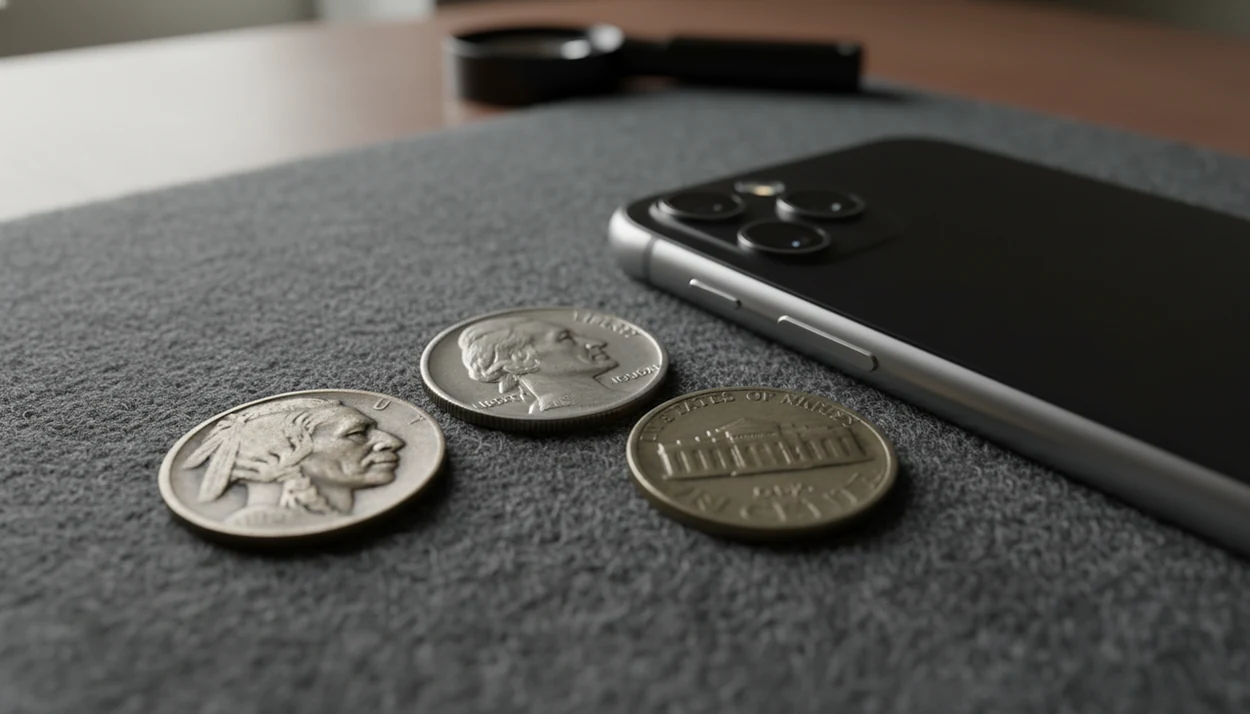
A dark wooden table can make copper look redder. It can also flatten nickel detail.
How To Use A Nickel Identifier App For Dates And Mint Marks
Use a nickel identifier app as a short inspection workflow, not a single-button verdict. The goal is to capture both sides, read the result, then compare the app output with the coin in your hand.
- Place the nickel on a plain surface in bright, indirect light.
- Photograph the obverse and reverse, keeping the phone level and the coin fully in frame.
- Review the app’s type, date, mint mark, and confidence warning before accepting the match.
- Zoom into the date and mint mark area, especially on worn Buffalo nickels and 1942 Jefferson nickels.
- Save possible better finds to your collection notes with both photos attached.
- Verify valuable results against a trusted reference, dealer, or grading service.
For U.S. denominations beyond nickels, a broader US coin identifier workflow can help keep dates, mint marks, and denomination checks consistent.
Before You Scan A Nickel
Before you scan a nickel, set up the coin and camera so the app is judging the coin, not glare, blur, or a busy background. A little preparation makes the first result easier to trust and easier to verify.
- Choose indirect daylight near a window or a bright lamp angled away from the coin. Harsh reflections can wash out dates, mint marks, and Monticello details.
- Set the nickel on a plain, non-reflective surface such as white paper, matte card, or a soft cloth with no pattern.
- Leave the coin as found. Do not clean, polish, rub, or rinse it before scanning because surface changes can hurt both identification and value.
- Photograph the obverse and reverse before accepting any result, even if the first side looks obvious.
- Keep a loupe or small magnifier nearby for the final check. Dates, mint marks, worn Buffalo details, and small variety clues often need your eyes as much as the app.
Think of the scan as the start of the inspection. The better the setup, the fewer mystery results you have to untangle later.
Buffalo Nickel Identifier Checks For Dates, Types, And Mint Marks
How do you identify a Buffalo nickel? Buffalo nickels were issued from 1913 to 1938, and the main checks are the date, mint mark, reverse type, and surface wear.
1913 Type 1 Versus Type 2 Buffalo Nickels
The 1913 Type 1 Buffalo nickel shows the bison on a raised mound. The 1913 Type 2 changed the reverse so FIVE CENTS sat in a recessed area, which protected the denomination from wear.
Worn Buffalo Nickel Date Clues
A worn date on a Buffalo nickel can be hard for AI and humans to read. Rotate the coin under bright window light and check the date area on the obverse before trusting a low-confidence scan.
The U.S. Mint produced more than 158 million Buffalo nickels in 1936, according to PCGS CoinFacts (https://www.pcgs.com/coinfacts/coin/1936-5c/3975). For beginners, date-and-mint-mark checking is often better than age-based guessing because common old coins can still have high mintages.
War Nickel App Clues For 1942 To 1945 Silver Jefferson Nickels
A war nickel app check should confirm both the date range and the large reverse mint mark. Silver war nickels are 1942 to 1945 Jefferson nickels with a large P, D, or S above Monticello.
- War nickels require the 1942 to 1945 date range and the large reverse mint mark.
- Not every 1940s Jefferson nickel contains silver.
- Silver war nickels contain 35% silver and 0.05626 troy ounces of silver per coin, according to the U.S. Mint and NGC references (https://www.usmint.gov/learn/coin-and-medal-programs/coin-specifications and https://www.ngccoin.com/coin-explorer/united-states/nickels/jefferson-five-cents-1938-date/).
- From 1942 through 1945, the U.S. Mint struck approximately 870 million silver war nickels; verify date-by-date totals against a mintage table such as PCGS CoinFacts (https://www.pcgs.com/coinfacts/category/nickels/jefferson-five-cents-1938-date/84).
- Melt value can exceed face value, but collector value still depends on condition and demand.
Large Mint Mark Above Monticello
Look above Monticello on the reverse. That large letter is the fast clue.
Silver Content Versus Face Value
The common question is, “Is this silver or just old?” With war nickels, silver content comes from the date plus the large mint mark, not from age alone.
Jefferson Nickel Lookup Signals For Common And Better Dates
A Jefferson nickel lookup should sort coins into common, possible premium, and needs verification groups. Most circulated Jefferson nickels are common, especially high-mintage modern dates.
| Signal | What to check | What it usually means |
|---|---|---|
| Common date | High mintage, heavy circulation wear | Often face value or low premium |
| Possible premium | Better date, mint mark, strong condition | Worth a closer look |
| War nickel flag | 1942 to 1945 plus large reverse mint mark | Contains 35% silver |
| Variety or error note | Doubled die, repunched mint mark, unusual strike | Needs close verification |
More than 2.8 billion 1964 and 1964-D Jefferson nickels were produced combined, according to PCGS CoinFacts mintage listings for 1964 Philadelphia and Denver issues (https://www.pcgs.com/coinfacts/category/nickels/jefferson-five-cents-1938-date/84). That is why many older-looking 1964 nickels remain common unless condition or variety changes the picture.
A good ai coin identification, rarity lookup, and collection value estimation app for collectors and beginners delivers structured clues and estimated value ranges, not instant certified grades or guaranteed sale prices.
Five Nickel Identifier App Facts Collectors Should Know
These five facts are the practical center of nickel app identification. Keep them beside your collection value list and calculator when sorting a new group.
- AI recognition can identify type, date, and basic nickel details in seconds when photos are clear.
- Buffalo nickel value depends heavily on date, mint mark, type, and condition.
- War nickels require the 1942 to 1945 date range and large mint mark above Monticello.
- Value estimates are ballpark figures, not professional grading opinions.
- Important finds should be checked against trusted references or expert review.
For a beginner, app scanning usually works best as a sorting method because it separates obvious common circulation finds from coins that deserve closer research.
Common Nickel Identifier App Myths About Value And Silver
Nickel app myths usually start with silver, rarity, or grading. These are the four we correct most often when reviewing beginner collection notes.
Every 1940s nickel is silver. False. Only qualifying 1942 to 1945 Jefferson nickels with the large mint mark above Monticello are silver war nickels.
An app can assign the exact grade and sale price. False. Grade hints are useful, but in-hand inspection still matters.
A rare label means a large payout. False. Demand, condition, and selling venue affect the real price.
AI catches every variety. False. Doubled dies, repunched mint marks, overdates, and subtle errors can be missed. A dedicated error coin identifier check may help, but expert review is still safer for expensive claims.
Verification Steps After A Nickel Identifier App Flags A Find
After an app flags a nickel, take a second photo set before making a value decision. Re-shoot both sides in better light, then compare the date, mint mark, and reverse design against a trusted U.S. nickel reference.
If the coin appears scarce, has a variety label, or carries a high estimated value range, consider a dealer opinion or professional grading service. Wipe dust from the outside of a cardboard 2x2 flip if needed, but don’t clean the coin itself.
For related denomination checks, the same caution applies to a dime identifier app, a quarter identifier app, or a penny identifier app. The app can organize the question. The coin still needs proof.
Limitations
A nickel identifier app is useful, but it has real limits. Treat uncertain results as leads, not conclusions.
- Clear, well-lit photos are required; glare, blur, dirt, and shadows can cause wrong matches.
- Heavily worn Buffalo nickels may have unreadable dates even if the app identifies the type.
- Cleaned, corroded, damaged, or altered nickels may be harder to match accurately.
- Minor errors and varieties can be missed unless the app database is trained for them.
- App value estimates can be too high or too low because grade and market demand matter.
- Professional grading or expert inspection is still needed for expensive or disputed coins.
- A low-confidence result should be re-shot, not treated as a final answer.
Small scratches matter. So does lighting.
FAQ
What nickel do I have?
Scan both sides, then compare the app result to the date, design, reverse, and mint mark. A Buffalo, Jefferson, or war nickel identification should match visible coin details.
Are all 1942 nickels silver?
No. Only qualifying 1942 Jefferson nickels with the large mint mark above Monticello are silver war nickels.
Where is the war nickel mint mark?
The war nickel mint mark is a large P, D, or S above Monticello on the reverse. It is much larger than ordinary Jefferson nickel mint marks.
How much silver is in war nickels?
Silver war nickels contain 35% silver. Each coin has 0.05626 troy ounces of silver.
Can an app identify Buffalo nickels?
Yes, apps such as CoinIdentifier can usually identify Buffalo nickels from clear photos. Worn dates may still require careful verification.
Are 1964 nickels valuable?
Most circulated 1964 Jefferson nickels are common because mintage was very high. Exceptional condition or a notable variety can change the value.
Can an app grade nickels?
CoinEd and similar apps can provide grade hints. Professional grading is needed for high-value or disputed nickels.
Should I clean old nickels?
No. Cleaning old nickels can damage the surface and reduce collector value.