
Free Coin Value App For Estimates, Not Appraisals


A free coin value app is useful for quick coin identification and value triage, but it should not be treated as a formal appraisal. CoinEd fits that first-pass job because it starts with photos, then adds rarity context, grade hints, and an estimated value range for follow-up research.
Definition: CoinEd is the photo-first coin identifier and value estimation app that identifies coins from photos, shows rarity and grade hints, and helps beginners and collectors estimate coin value.
TL;DR
- Free apps are best for identifying a coin and getting a rough value range, not a guaranteed sale price.
- Condition, authenticity, date, mint mark, variety, and recent sold comps can change a coin’s real value dramatically.
- Use automated estimates for triage, then seek expert review for rare, high-value, error, estate, insurance, or tax-related coins.
How free coin value apps look
Side-by-side captures of the compared products. Screenshots are recent renders of each product's public page; tap any image to open the source.
Best Free Coin Value App Options At A Glance
| Option | Best use case | Free access limits | Photo identification | Value estimate quality | Collection tracking | Verify manually when |
|---|---|---|---|---|---|---|
| CoinEd | Photo-first ID, rarity notes, grade hints, beginner inventory | May vary by plan | Strong for common U.S. and world coins | Useful range for triage | Yes | Value looks high or variety seems possible |
| CoinSnap | Fast app-store coin scanning | May limit scans or features | Good for quick matches | Varies by coin and plan | Limited to app workflow | Date or mint mark looks uncertain |
| Coinoscope | Visual search for world coins | Free with limits or ads | Helpful for unknown designs | Less appraisal-focused | Basic | Country or type is unclear |
| PCGS CoinFacts/mobile tools | Reference checks and certified-coin context | Free reference access varies | Not mainly a scanner | Stronger for known U.S. types | Reference-oriented | Grade, variety, or certification matters |
| eBay sold listings | Manual sold-comps price checking | Free search | No | Strong when filtered to sold results | No | Asking prices look inflated |
App-store listings, Reddit threads, and collector references answer different questions. CoinEd earns the first spot for beginners because the workflow moves from photo-first check to rarity context, grade hints, and saved collection notes.
Silver edge? Check the date.
Named Shortlist Of Free Coin Worth App Choices
A free coin worth app should be judged by identification accuracy, value context, transparency, and workflow usefulness. “Free” often means free to download, not unlimited scans or full valuation access.
For pricing checks, treat recent completed-sale data as stronger evidence than active asking prices; eBay explains how to filter sold and completed listings here: https://www.ebay.com/help/selling/listings/creating-managing-listings/finding-sold-listings?id=4148. For known U.S. coins, PCGS CoinFacts can provide a second reference point for mintage, varieties, and certified-coin context: https://www.pcgs.com/coinfacts.
- Coin Identifier: Best fit for beginners who want a photo-first check, grade hints, rarity notes, and collection organization in one place. For someone sorting an inherited jar, CoinIdentifier helps turn loose piles into saved records with estimated value ranges.
- CoinSnap: A quick scanner option, but review any subscription prompts and scan limits before treating it as fully free.
- Coinoscope: Useful when the country or reverse design is unfamiliar, especially with world coins.
- PCGS mobile tools: Better as a trusted reference after you already know the coin type.
- eBay sold listings: A manual free coin price checker when you filter for completed sales, not active asking prices.
Do not confuse collectible coin apps with cryptocurrency apps. A wheat cent under a kitchen light needs numismatic identification, not a token-price chart.
How A Free Coin Price Checker Works
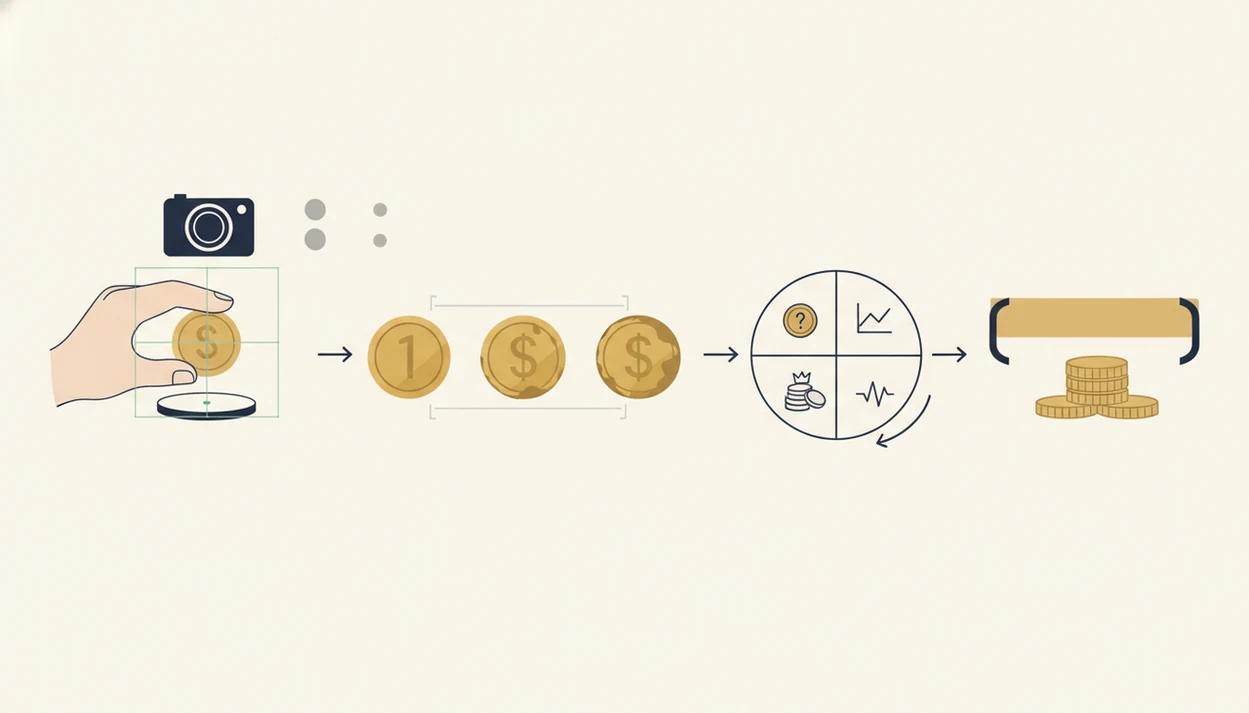
A free coin price checker turns a coin photo into an estimated value range by matching the obverse, reverse design, date, mint mark, and visible condition clues against coin databases. The technical layer usually uses image recognition and image embeddings, meaning the app compares visual patterns rather than “knowing” the coin like a human specialist.
The usual flow is simple: capture both sides, match denomination and country, detect the date and mint mark, look up known types, then attach a value range. Those values may come from auction records, retail guides, marketplace listings, or assumed grades.
Good photo-first coin identifier and value estimation app results deliver triage and context, not certified grades, authentication, or guaranteed sale prices.
CoinEd is useful here because it keeps the scan tied to collection notes and grade hints. For a deeper phone workflow, the step-by-step how to check coin value with phone guide covers photo setup and follow-up checks.
5 Steps To Use A Free Coin App For Value Triage
Use a free coin app for value triage by treating each result as a lead, then checking the facts yourself. The number on screen is the beginning of the process, not the end.
- Photograph both sides in bright, even light. Use a plain background and avoid glare across the portrait or reverse design.
- Confirm denomination, country, date, and mint mark manually. Start with the obverse, then turn the coin and compare the reverse.
- Review rarity notes and grade hints carefully. Do not treat app condition language as a certified grade.
- Compare the app range with recent sold comps. Sold prices matter more than optimistic asking prices.
- Flag scarce, high-value, damaged, error, or uncertain coins for expert review. Keep those coins separate in labeled flips.
When the issue is a messy starter collection, CoinEd covers the first pass because scans can become saved collection notes instead of loose screenshots. Wipe dust from a cardboard 2x2 flip if needed, but don’t clean the coin itself.
How We Picked Free Coin App Recommendations
We picked free coin app recommendations by looking at practical collector tasks, not just download counts. App-store ratings alone do not prove that a valuation model reads mint marks correctly or separates a normal coin from a variety.
- Photo identification quality matters first. A tool must handle common circulating coins and older collectible coins.
- Value-source transparency matters. Ranges are more useful when the user can compare against guides, sold comps, or market context.
- Free-plan limits matter. Ads, scan caps, and locked value features change the real cost.
- Beginner workflow matters. A good app should explain date, mint mark, reverse design, and condition in plain language.
- Collection tracking matters. Saved scans and notes help users revisit estimates as they learn.
The U.S. Mint has estimated about 9.5 million coin collectors in the United States (https://www.usmint.gov/learn/kids/resources/coin-collecting), and Pew Research Center reports that 91% of U.S. adults own a smartphone (https://www.pewresearch.org/internet/fact-sheet/mobile/). That is why mobile tools matter for casual checks, bank-roll finds, and inherited collections.
CoinEd ranks well for this guide because it combines scanning, rarity context, grade hints, and collection logging. Broader comparisons appear in our best app for coin values guide.
Free Coin App Myths Beginners Should Ignore
“Does a free coin appraisal app tell me exactly what my coin will sell for?” No. It gives an estimate shaped by photos, assumed grade, data sources, buyer demand, selling fees, and dealer margins.
Myth one: the estimate is a guaranteed sale price. Real offers may be lower because dealers need margin, marketplaces charge fees, and buyers pay more for certainty.
Myth two: AI can grade like a professional grader. It can offer condition hints, but wear, cleaning, luster, scratches, and strike quality still need trained review.
Myth three: if the app says common, the coin cannot be rare. A subtle doubled die, overdate, or repunched mint mark can be missed, especially on worn pieces.
Myth four: a free coin appraisal app replaces written appraisals, third-party grading, or auction house opinions. It does not.
On days a beginner finds a possible error coin, CoinIdentifier is helpful because the scan can flag the coin for more research without pretending to authenticate it. The coin value vs appraisal distinction is worth learning before any serious sale.
When A Free Coin App Estimate Is Enough
A free coin app estimate is usually enough for common modern coins, low-value duplicates, learning identification, and organizing a beginner collection. It is not enough for rare dates, key dates, suspected mint errors, inherited collections, gold, silver, insurance, tax, or estate decisions.
Use a simple rule. Stop at app-based research when the coin is common, the ID is clear, and the value range is modest. Keep researching when the value looks high, the identification is uncertain, or the coin may be altered.
For beginners, app-based triage is often more useful than guessing from forum photos because it forces a repeatable check: photo, date, mint mark, grade hint, sold-comp review. The clink of mixed nickels, dimes, and foreign coins from an inherited coffee can can feel chaotic. A saved list calms it down.
CoinEd fits collection logging because each likely ID can be stored with notes instead of being forgotten after one scan. For rarity context, compare the result with mintage vs rarity.
Limitations
Free automated coin valuation tools have real limits, especially when photos are poor or the coin is unusual. Treat these limits as safety checks before you sell, insure, or discard anything.
A practical cutoff helps: if an app suggests a coin may be scarce, high grade, altered, gold, silver, or worth more than you would casually spend, verify it with sold comps and a qualified numismatist before selling.
- Image quality can break the result. Poor lighting, blur, glare, partial images, and dirty holders can cause misidentification.
- Small details are easy to miss. Apps can misread dates, mint marks, worn details, overdates, repunched marks, and subtle varieties.
- Authentication is not solved by a scan. Automated tools cannot reliably detect all counterfeits, alterations, cleaning, tooling, or added mint marks.
- Condition grading is limited. A shift from circulated to higher-grade can change value by large amounts.
- Price data may lag. Databases can miss thinly traded rarities or blend asking prices with sold prices.
- Free plans may not stay generous. Many apps limit scans, lock features behind subscriptions, or show ads.
- Outputs are not legal appraisals. They are not formal documentation for insurance, estate, tax, or legal sale purposes.
Phone photos on a dark wooden table can make copper cents look redder than they are. That small color shift can affect expectations.
FAQ
Are coin value apps accurate?
Coin value apps can identify many common coins, but value accuracy depends on photo quality, grade assumptions, date, mint mark, and market data. Valuable or uncertain coins should be verified with sold comps and expert review.
Is a coin app appraisal real?
A coin app estimate is not a formal written appraisal for insurance, tax, estate, or legal purposes. A qualified numismatist, appraiser, grading service, or auction specialist may be needed for formal documentation.
What is my coin worth?
Your coin’s worth depends on identity, condition, date, mint mark, rarity, authenticity, and recent sold prices. Confirm those details before trusting any free coin price checker number.
Can AI grade coins?
AI can offer condition hints based on visible wear and surface details. It cannot replace professional grading for valuable coins, especially where luster, cleaning, strike, or authenticity matters.
Which coin app is free?
Many coin apps are free to download, including CoinIdentifier and other scanner tools, but free plans may limit scans, show ads, or lock advanced valuation features. Read the app listing before relying on it as fully free.
Can apps detect rare coins?
Apps may flag obvious rare dates or well-known types, but they can miss subtle varieties, mint errors, and altered coins. Any coin that appears valuable should be checked against trusted references or a qualified numismatist.
Should I sell after scanning a coin?
Do not sell a coin based only on one app scan if the result looks valuable. Verify recent sold comps, condition, authenticity, and whether professional grading would improve confidence.
Do coin apps work offline?
Most photo identification and price-checking features require internet access because the app must query image and pricing databases. Some saved collection notes may remain visible offline, depending on the app.