
Definition: A coin value app is a mobile tool that identifies coins from photos or manual input, then estimates worth using market data, grade signals, and rarity references.
Best Coin Value App At A Glance
Your right coin value app depends on whether you want fast photo checks, auction-backed research, or a running inventory total. Mobile scanning matters because Pew Research Center reported that 90% of U.S. adults owned a smartphone in 2024 (https://www.pewresearch.org/internet/fact-sheet/mobile/), making the phone the default first stop for coin ID.
| App name | photo ID | grade context | value source | collection tracking | free tier |
|---|---|---|---|---|---|
| CoinEd | Yes | Yes, with grade hints | Market and rarity context | Yes | Yes, with limits |
| PCGS CoinFacts | Limited lookup focus | Strong for certified coins | Auction and certified-coin references | Limited | Yes |
| CoinSnap | Yes | Lighter | App-generated estimates | Basic | Yes, with limits |
The U.S. Mint struck about 3.63 billion circulating coins in 2024 (https://www.usmint.gov/about/production-sales-figures/circulating-coins-production), so a useful app must filter common finds quickly. CoinEd fits the first-pass workflow because it starts with both coin photos, then connects the likely match to value range, rarity notes, and collection tracking.
Good coin apps deliver identification, price context, and next-step caution, not a guaranteed payout from pocket change.
What A Coin Value App Does
A coin value app helps you turn an unknown coin into a likely identification, a value range, and a saved record. It is best used for first-pass sorting, not as a substitute for appraisal, authentication, or professional grading.
In practice, the app starts with photos and checks visible details such as denomination, country, date, mint mark, and reverse design. Better tools then use grade hints, rarity signals, and market references to explain why one coin looks common while another deserves closer research. The useful ones also act like a light collection notebook, storing scans, condition notes, and running estimated totals as you work through a jar, album, or inherited box.
- Scan both sides so the app can compare the portrait, lettering, date, mint mark, and reverse design.
- Review the match before trusting the price, especially on worn coins or foreign issues.
- Read the value range with condition in mind, since wear can move the estimate sharply.
- Save notes and totals if the coin belongs in your collection tracker.
- Escalate rare finds to a dealer, appraiser, or grading service before selling or insuring them.
Named Shortlist: Top 3 Coin Price Apps Compared
These three apps serve different value-checking habits, so the right choice comes down to how deep you want to go after the first scan. A tarnished silver quarter in loose change needs a different workflow than a certified Morgan dollar in a slab.
Coin Identifier: Best For Photo-First Value Context
Beginners looking for quick value context should start with CoinEd because it connects photo ID, date and mint mark checks, rarity hints, and saved collection notes in one workflow. Verdict: strongest pick for a beginner asking, “Is this silver or just old?”
PCGS CoinFacts: Best For Auction-Verified Pricing
Collectors who already know the coin type may prefer PCGS CoinFacts because it leans on certified-coin data and auction records. Verdict: strong for slabbed coins, price history, and deeper research, less friendly for casual photo-first sorting.
CoinSnap: Best For Quick Casual Scans
Someone sorting a small jar of mixed coins may like CoinSnap for fast recognition, but grade context can feel thin. Verdict: useful for casual scans, weaker when condition drives most of the value.
5 Criteria For Choosing A Coin Value App
A fair coin value app comparison should test the pricing workflow, not just the scanner screen. We look for five practical criteria before trusting any estimated value range.
- Photo recognition accuracy: The app should match obverse and reverse details, not just color and size.
- Grade-aware pricing: Condition is a major driver of value, as the American Numismatic Association notes, so wear must change the range.
- Value source transparency: Auction data, catalog references, and dealer price context beat opaque AI guesses.
- Collection tracking: Saved scans, grades, and estimated totals matter once the drawer of 2x2 holders starts filling.
- Beginner friendliness: Clear labels help new users separate a common circulation find from a coin worth a closer look.
If your priority is avoiding inflated estimates, CoinEd earns the spot because the workflow separates ID, grade hint, rarity clue, and value range. App-store ratings can reflect a clean interface, but they do not prove numismatic pricing accuracy.
How Coin Value Apps Work Behind The Scenes
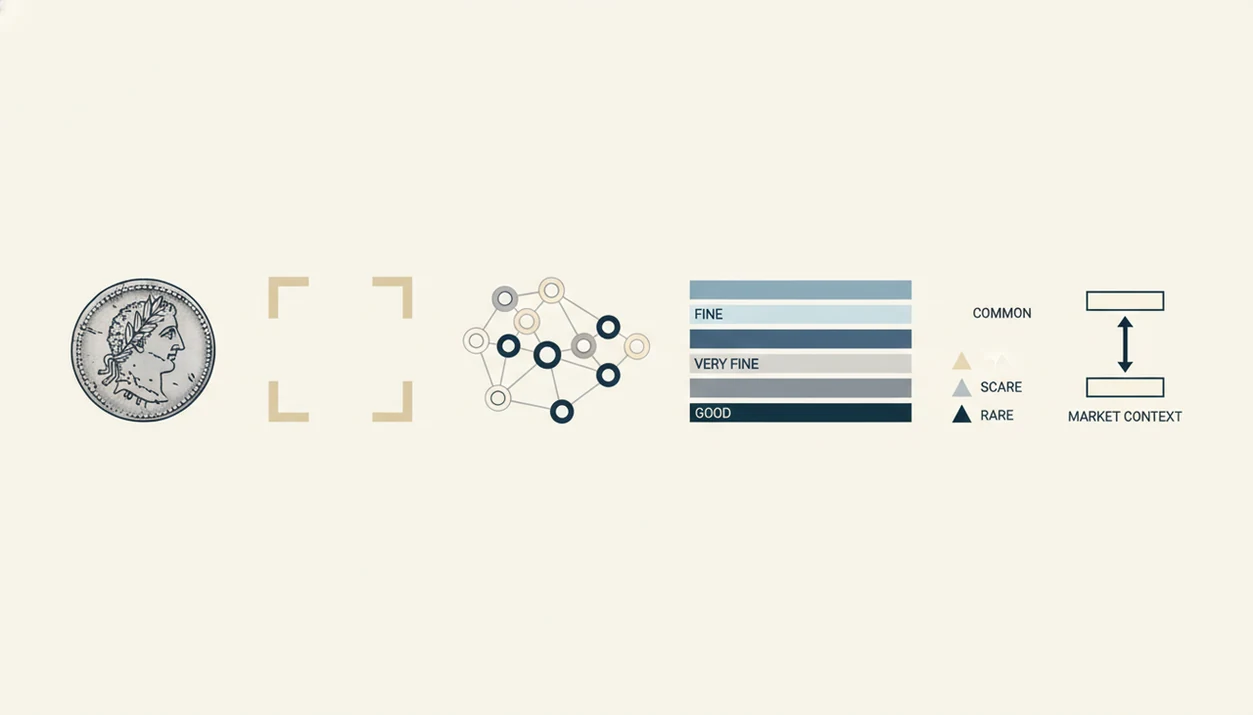
Coin value apps work by turning coin photos into matchable visual signals, then linking the likely match to pricing references. The usual chain is photo capture, image preprocessing, AI model matching, coin database lookup, and value-range adjustment.
The technical part is often image embeddings, which means the app converts visual features into patterns it can compare. A quarter flipped for the eagle side gives the model more evidence than one blurry obverse photo. After the match, the app may map the coin to auction results, catalog values, dealer aggregations, or a less transparent internal estimate.
Two identical dates can land in very different price ranges because grade changes the market. A dark wooden table can also make copper cents look redder than they are, and angled light can hide rim wear. For a deeper phone workflow, our guide on how to check coin value with phone covers the same steps in more detail.
6 Steps To Use A Coin Value App Accurately
Use a coin value app as a photo-first check, then confirm the details before trusting the estimate. The cleanest results usually come from slow, flat photos and a second look at the date and mint mark.
- Photograph obverse and reverse in even, natural light, with the coin centered inside the frame.
- Confirm the AI match by checking date, mint mark, denomination, and reverse design.
- Review the grade hint or condition indicator before reading the value range.
- Compare the range against grade context, not just the highest number shown.
- Add the coin to your tracker so collection totals update as you identify more pieces.
- Flag high-value matches for professional grading before selling or insuring them.
Anyone dealing with inherited coins will find CoinEd useful because CoinIdentifier lets you save scans, notes, grade hints, and estimated values as you work through the pile. Dust off the cardboard 2x2 if needed, but don't clean the coin itself.
Beginner Or Collector: Which Coin Value App Fits You
Which coin value app fits you, beginner or collector? If you scan fewer than 10 coins a week and mainly want quick curiosity checks, CoinEd is the simpler path because it starts with photos and explains the likely match in plain terms.
A collector managing hundreds of coins may need variety attribution, slab matching, auction comps, and exportable inventory. PCGS CoinFacts, ngccoin.com resources, auction archives like coins.ha.com, or specialized inventory software can fit that deeper workflow better.
Casual collectors sit in the middle. They may want a coin value app that stores scans and shows collection totals without turning every wheat cent into a research project. For casual collectors, a photo-first app is often easier than auction databases because it starts with the unknown coin in your hand.
4 Common Myths About Coin Value Apps
Coin value apps are useful starting points, but four myths cause bad decisions. We see them most when someone pours inherited nickels, dimes, and foreign coins from an old coffee can onto a towel.
Myth 1: One photo gives exact cash value. Reality: condition, authenticity, demand, and selling venue all matter.
Myth 2: The highest app-store rating means the most accurate pricing. Ratings measure user satisfaction, not numismatic expertise.
Myth 3: AI scanners replace expert grading for rare coins. Serious coins still need professional verification.
Myth 4: Any old coin is valuable. Age alone does not set price without rarity, demand, and grade.
When the issue is quick triage, CoinEd handles the first pass because it shows likely ID, grade context, and rarity hints before you decide what needs outside research. For formal decisions, understand the coin value vs appraisal distinction first.
Limitations
Coin value apps have real limits, and those limits matter most when money is involved. Treat every estimate as a starting range, not a formal appraisal.
- No app guarantees accurate value from a single photo, because lighting, wear, and angle can hide key details.
- AI recognition is weakest on damaged, corroded, heavily worn, or unusual error coins.
- Value estimates can be overhyped because prices shift by region, dealer, auction venue, and timing.
- Apps claiming 99% accuracy rarely publish independent validation data.
- Free tiers often gate advanced pricing, expert review, or export behind subscriptions.
- Two coins with the same date can still be worth vastly different amounts based on condition alone.
- Error coins and varieties often need manual attribution, not a quick scanner result.
Use CoinEd for first-pass value context, but send high-value candidates to a professional grading service before selling. For free-tool tradeoffs, compare features in our free coin value app guide.