
State Quarter Identifier for Designs, Mint Marks, and Error Checks
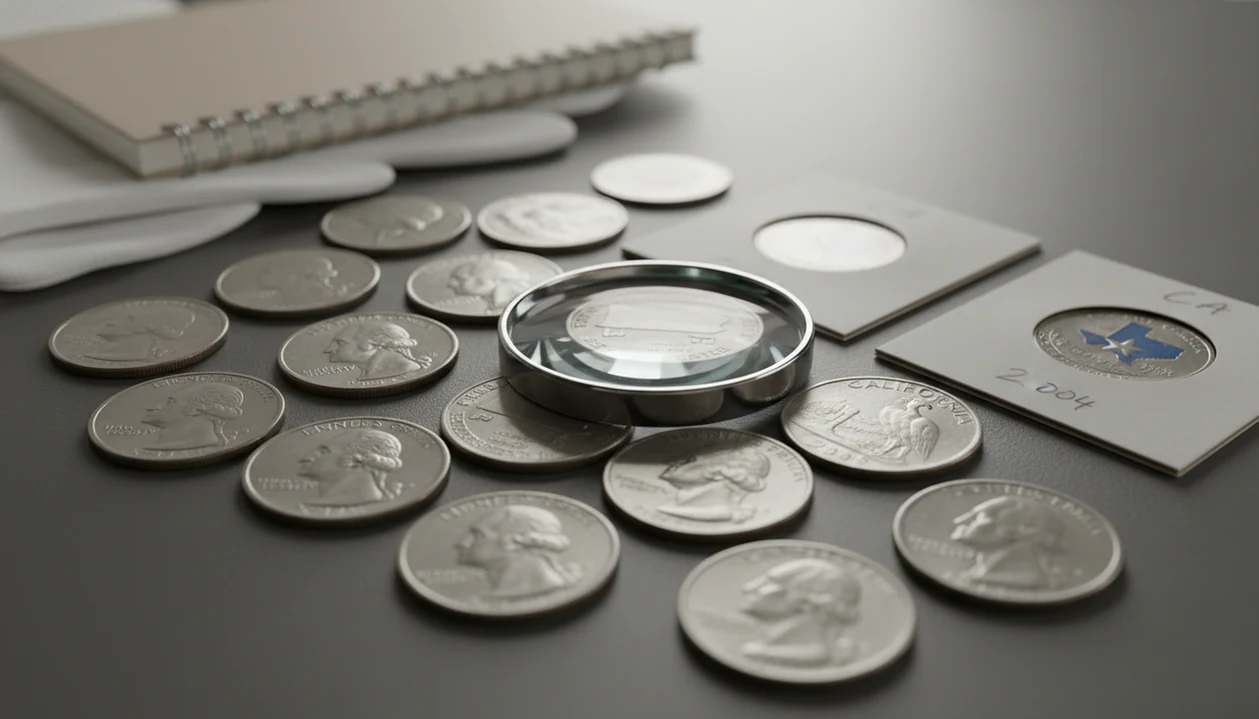


A state quarter identifier helps you match a quarter to its state design, year, mint mark, proof status, and possible error category from photos and visible coin details. For most 50 state quarters, the result will be a common circulation coin worth face value, but the right workflow can flag coins that deserve closer inspection.
Definition: A state quarter identifier is a photo-first coin identification tool or workflow that matches U.S. state quarter designs to dates, mint marks, known varieties, and realistic value context.
TL;DR
- The 50 State Quarters Program ran from 1999 through 2008 and released 50 circulating commemorative designs.
- Most circulated state quarters are common because the U.S. Mint produced about 34.3 billion during the program.
- True state quarter errors usually show mint-made features, while scratches, stains, dents, and wear are usually post-mint damage.
State Quarter Identifier Definition for Collectors
A state quarter identifier is a practical sorting method that matches a U.S. quarter’s reverse design, year, mint mark, proof status, and possible error clues before any value claim is made. It starts with what can be seen: the state name, date, inscriptions, imagery, and the small mint mark on the obverse.
For beginners, that means less guessing at a tray of similar Washington quarters. For collectors, it creates a repeatable check before adding the coin to collection notes. A good ai coin identification, rarity lookup, and collection value estimation app for collectors and beginners delivers organized clues and realistic context, not instant certified grades or guaranteed rare finds.
Photo-first tools can support this workflow by matching coin photos to design, date, mint mark, and rough value context. Treat the result as triage and education, not final authentication or a certified grade.
Five State Quarter Collection Facts Before You Identify Coins
- The 50 State Quarters Program released 50 different circulating commemorative designs from 1999 through 2008, according to the U.S. Mint: https://www.usmint.gov/learn/coin-and-medal-programs/50-state-quarters.
- The designs were issued in the order each state joined the Union, which helps explain why Delaware appears in 1999 and Hawaii appears in 2008.
- The U.S. Mint produced about 34.3 billion state quarters during the program, so most worn examples are common circulation finds: https://www.usmint.gov/learn/coin-and-medal-programs/50-state-quarters.
- The 2009 District of Columbia and U.S. territories quarters are a related follow-up set, not part of the original 50 state lineup.
- High mintage keeps most circulated pieces near face value unless condition, proof status, or a confirmed error changes the picture.
A complete state quarter collection can still be satisfying. The coin tray lined with velvet slots tells you which designs are missing at a glance.
Common does not mean uninteresting.
How a State Quarter Identifier Works From Photos
A state quarter identifier works by reading visible coin features from photos, then comparing them with known quarter designs, mint issues, proof issues, and error references. The usual data flow is photo capture, feature recognition, design match, mint mark check, condition screen, then rarity and estimated value context.
Image recognition looks for the reverse design, state name, date, inscriptions, and mint mark. In technical terms, the system may compare image embeddings, which are pattern summaries of the photo, against reference images. In plain English, it is matching shapes and text, not “knowing” the coin like a grader at a desk.
The photo still matters. A thumb shadow covering a mint mark can send the result sideways, and desk lamp glare across shiny copper-colored toning can make surfaces look worse than they are. For broader quarter types, a quarter identifier app can help separate state quarters from earlier Washington designs.
Before You Identify State Quarters
Before you identify state quarters, set up the coin so the photo and your eyes are not fighting glare, dirt, or shadows. A few minutes of prep makes the later design, mint mark, and error checks much more reliable.
- Use soft, indirect light from a window, shaded lamp, or bounced desk light so reflective fields do not wash out the date or small letters.
- Keep a 5x or 10x loupe nearby for the mint mark, possible doubling, and tiny raised details that a phone camera may smooth over.
- Leave the coin uncleaned, even if toning, dust, or pocket grime looks distracting. Cleaning can scratch the surface and make value questions harder, not easier.
- Photograph both the obverse and reverse on a plain, non-reflective background, with the coin flat and the camera square to the surface.
- Separate obvious damage from possible mint-made features before checking value. Deep cuts, dents, and stains belong in one mental pile; raised, repeated, or strike-related details deserve slower review.
This setup is not fancy. A sheet of matte paper, steady hands, and patience often beat a bright lamp on a shiny table.
How to Use a State Quarter Identifier Step by Step
Use a state quarter identifier by photographing both sides, confirming the state design and date, then checking mint mark, condition, and error flags before saving the record. A paper coin roll split at the seam can turn into a tidy checklist if you sort one coin at a time.
- Photograph the obverse and reverse under soft light, with the coin flat and the camera steady.
- Check the reverse for the state name, theme, inscriptions, and design imagery.
- Confirm the date and mint mark on the obverse, usually P, D, or S.
- Review condition notes, including wear on Washington’s hair, rim marks, and surface stains.
- Compare any error flag with a trusted reference before assuming added value.
- Save the coin to a state quarter collection record with photos, grade notes, and estimated value range.
For beginners, a photo-first check is often easier than scanning long mintage tables because the design narrows the search immediately.
State Quarter Identifier by Year, Design, and Mint Mark
A state quarter identifier by year should confirm that the coin falls between 1999 and 2008 for the original 50 state quarters, then match the reverse design to the correct state. Related searches like “state quarter identifier by year” and “list of state quarters with pictures” usually point to the same task: match the visible design first, then verify the mint information.
| Checkpoint | What to look for | Collector meaning |
|---|---|---|
| Year | 1999 through 2008 | Original 50 state quarter program |
| Reverse design | State name, theme, inscriptions, imagery | Confirms the state issue |
| P mint mark | Philadelphia | Normal circulation strike for many issues |
| D mint mark | Denver | Normal circulation strike for many issues |
| S mint mark | San Francisco | Usually proof or special issue context |
Year and state design match
Start with the reverse design, because the state name and artwork usually identify the coin faster than the date alone.
P D and S mint mark check
P and D marks usually indicate circulation strikes, while S marks deserve a proof-status check, especially when the surfaces look mirrorlike or unusually sharp. CoinIdentifier can be useful here when photos and collection notes need to stay together.
State Quarter Errors Versus Post-Mint Damage
State quarter errors are mint-made problems or varieties, while post-mint damage happens after the coin leaves the Mint. The distinction matters because scratches, stains, dents, and discoloration rarely add value.
| Feature type | Examples | What it usually looks like |
|---|---|---|
| Mint error or variety | Doubled dies, extra design elements, off-center strikes, clips | Raised, repeated, or structurally part of the strike |
| Post-mint damage | Scratches, stains, dents, gouges, heat color, random marks | Cuts into metal, interrupts surfaces, or looks uneven |
| Needs confirmation | Possible major error, unusual doubling, wrong planchet claim | Requires magnification or professional review |
Mint-made features are usually raised and integrated into the design. Damage often breaks the surface instead. We have seen beginners get excited about a “line through the horse,” only to find it was a deep scratch under a 10x loupe.
Possible valuable state quarter errors are worth documenting, but they should be checked against an error coin identifier workflow or a specialist reference before selling.
Common State Quarter Myths That Mislead Collectors
Common state quarter myths usually inflate value before the coin has been identified, graded, or checked for genuine mint-made features. A calm checklist prevents most of that confusion.
Old or dirty means rare. Age and dirt do not create rarity. A quarter that rode in a glove box for years may look dramatic, but it is still usually a 25-cent coin.
Every circulated state quarter is collectible at a premium. Most circulated state quarters remain worth face value because billions were made and saved.
No mint mark means a major error. Modern state quarters are not generally known for legitimate no-mint-mark error issues, so missing or weak marks need careful viewing.
Any odd mark is an error. Random color, scrapes, rim dings, and flattened spots are often damage.
A full circulated set is automatically valuable. A basic circulated 50 state quarter collection usually has modest value. The fun is often in completion, not resale.
State Quarter Collection Value Checks After Identification
“Is my state quarter worth more than 25 cents?” Value depends on the design, mint mark, condition, demand, proof status, and whether any error is confirmed. Most circulated state quarters remain face value, while cleaner album coins may bring a modest collector premium.
Recent auction results are more useful than old price-list guesses because they show what buyers actually paid. Still, one unusual sale does not set the value for every similar-looking coin. A shiny bicentennial quarter in a grandchild’s hand may start the collecting habit, but state quarter pricing still comes back to evidence.
Think in three buckets: face value, modest premium, and high-value exception. High-value exceptions usually need strong condition, proof status, or a major confirmed error. Third-party grading may make sense when the likely value exceeds grading and shipping costs. For mixed denominations, a US coin identifier keeps quarter finds from getting confused with silver dimes or older cents.
The most reliable value check starts with correct identification, then uses condition and recent market evidence before assigning an estimated value range.
Limitations
A state quarter identifier can make sorting faster, but it cannot remove every judgment call from coin collecting. Use it as a first pass, then slow down for anything that looks unusual.
- AI image recognition can struggle with glare, blur, reflective surfaces, dark backgrounds, and heavy wear.
- Smartphone photos may miss subtle doubled dies, minor varieties, or very small mint mark details.
- Value estimates are approximate and can change with demand, buyer interest, and recent sales activity.
- A tool cannot replace third-party grading for high-value finds, major error claims, or authentication.
- Many correct identifications still lead to common coins worth face value.
- Minor varieties may be difficult to sell even when the identification is accurate.
- Proof status can be misread when a normal coin is unusually shiny or harshly cleaned.
- Surface color in photos can lie, especially on dark wooden tables that make coppery tones look redder.
Do not clean the coin. Wipe dust from the cardboard 2x2 flip if needed, but leave the metal alone.
FAQ
What state quarter is this?
Check the reverse design for the state name, theme, and inscriptions, then confirm the year and mint mark on the obverse. A state quarter identifier or CoinEd can help match those visible details from photos.
Are state quarters worth money?
Most circulated state quarters are worth 25 cents because the Mint produced them in very large numbers. Added value usually requires strong condition, proof status, collector demand, or a confirmed error.
Which state quarters are rare?
Rare state quarters usually involve confirmed varieties, major mint errors, proof issues, or exceptional grade. A normal worn circulation strike is usually not rare.
Where is the mint mark on a state quarter?
The mint mark is on the obverse near Washington’s portrait, and it is usually P, D, or S. P means Philadelphia, D means Denver, and S usually points to San Francisco proof or special issue context.
Are no-mint-mark state quarters errors?
Modern state quarters are not generally known for legitimate no-mint-mark error issues. A missing mark is often caused by wear, lighting, damage, or misreading.
What are state quarter errors?
State quarter errors are mint-made features such as doubled dies, off-center strikes, clips, or extra design elements. Scratches, stains, dents, and random discoloration are usually post-mint damage.
How many state quarters exist?
The original program includes 50 state quarter designs from 1999 through 2008. The 2009 D.C. and U.S. territories quarters added six related follow-up designs.
Should I grade state quarters?
Grading may make sense for a high-grade coin, proof issue, or confirmed major error with enough value to justify the cost. It is usually not cost-effective for common circulated state quarters.