
Error Coin vs Damage: How to Avoid False Claims
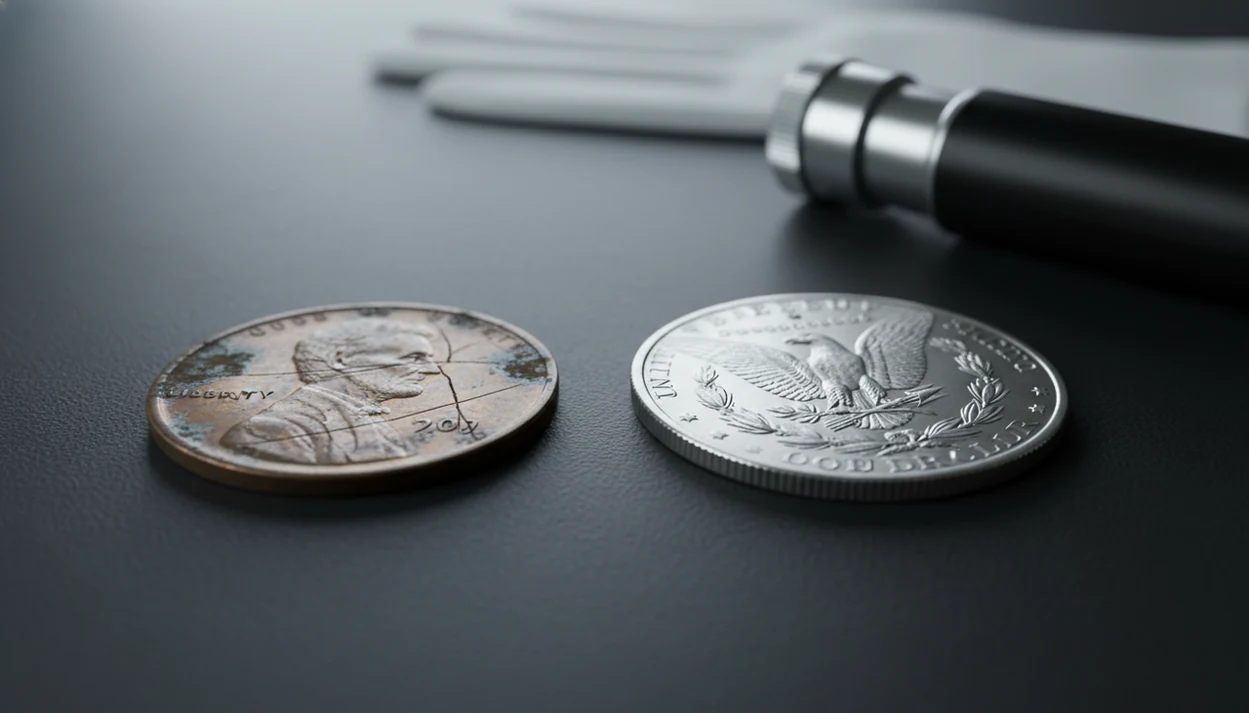


Most odd-looking coins are damage, not errors: an error coin vs damage check starts by asking whether the change happened before or during the final mint strike, or after the coin left the striking process. Scratches, corrosion, dents, bent rims, heat marks, and chemical stains are usually post-mint damage with little or no added value.
Definition: An error coin is a coin made incorrectly during the minting process, while post-mint damage is any change that happens after the final strike.
- Assume damage first, then rule it out with minting-process clues.
- True mint errors follow repeatable patterns such as off-center strikes, wrong planchets, double strikes, or die-related issues.
- Damaged coin value is usually face value, bullion value, or less than a normal collectible coin unless a specialist confirms a real mint error.
Error coin vs damage, side by side
Side-by-side captures of the compared products. Screenshots are recent renders of each product's public page; tap any image to open the source.

Error Coin vs Damage at a Glance
The dividing line is simple: a mint error happens before or during the final strike, while post-mint damage happens after the coin is already formed. Most pocket-change oddities fall on the damage side.
| Checkpoint | More like a mint error | More like post-mint damage |
|---|---|---|
| Timing | Before or during final strike | After final strike |
| Metal surface | Raised, flowed, or struck into the design | Cut, scraped, gouged, or crushed |
| Pattern | Matches known minting mechanics | Random impact or wear pattern |
| Design flow | Lettering and devices move with the strike | Surface is interrupted across the design |
| Value path | Needs documented examples or expert confirmation | Usually face value or reduced collector value |
A beginner turning over a wheat cent under a kitchen light may spot a tiny mark and hope it is rare. Slow down. Valuable errors need comparison to certified examples, not just a strange shape.
Five Facts About Coin Damage or Error Claims
Before making a coin damage or error claim, start with these five facts. They prevent most false listings, especially for coins pulled from change jars, parking lots, and bank rolls.
- A mint error happens before or during the final strike, when the planchet, die, collar, or press action goes wrong.
- Post mint damage happens after the final strike, even if the mark looks dramatic.
- Most weird coins from circulation are damaged, altered, corroded, heat-affected, or environmentally changed.
- Real errors must match known minting mechanics, not just look unusual in one photo.
- Professional grading, experienced dealers, and photo-based tools can reduce false claims.
A good ai coin identification, rarity lookup, and collection value estimation app for collectors and beginners should give likely ID, variety clues, and value context, not a guaranteed rare-coin verdict.
That distinction matters.
How Mint Errors and Post Mint Damage Work
Mint errors and post-mint damage differ because struck metal records pressure in predictable ways. A blank planchet sits between dies, the press applies force, and the final strike forms the obverse, reverse design, rim, and lettering.
That before-or-after-strike timing matches the U.S. Mint’s basic production sequence: blanking, annealing, upsetting, striking, inspecting, and bagging (U.S. Mint coin production process).
Under striking pressure, metal flows into die recesses. That flow can leave clues around letters, devices, and fields. If a coin is off-center, double struck, or struck on the wrong planchet, the evidence usually follows that pressure system.
Post-mint forces behave differently. A hammer flattens high points. A vise squeezes edges. Chemicals stain or pit surfaces. A dryer can roll and distort rims after the design is already present. The U.S. Mint reported approximately 11.4 billion circulating coins shipped in fiscal year 2023, so true escaped errors are rare beside total output (U.S. Mint FY 2023 Annual Report).
For beginners, the safest method is to compare the mark against mint mechanics first, then value second.
Where Real Error Coins Win Value
Real error coins can win value when the mistake is visible, unusual, collectible, and confirmed. Value depends on error type, denomination, rarity, demand, condition, and whether certified examples exist for comparison.
Off-Center and Double Strikes
Off-center strikes show a design struck away from the proper center, often with blank planchet space visible. Double strikes show a second strike that repeats or shifts the design in a way consistent with press action.
Wrong Planchets and Die Problems
Wrong planchets occur when a coin is struck on a blank intended for another denomination or composition. Clipped planchets, broadstrikes, and filled-die missing letters can also be collectible when the diagnostics match known examples.
Not every real error is valuable. A tiny filled-letter issue on a common coin may be interesting but cheap. When a close-up photo of rim wear raises questions, compare it with certified listings before spending grading money.
Where Post Mint Damage Explains Weird Coins
“Is this coin damage or error?” If the feature looks random, cuts across the design, or could be made after minting, post mint damage is the more likely answer.
Impact, Bending, and Rim Damage
Scratches, gouges, dents, rim dings, bends, flattened details, dryer coins, spooned rims, and train-track coins usually interrupt the finished surface. A coin with a crushed rim and smeared letters may look dramatic, but the metal often moved after the design was complete.
Corrosion, Heat, and Chemical Damage
Corrosion, heat damage, chemical toning, stains, plating bubbles, and environmental pitting usually come from storage, soil, moisture, chemicals, or heat. Damaged coin value is usually face value, metal value, or less than a normal collectible coin.
Ask one plain question: could this be made with a hammer, vise, heat, chemicals, road, dryer, or long circulation?
Usually, yes.
How to Check Error Coin vs Damage in Photos
Use a photo-first check before posting, selling, or submitting a questionable coin. Good photos reduce guessing, especially when copper cents look too red on a dark wooden table.
- Photograph both sides under neutral light, including the obverse, reverse, rim, and closeups.
- Compare the coin to a normal example with the same date, mint mark, and denomination.
- Inspect the metal for raised, sunken, cut, flattened, displaced, or corroded areas.
- Match the feature to documented error types before assuming added value.
- Use photo tools carefully for first-pass identification and value context, then seek expert verification before claiming a valuable error.
Photo-identification tools can help organize the first pass, but they should not replace authentication for a coin that might justify certification. For focused triage, an error coin identifier can be useful after the damage-first check.
Common Myths About Damaged Coin Value
Damaged coin value is often misunderstood because dramatic marks photograph well. A coin can look strange, even exciting, and still have no premium.
Myth 1: Any weird coin is rare. Most weird coins are common circulation finds with impact, corrosion, heat, or chemical changes.
Myth 2: All doubling is a doubled die. True doubled dies form in the die; machine doubling and strike doubling are different. The doubled die vs machine doubling comparison is worth reading before claiming value.
Myth 3: Mint-related handling always means a valuable error. If damage happens after the final strike, it is usually still post-mint damage.
Myth 4: Online comments are enough proof. A confident reply under a blurry nickel on a kitchen counter is not authentication.
Myth 5: Dramatic damage automatically creates a premium. Bigger damage often means lower collector value, not higher value.
When Coin Error Review Beats Damage Dismissal
Choose error review when the feature matches a known mint process; choose damage dismissal when the marks are random, scratched, corroded, bent, or easy to reproduce after minting. Research first, ask a dealer second, and consider certification only when comparable examples from PCGS, NGC, ANACS, major auction archives, or established error-coin references support a credible value case.
| Path | Use it when | Next step |
|---|---|---|
| Error review | Feature matches mint mechanics | Compare with certified examples |
| Error review | Design and fields show consistent struck evidence | Ask an experienced dealer |
| Damage dismissal | Marks are cut, scraped, bent, burned, or corroded | Keep as a curiosity |
| Damage dismissal | The effect can be made with tools, heat, road wear, or chemicals | Do not pay grading fees |
Choose Error Review When
Keep investigating if the feature resembles off-center strikes, wrong planchets, die issues, or other certified examples. A coin variety identifier can also help separate die clues from random surface marks.
Choose Damage Dismissal When
Stop spending money when the coin is scratched, pitted, bent, heat-affected, or visibly altered. Grading low-value maybes can cost more than the coin is worth.
Sources and Authentication Standards
Use the strongest source for the exact claim you are making: Mint records for how coins are made or how many were produced, and certified coin evidence for whether a suspected error is real. Price talk should come only after the coin type, grade, and error match are reasonably comparable.
- Start with official Mint information when discussing the production sequence, planchets, dies, collars, mint marks, or mintage and shipment numbers.
- Compare your coin with certified PCGS, NGC, or ANACS examples of the same error class, not just a similar-looking mark.
- Check auction archives only when the denomination, date range, grade, certification status, and error type are close enough to matter.
- Treat forum replies and social posts as possible leads, especially for terminology, but not as authentication.
- Document the coin before making a claim: clear photos, weight, diameter, edge view, date, mint mark, and any ownership or discovery history.
That paper trail will not turn damage into an error, but it can keep a real candidate from being dismissed too quickly.
Limitations
This guide helps with triage, not final authentication. Some borderline coins can still split opinions among experienced collectors, especially from photos alone.
- Some borderline cases are disputed even by experienced collectors and dealers.
- AI coin identification can triage photos, but it cannot replace professional authentication for high-value pieces.
- Some real errors are minor and carry little or no premium.
- Damaged coins rarely regain numismatic value after scratches, cleaning, corrosion, or bending.
- Grading fees can exceed the value of many suspected errors.
- Photos can hide surface texture, luster breaks, tooling, corrosion, and rim problems.
- A coin photographed under warm light may look toned, red, or prooflike when it is not.
- CoinIdentifier can help keep scans and collection notes together, but expert review is still needed for expensive claims.
Wipe dust from a cardboard 2x2 flip if needed, but don't clean the coin itself.
FAQ
Is my coin damaged?
Your coin is more likely damaged if the mark is scratched, gouged, bent, corroded, flattened, or random. A mint error should match a known before-or-during-strike process.
What is post mint damage?
Post mint damage is any change that happens after the final strike. Common examples include scratches, rim dings, bends, corrosion, heat marks, stains, and road damage.
Are scratched coins valuable?
Scratched coins usually lose collector value rather than gain a premium. Rare dates may still have some value, but the scratch is a defect.
Are bent coins mint errors?
Bent coins are almost always post-mint damage unless the bend is part of a documented striking error. Ordinary bending after circulation is not a mint error.
Do damaged coins have value?
Damaged coins may still have face value, bullion value, or reduced numismatic value. Damage rarely creates extra collector value by itself.
Is coin corrosion an error?
Coin corrosion is environmental damage, not a mint error. It usually comes from moisture, soil, chemicals, or poor storage.
Which coin errors are valuable?
Authenticated off-center strikes, double strikes, wrong planchets, clipped planchets, broadstrikes, and major die errors may carry premiums. Value depends on rarity, visibility, condition, demand, and certification.
Is all coin doubling valuable?
No, all coin doubling is not valuable. True doubled dies can be collectible, but machine doubling and strike doubling usually have little or no premium.
Should I grade damaged coins?
Most damaged coins should not be graded because fees can exceed their value. Consider grading only when research and expert opinion support a credible error or rare-date claim.