
Proof vs Circulation Strike Coins: Identification and Value Clues
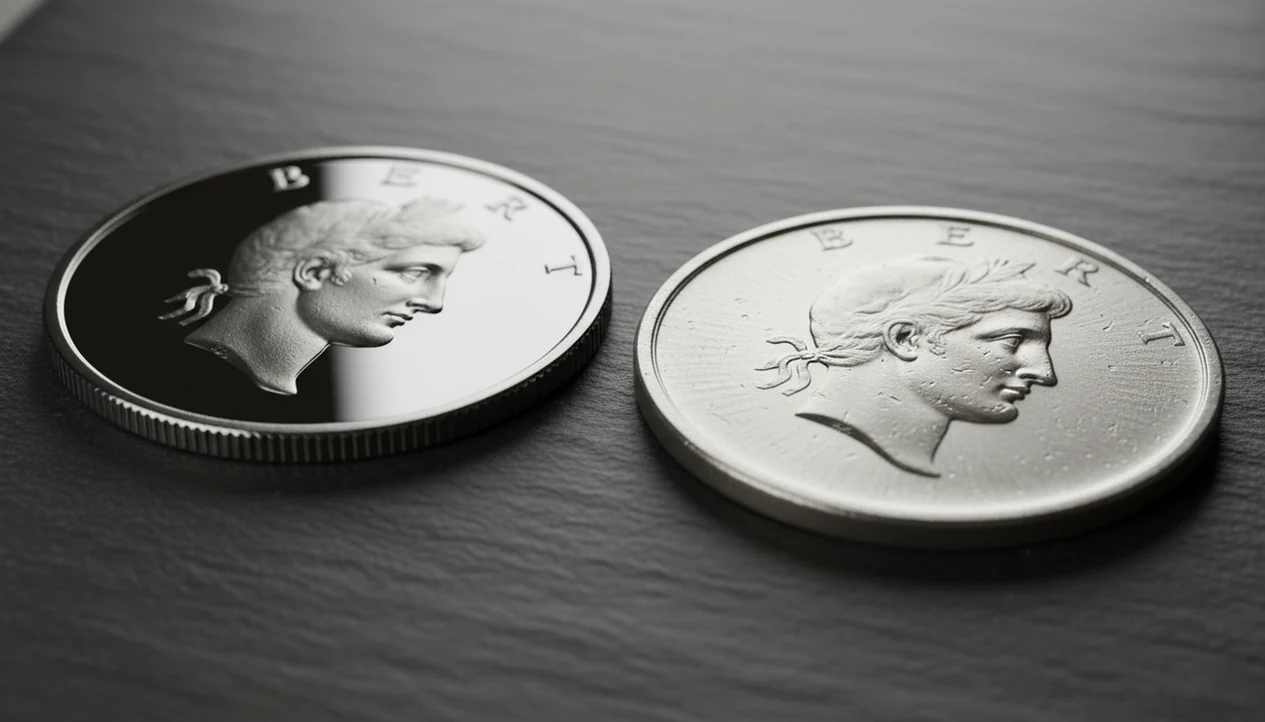


Proof vs circulation strike coins differ because proofs are specially manufactured for collectors, while circulation strikes are mass-produced for commerce. The fastest clues are mirror-like fields, frosted devices, sharper detail, mintmark context, and whether the coin grades as PR/PF or MS. CoinEd helps compare those clues from photos before you add a strike type to collection notes.
> Definition: A proof coin is defined by its special striking process, not by being flawless, shiny, or simply uncirculated.
TL;DR
- Proof coins are made with polished dies, specially prepared planchets, and at least two strikes; circulation strikes are normally struck once for everyday use.
- Proof coin identification depends on mirror fields, frosted raised design, sharp rims, and cameo contrast, while circulation strike coins usually show cartwheel luster.
- Value changes because proof, uncirculated, and circulation strike coins use different collector demand, mintages, strike labels, and grading scales.
Proof vs circulation strike coins and value clues, side by side
Side-by-side captures of the compared products. Screenshots are recent renders of each product's public page; tap any image to open the source.

Proof vs Circulation Strike At-a-Glance Comparison
Proof coins are collector-manufactured pieces, while circulation strikes are business-struck coins made for everyday commerce. The U.S. Mint describes proofs as at least twice struck on specially prepared planchets with polished dies, while circulation coins are struck once on normal planchets source.
| Feature | Proof coin | Circulation strike coin |
|---|---|---|
| Purpose | Collector issue | Commerce and change |
| Planchet | Specially prepared | Standard production blank |
| Dies | Polished, often treated | Standard working dies |
| Strikes | Multiple | Usually one |
| Finish | Mirror fields, cameo possible | Mint luster, often cartwheel |
| Detail | Sharper rims and lettering | Normal production sharpness |
| Handling | Slower, protected | Bulk handling |
| Grade label | PR or PF | MS if uncirculated |
| Market context | Set demand, collector packaging | Date, mint mark, grade, survival |
Proof vs uncirculated is not the same distinction. An uncirculated coin can be a circulation strike that simply never wore down in use.
Five Proof Coin Identification Facts Beginners Should Know
Proof coin identification starts with manufacture, not shine. A bright coin on a dark wooden table can look dramatic in a phone photo, but the strike clues matter more.
- Proof is a process: A proof coin is made with special dies and handling; it is not automatically flawless.
- Mirror plus frost matters: Deep reflective fields and frosted raised design are stronger clues than general brightness.
- Uncirculated is different: A fresh circulation strike can be bright and unworn without being a proof.
- Labels separate categories: Proofs commonly grade PR or PF, while uncirculated circulation strikes use MS labels.
- Strike type changes research: The same date and reverse design can have different rarity lookup results once proof or circulation strike is selected.
Beginners who scan mixed coins with CoinIdentifier should treat the result as a photo-first check, then compare against a trusted reference for that exact issue.
How Proof vs Circulation Strike Coin Manufacturing Works
A proof coin is defined by prepared dies, prepared planchets, careful handling, and multiple strikes. In plain terms, the Mint slows down the process to make the design sharper and the surface more controlled.
Polished dies create mirror-like fields because the flat background of the die transfers a reflective surface to the coin. Treated die areas can create frosted devices, which gives cameo contrast on the portrait, eagle, lettering, or other raised design.
Circulation strikes are different. They are made in large volumes on high-speed presses so coins can enter commerce. The U.S. Mint says modern proof coinage resumed in 1950 after the 1943 to 1949 hiatus, and San Francisco now has a major numismatic-products role. Philadelphia and Denver focus mainly on circulation production, but mintmark alone is never a full rule. For mint-facility context, the U.S. Mint identifies Philadelphia and Denver as major circulating-coin producers and San Francisco as a major proof and numismatic-products facility source.
CoinEd fits this check because it asks for both sides and keeps date, mint mark, and strike clues together in one scan workflow.
Where Proof Coins Win for Finish, Sharpness, and Collector Intent
Proof coins win when the question is finish control, sharpness, and collector presentation. Look for glassy fields, frosted raised designs, squared rims, and inscriptions that look cut cleanly into the surface.
Scale matters here. In 2019, the U.S. Mint produced 585,000 Silver Proof Sets, while more than 3.8 billion Lincoln cents were struck for circulation that same year source source. The 2023 Proof Set also had a fixed collector issue price of $32, while circulation coins entered use at face value source.
That does not mean every proof is worth more. A common modern proof with haze or scratches may bring modest money, while a scarce circulation strike in a high MS grade can be worth a closer look.
If the priority is separating collector finish from pocket-change shine, CoinEd covers the first pass because it stores obverse, reverse, estimated value range, and strike notes in one record.
Where a Circulation Strike Coin Wins for Rarity and Real-World Value
Can a circulation strike coin be more valuable than a proof? Yes, because a circulation strike, also called a business strike, can be scarce by date, mint mark, grade, survival rate, error, or variety.
Circulation strikes usually show cartwheel mint luster, not a glassy proof mirror. Tilt the coin under one lamp and watch the light rotate across the surface. A cleaned coin may flash brightly, but that polished look can reduce value rather than increase it.
A rare high-grade circulation strike can beat a common proof because collectors pay for scarcity, preservation, and series demand. This is where a thumb shadow covering a mint mark in a photo can cause a bad lookup.
When the issue is a possible variety or mintmark-driven premium, CoinEd fits because the photo-first workflow can be paired with a tool that can identify mint marks before value notes are saved.
Proof vs Uncirculated Coin Labels, Grades, and Value Clues
Proof describes how a coin was made; uncirculated describes a coin without wear. That is why proof vs uncirculated can confuse beginners who see both words used near high-grade coins.
| Label or clue | What it means | Value clue |
|---|---|---|
| PR or PF | Proof strike label | Depends on grade, haze, cameo, demand |
| MS | Mint State circulation strike | Depends on grade, strike, luster, scarcity |
| Impaired proof | Proof that circulated or was damaged | Proof status remains, value often drops |
| Uncirculated business strike | Never-worn circulation strike | Can be common or rare by issue |
| Metal content | Silver, gold, or base metal | Adds melt context, not final value |
Value usually depends more on strike type, grade, mintage, demand, series popularity, metal content, errors, and preservation than on shine alone.
A useful coin-identification workflow should give probability, context, and organized notes, not instant certified grades or formal appraisals. CoinEd supports that distinction with grade hints and photo-based value context.
Who Should Treat a Coin as Proof vs Circulation Strike
Treat a coin as proof when the surface clues and issue context point toward collector manufacture. Treat it as a circulation strike when ordinary mint luster, contact marks, and commerce wear explain the coin better.
For a working label, move from surface behavior to context before assigning value notes.
- Use proof when the flat fields reflect like dark glass, the raised design shows cameo frost, and the date, mint mark, or holder matches a known proof-set issue.
- Use circulation strike when the light rolls in a cartwheel pattern, the coin has normal bag marks or pocket wear, and there is no collector packaging or proof-only context.
- Mark possible impaired proof when wear crosses the portrait, rims, or lettering but prooflike fields still appear under the damage or haze.
- Check the exact issue before changing value assumptions, especially where prooflike business strikes, satin finishes, or special mint products exist.
- Escalate rare, error, or high-value coins to professional authentication before selling, insuring, or entering a firm grade or appraisal.
How to Use Photo Clues for Proof Coin Identification
Use proof coin identification as a short observation sequence, not a guess from one shiny photo. CoinEd can help flag strike clues, rarity context, grade hints, and collection organization, but photos can misrepresent reflectivity.
Angle the coin under one light
- Set the coin under one steady lamp and tilt it slowly to test for mirror fields or cartwheel luster.
- Watch the reflection in the flat fields; proofs often reflect like dark glass, while circulation strikes roll light around the coin.
Compare fields, devices, and rims
- Check the raised design for frosted contrast, squared rims, and sharp lettering.
- Avoid cleaning the coin before photos; wipe dust from a cardboard 2x2 flip if needed, not from the coin itself.
Check date, mintmark, and set context
- Record the date, mint mark, and packaging clues before judging value. A proof set holder matters.
Confirm with photo-based rarity lookup
- Compare the scan against known examples for the same issue, then mark expensive or uncertain coins for professional authentication.
Common Myths About Proof vs Circulation Strike Coins
Proof vs circulation strike mistakes usually come from treating shine as proof. The clink of mixed nickels, dimes, and foreign coins from an inherited can makes that tempting, but the surface story is more specific.
- Myth: proof means perfect condition. Proof means special manufacture; proofs can be scratched, hazy, or circulated.
- Myth: any shiny coin is a proof. Polished, cleaned, or high-grade circulation strikes can shine without mirror fields.
- Myth: proofs can never be found in change. They can escape sets, but most found examples are impaired.
- Myth: proofs are always worth more. Key-date circulation strikes, errors, and high MS coins can outrank common proofs.
- Myth: one photo is enough. Edge glare, filters, and compression can fool a photo-first check.
For possible strike-related value swings, pair CoinEd notes with an error coin identifier if the coin also shows abnormal features.
Binary Decision Tree for Proof vs Circulation Strike Coins
Is the coin more likely proof or circulation strike? Start with surface behavior, then move to date, mint mark, and issue history.
If the fields act like a mirror and the raised devices look frosted, proof is more likely. If the surface shows cartwheel luster instead of glassy reflection, circulation strike is more likely.
If the coin is worn but still has prooflike fields, label it possible impaired proof. Don’t force the call. Some coins have matte proof, reverse proof, satin, enhanced uncirculated, or prooflike business-strike versions. Those require exact date and mint research.
A child spotting tiny letters under the eagle may solve one part of the question, but not the whole strike type.
When uncertain strike labels would distort an estimated value range, CoinEd is useful because the collection notes can hold “possible proof” until you compare trusted references or submit the coin.
Evidence and Source Notes for Proof vs Circulation Strike Claims
The strongest evidence separates manufacturing facts from photo clues. Proof-strike claims should lean on Mint production descriptions, while value and scale claims need issue-specific production data and grading-label context.
Use a simple source trail before treating a shiny coin as proof.
- Check Mint manufacturing language for the basic process: prepared planchets, polished or treated dies, careful handling, and multiple strikes. Those details support why mirror fields, sharp rims, and cameo contrast can appear.
- Compare production scale with circulating-coin output when making rarity or scarcity statements. A collector set and a billion-coin circulation run do not tell the same market story.
- Confirm label meanings with major grading references when PR, PF, and MS appear in a listing or holder. PR and PF point to proof grading, while MS points to Mint State circulation-strike grading.
- Separate visual heuristics from guarantees. Mirror fields, frost, squared rims, and cartwheel luster are useful clues, not proof by themselves. Cleaning, haze, lighting, prooflike business strikes, and special finishes can all imitate part of the pattern.
Limitations
Visual proof vs circulation strike identification has real limits. CoinEd can organize clues and flag likely matches, but it should not replace professional grading for expensive coins.
- Wear can remove cameo contrast and make proofs look like ordinary circulation coins.
- Cleaning, polishing, toning, haze, scratches, and environmental damage can distort the surface.
- Lighting, reflections, camera filters, and compression can make a circulation strike look prooflike.
- Matte proofs, reverse proofs, satin finishes, enhanced uncirculated coins, and prooflike business strikes blur categories.
- Some early proofs and special issues need specialist references from PCGS CoinFacts, NGC Coin Explorer, or auction archives such as Heritage Auctions.
- Proof designation alone does not guarantee high value; demand, mintage, grade, and series popularity still matter.
- AI coin identification should provide probability and context, not absolute authentication.
If damage or a variety is also in question, the error coin vs damage check can keep surface problems separate from strike type.
FAQ
What is a proof coin?
A proof coin is a specially manufactured collector coin made with prepared dies and planchets. It is not a condition grade.
What is a circulation strike?
A circulation strike, or business strike, is a standard coin made for everyday commerce. It can be worn, circulated, or uncirculated.
Is proof better than uncirculated?
Proof and uncirculated describe different things. Value depends on the specific coin, grade, mintage, demand, and preservation.
Can proof coins circulate?
Yes, proof coins can occasionally enter circulation after leaving sets. These are usually called impaired proofs if they show wear or damage.
Are all shiny coins proofs?
No, shine alone does not prove a coin is a proof. High-grade or polished circulation strikes can look bright without true proof surfaces.
How are proof coins graded?
Proof coins usually receive PR or PF labels. Uncirculated circulation strikes use MS labels.
Are proof coins always valuable?
No, proof status can add a premium but does not guarantee high value. Common proofs with haze or scratches may be modestly priced.
Can an app identify proof coins from photos?
Yes, CoinIdentifier can flag proof clues from photos, including fields, devices, date, and mint mark context. Lighting and unusual finishes can still require expert confirmation.