
App That Identifies Old Coins And Explains Next Steps
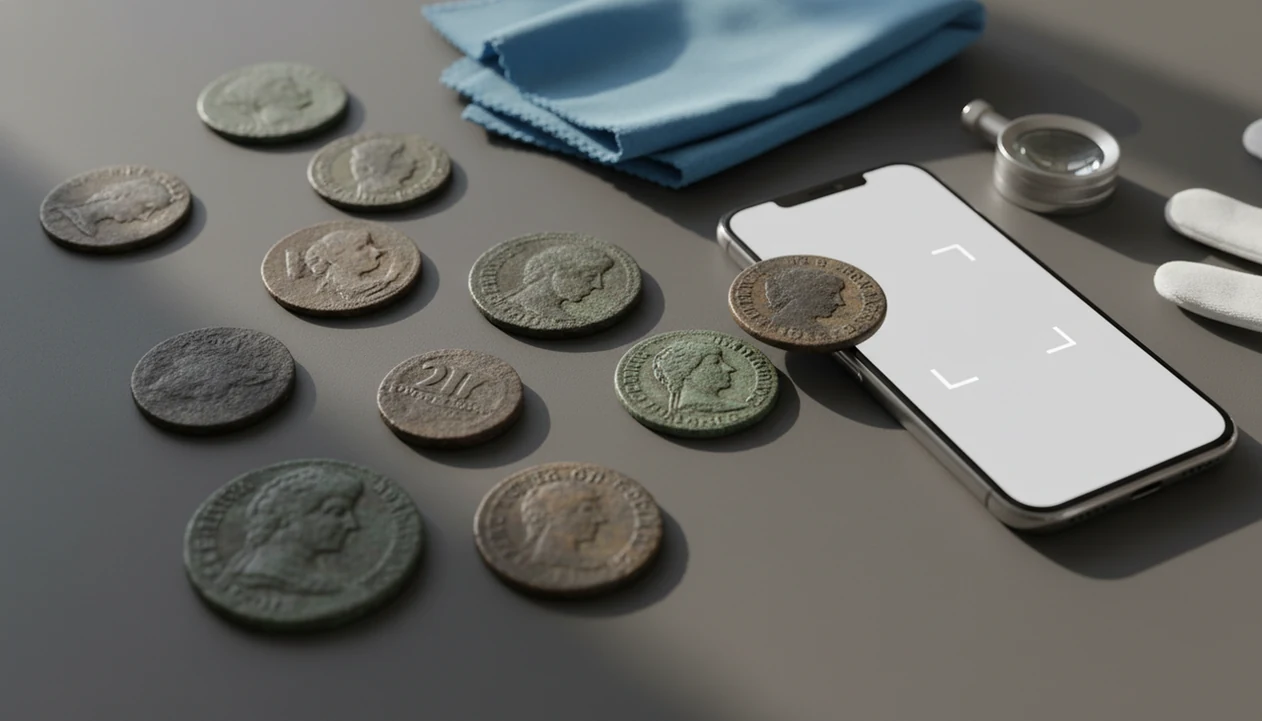


Yes, an app that identifies old coins can quickly narrow a coin’s country, type, date, mint mark, metal clues, rarity signals, and estimated value range from photos. Use it as a triage tool, not a final appraisal, especially for worn, cleaned, suspicious, or potentially valuable coins.
> Use a photo-based old coin identifier app to narrow the likely country, type, date, mint mark, rarity signals, and value range before you clean, sell, or grade the coin.
- Scan both sides of the old coin in clear light before making any decision about cleaning, selling, or grading.
- Treat app value estimates as ranges, because wear, rarity, demand, and authentication can change the real market price.
- If the app flags a rare, high-value, error, or suspicious coin, get expert review from a reputable dealer or third-party grader.
How these apps look
Side-by-side captures of the compared products. Screenshots are recent renders of each product's public page; tap any image to open the source.
What an app that identifies old coins can tell you
An old coin identifier app can usually suggest a coin’s country, denomination, date, mint mark, type, metal clues, and broad value range from photos. It is a photo-first check, not a certified opinion.
The practical use is triage. Before you clean, sell, store, insure, or mail a coin for review, the app helps you decide whether the piece is a common circulation find or worth a closer look. A beginner may turn over a wheat cent under a kitchen light and finally notice the tiny mint mark under the date.
Most scanned coins will be common. The U.S. Mint reports that it produces billions of circulating coins in many years, including over 13.1 billion in fiscal year 2022. source For beginners, a photo-based app is often easier than starting with a printed catalog because it narrows the search before you compare against a trusted reference.
At-a-glance old coin identifier app decision guide
Use the app result as a sorting decision, then choose the next careful step. Dirty, worn, corroded, off-center, or one-sided photos can push an app toward the wrong match.
| App result | What it may mean | Next step |
|---|---|---|
| Common match | The coin fits a familiar type and date range | Save the result and add collection notes |
| Uncertain match | The photo, wear, or design is unclear | Rescan both sides in better light |
| High-value estimate | The coin may have date, mint, grade, or metal interest | Handle by the edge and seek review |
| Possible error coin | The app sees unusual strike or design clues | Photograph the suspected error close up |
| Possible counterfeit | Weight, design, or surface clues may conflict | Do not sell as genuine without authentication |
| No match | The coin may be obscure, damaged, token-like, or poorly photographed | Try a new scan and compare references |
A close-up of reeded coin edges can help with denomination and metal clues. The wider photo still matters.
Before You Scan an Old Coin
Before you scan an old coin, set up the coin, the light, and your notes so the app sees the coin as it really is. The goal is a clear record, not a nicer-looking surface.
- Wash and dry your hands before touching loose coins, then work over a soft, clean area in case one slips.
- Prepare a plain white, gray, or non-reflective background with indirect light, and keep the phone steady above the coin instead of shooting at a steep angle.
- Leave toning, dirt, tape residue, old holder marks, and cloudy surfaces alone; do not rub or “improve” the coin for the camera.
- Set aside anything that looks unusually sharp, silver, gold-colored, ancient, error-like, or high value, and handle those pieces only by the edge.
- Record where the coin came from before scanning or storing it, such as an inherited jar, dealer purchase, estate lot, travel find, or old album page.
Those small details can matter later. Provenance notes, original holders, and even an unattractive surface may help explain the coin’s history and value.
How an app that identifies old coins works from photos
An app that identifies old coins works by capturing images, cleaning up the visual input, matching features, comparing references, and assigning confidence scores. In plain terms, the app looks for patterns it has seen before.
The process often starts with image preprocessing, which adjusts crop, contrast, orientation, and glare. Then visual feature matching compares the obverse and reverse design against large coin image and reference datasets. A profile, ruler portrait, eagle, shield, wheat ears, or foreign script can narrow the country and type before the app reads date and mint mark clues.
After identification, the app may show rarity notes and an estimated value range. That range can use catalogs, recent market data, metal content, and condition assumptions. Treat those results as structured research clues: a likely match, a confidence level, a value range, and prompts for what to check next.
How to use an old coin identifier app for cleaner scans
Cleaner scans come from steady photos, not from changing the coin. If you need the longer photo workflow, our guide on how to scan both sides of a coin covers the same basic habits in more detail.
- Place the coin on a plain, non-reflective background.
- Photograph the obverse in indirect light without glare.
- Photograph the reverse at the same distance and angle.
- Zoom in on date, mint mark, lettering, and unusual marks when prompted.
- Save the result with notes, provenance, purchase price, and certification details if known.
A dark wooden table can make copper cents look redder than they are. Use white paper, gray card, or a soft cloth instead. Tools like CoinEd can help organize the scan, but the first job is still a clean, honest photo.
Step 1: Scan old coins without cleaning the surface
Should you clean an old coin before scanning it? No. Do not clean, polish, rub, soak, scrape, or brighten an old coin to improve an app scan.
Cleaning can permanently alter surfaces, remove natural toning, create fine hairlines, and reduce collector value. The American Numismatic Association warns that improper cleaning is one of the common ways collectors damage coins and reduce value source. Wiping dust from a cardboard 2x2 flip is fine; wiping the coin itself is not.
Handle old coins by the edge. After scanning, place them in an inert flip, capsule, or album slot if available. If dirt hides every detail, photograph the coin as found and ask a dealer before doing anything else. Leave the surface alone.
Step 2: Check old coin app results against date and mint mark clues
Five checks can confirm whether the old coin app result matches the actual coin in your hand. Start with the obverse, then turn to the reverse design.
- Country check: Visible lettering, ruler names, symbols, and language should agree with the app’s country result.
- Denomination check: The stated value, size, edge, and metal clues should fit the matched type.
- Date check: A single wrong digit can move a coin from common to key date.
- Mint mark check: A worn mint mark, missing mint mark, or thumb shadow can change the match.
- Design check: Old, antique, foreign, and commemorative coins often have lookalike varieties.
If the app says one thing and the coin says another, rescan both sides. A Philadelphia coin with no mint mark, for example, should not be forced into a mint-marked listing. For foreign pieces, the question of what app identifies foreign coins often depends on readable script and complete reverse images.
Step 3: Treat antique coin app value ranges as estimates
Antique coin app values are estimates, not binding offers, formal appraisals, or sale guarantees. Save a conservative low-to-high range instead of one exciting number.
Real value depends on grade, wear, cleaning, rarity, metal content, collector demand, and recent sales. A coin with strong detail but old cleaning can sell differently from an untouched coin with the same date. “Is this silver or just old?” comes up often with 1964 dimes and quarters, and the answer changes the value conversation quickly.
The U.S. coin-collecting market was estimated at about $4.8 billion in annual retail sales in the early 2010s, according to a U.S. Mint market study. That demand explains why valuation tools matter. For collection tracking, a coin value app can store the estimate beside condition notes, purchase price, and later sale research.
Step 4: Send valuable old coin identifier app matches for expert review
Send an app match for expert review when the result affects trust, sale price, or authenticity. Professional review matters most when the coin is rare, valuable, suspicious, or hard to classify.
- High estimated value: A large app estimate should be checked before selling.
- Rare date or mint mark: Key-date clues deserve comparison against trusted references.
- Possible error coin: Off-center strikes, doubled lettering, and wrong-planchet claims need closer inspection.
- Ancient coin or suspected counterfeit: Image matching cannot confirm metal, weight, tooling, or casting.
- Conflicting app results: Two different matches usually mean the photo or reference fit is weak.
PCGS reports grading more than 52 million coins with declared value exceeding $49.3 billion source. NGC states it has certified over 60 million coins, tokens, and medals worldwide source. PCGS and NGC certification are especially important for serious sales and authentication.
Common myths about apps that scan old coins
Apps that scan old coins are useful, but several myths lead to bad decisions. The safest habit is to treat the scan as an informed starting point.
- Myth: an app gives a precise sale price. It gives an estimated value range based on available references and assumptions.
- Myth: a recognized coin is automatically authentic. A correct type match does not prove the coin is genuine.
- Myth: cleaning improves value or identification. Cleaning can damage surfaces and lower value.
- Myth: one scan is enough to judge grade and rarity. Grade, luster, marks, and tiny varieties need closer checking.
- Myth: every old coin is rare because it is old. Many older coins were made in large numbers and remain common.
We have seen inherited lots where foreign coins clinked from a biscuit tin beside U.S. nickels and dimes. Age alone did not sort the pile.
Limitations
An identify antique coin app can narrow possibilities, but some coins need human review. These are the main limits to keep in mind.
- Heavily worn, corroded, bent, holed, clipped, off-center, or damaged coins can be misidentified.
- Poor lighting, glare, shadows, tilted angles, cropped photos, and one-sided scans reduce accuracy.
- Counterfeits, alterations, tooling, artificial toning, and cleaning may not be detected from images alone.
- Value estimates can lag market changes and may not reflect local demand, auction fees, dealer margins, or exact grade.
- Coverage may be weaker for obscure regional, ancient, token, medal, and low-mintage issues.
- Privacy and data-security policies matter when storing images, values, locations, and collection records.
- Subscription pricing, scan limits, and feature gates may affect how useful a free app is.
CoinIdentifier can help with photo-first sorting, but it is not a replacement for specialist authentication. For beginners, how to identify coins with phone is usually the right next skill to learn.
FAQ
Is there an app for old coins?
Yes, photo-based apps can identify and organize old coins by comparing both sides with reference images. CoinEd is one option for saving scans, notes, and estimated value ranges.
Can an app value old coins?
An app can estimate a value range, but it cannot guarantee a sale price. Grade, cleaning, rarity, demand, and authentication can change the final result.
Should I clean old coins first?
No, do not clean old coins before scanning or professional review. Cleaning can damage surfaces and reduce value.
Can apps detect fake coins?
Apps may flag suspicious visual clues, but they cannot reliably authenticate counterfeits from photos alone. Valuable or suspicious coins should be reviewed by a reputable expert.
Do coin apps identify mint marks?
Coin apps can often identify mint marks when photos are sharp and well lit. Wear, glare, shadows, and cropped images can cause errors.
Are free coin scanner apps accurate?
Free coin scanner apps vary in accuracy. Results depend on image quality, database coverage, coin condition, and whether both sides are scanned.
What photos do coin apps need?
Coin apps need clear photos of the obverse and reverse on a plain background. Indirect light, steady framing, and close-ups of date and mint mark help accuracy.
When should I grade a coin?
Consider professional grading when a coin appears rare, valuable, suspicious, or intended for serious sale. App results are useful triage, not a formal appraisal.