
Clipped Planchet Coin Guide For Error Identification
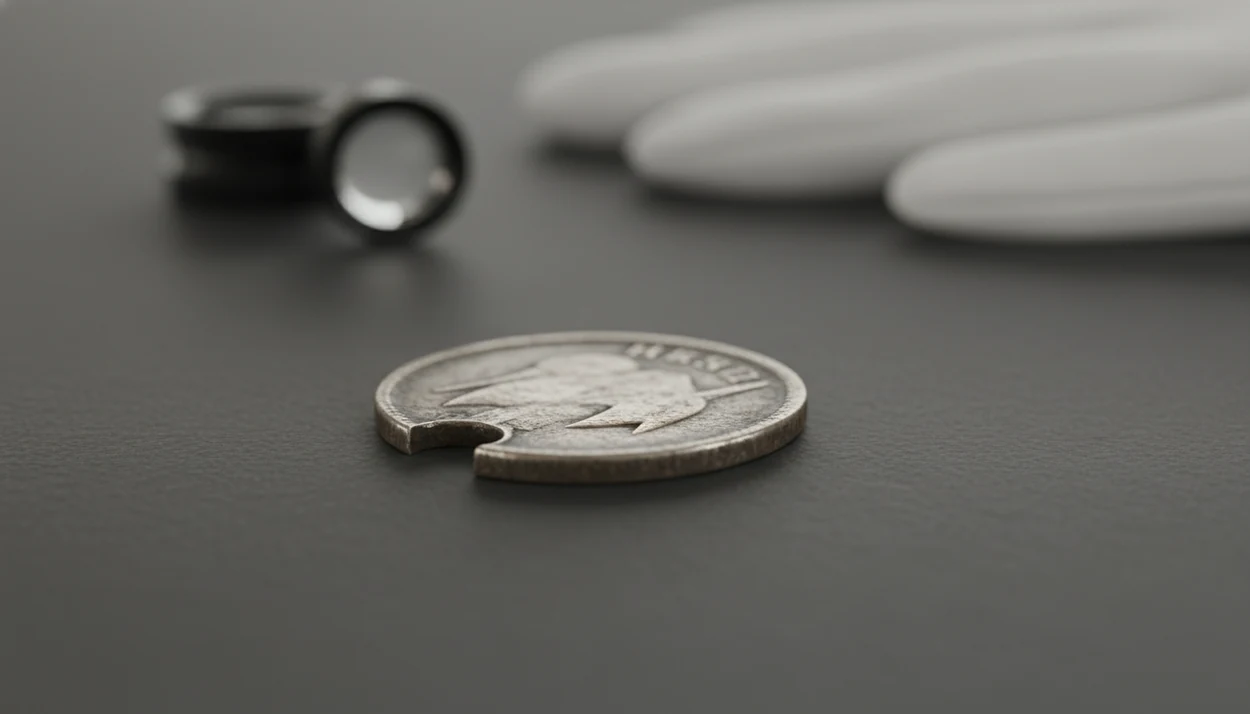


A clipped planchet coin guide helps you decide whether a coin’s missing edge is a real mint error or ordinary post-mint damage. The key checks are clip shape, rim weakness opposite the clip, stretched nearby design, and natural metal flow.
Definition: A clipped planchet error is a coin struck on a blank that was improperly punched from a metal strip, leaving part of the planchet missing before the coin was struck.
TL;DR
- Real clipped coin errors usually show mint-made clues such as a curved or straight missing section, weak rim opposite the clip, and stretched design near the missing edge.
- Post-mint cuts, grinding, corrosion, and vise damage often lack the Blakesley Effect and usually show sharp tool marks or disturbed surfaces.
- Clipped coin value depends on clip size, visibility, coin type, date, mintmark, condition, and whether the error is dramatic enough to attract specialist demand.
Clipped Planchet Coin Error Definition And 5 Facts
- A clipped planchet error happens before striking, when the blank already has missing metal; it is not a chip created after years in circulation.
- Curved clips, straight clips, ragged clips, and incomplete clips can all be legitimate forms, but each needs different diagnostics.
- Genuine planchet clips can appear on pennies, nickels, dimes, quarters, half dollars, dollar coins, and world coins.
- Not every coin with a missing chunk is valuable. A common cent with a tiny questionable bite may be worth only a closer look, not a grading fee.
- High-volume minting makes rare errors possible even with strict quality control; the U.S. Mint reported producing about 14.5 billion circulating coins in fiscal year 2023 (U.S. Mint FY 2023 Annual Report: https://www.usmint.gov/about/reports/annual-report).
A beginner usually notices the shape first. We often see a penny turned under a kitchen light, with the owner checking the date and mint mark before asking if the edge is “supposed to look bitten.”
Planchet Clip Formation At The Mint
Stat callout: When billions of coins are produced, a very small failure rate can still leave real mint errors in circulation.
How clipped planchets work: coinage metal is rolled into strip, blanks are punched from that strip, rims are raised in an upsetting mill, and the planchets are struck between dies. If a blank punch overlaps a hole already cut in the strip, the next blank can leave with a crescent-shaped missing area. That creates a curved clip.
Straight clips usually come from strip-end problems or feed misalignment. Ragged clips may appear when the strip edge is irregular or the blanking process catches metal poorly. The missing metal then affects the upsetting and strike. Less metal reaches one side of the coin, so the rim and design may look weak or stretched.
That little absence matters.
A clipped planchet is often easier to understand once you picture the blank before the design existed.
Before You Check A Clipped Planchet Coin
Before you judge a suspected clipped planchet, set up the coin so the clues are visible and repeatable. A few careful minutes before inspection can prevent bad calls caused by glare, shadows, fingerprints, or missing notes.
- Set up even lighting on a clean, plain background, then keep your phone stable rather than chasing the coin by hand. A small stack of books or a simple stand is better than a shaky close-up.
- Use a 5x to 10x loupe for the rim and edge. The missing area matters, but the opposite rim and nearby metal flow often tell the stronger story.
- Handle the coin only by the edge, and do not clean, rub, dip, or polish the surface. Cleaning can erase the same texture you need for a damage check.
- Record the date, mintmark, denomination, weight if you can measure it, and the clip’s clock position, such as “near 3 o’clock.”
- Photograph the obverse, reverse, edge, and the rim opposite the clip before estimating value or asking for opinions.
Clipped Coin Error Checklist In 6 Steps
How to use a clipped coin error checklist:
- Photograph both sides clearly. Use the obverse, reverse, and edge, with the coin flat and the missing section in focus.
- Compare the missing area to known clip shapes. Look for curved, straight, ragged, or incomplete planchet clip forms.
- Rotate the coin 180 degrees from the clip. Check the opposite rim for the Blakesley Effect.
- Inspect nearby design details. Look at letters, the date, devices, and rim for stretching or natural metal flow.
- Rule out post-mint damage first. Tool cuts, grinding, and corrosion should be separated before discussing clipped coin value.
- Use expert review for serious coins. Dramatic clips, scarce dates, and uncertain examples deserve a specialist or grading-service opinion.
For broader sorting, our error coin identifier guide gives beginners a calm way to separate mint errors from ordinary circulation damage.
Step 1: Match The Planchet Clip Shape
A planchet clip shape is the first visible clue, but it should never be the only proof of a clipped coin error.
Curved clipped planchet
A curved clipped planchet has a crescent-shaped missing area caused by overlapping blank punches. On a clipped planchet penny, dime, or quarter, the missing arc should feel integrated into the strike, not like a fresh bite cut through finished metal.
Straight clipped planchet
A straight clipped planchet has a flatter missing edge, often linked to strip-end or feed problems. These can be harder for beginners because a clean tool cut may also look straight in a quick phone photo.
Ragged clipped planchet
A ragged clipped planchet has an irregular edge and needs extra caution. Examine the rim, nearby letters, and edge under magnification before calling it mint-made. A bubble mailer beside a coin flip is fine for shipping, but document the coin first.
Step 2: Check The Blakesley Effect Opposite The Clip
Does a real clipped coin need the Blakesley Effect? A genuine clipped planchet often shows the Blakesley Effect, which is a weak or flattened rim directly opposite the missing section.
For a technical reference, Error-Ref describes the Blakesley Effect as rim weakness opposite a clip caused by disrupted metal flow during planchet preparation and striking: https://www.error-ref.com/blakesley-effect/.
The effect comes from missing metal disrupting the upsetting process and later metal flow during striking. Rotate the coin 180 degrees from the clip and inspect the opposite rim. On a quarter, this means checking across the coin, not just beside the missing metal.
A weak Blakesley Effect does not automatically disprove a clip, especially on small clips or worn coins. Still, a cut coin generally will not create the correct opposite-rim weakness. If the edge looks sliced and the opposite rim is normal, slow down before assigning a premium.
For clipped planchets, the opposite rim is often more important than the missing edge because damage can remove metal, but it cannot recreate mint-stage metal flow.
Step 3: Separate A Clipped Coin Error From Damage
A genuine clipped coin error should show mint-made behavior, while post-mint damage usually shows disturbed metal, tool marks, or unnatural surfaces. Use magnification on the edge before estimating value.
| Feature to check | Genuine clipped planchet | Likely post-mint damage |
|---|---|---|
| Missing area | Curved, straight, or irregular but strike-integrated | Sharp cut, filed edge, gouge, or snapped surface |
| Opposite rim | May show Blakesley Effect | Usually normal unless separately damaged |
| Nearby design | Letters or devices may stretch toward the clip | Design may be abruptly removed or bent |
| Edge surface | Natural metal flow, not freshly exposed | Bright exposed metal, file lines, grinding, corrosion |
| Coin shape | May remain flat and struck normally | May show vise marks, bends, pressure scars |
The edge tells on itself.
If the case is not clear, compare it with the broader error coin vs damage process before treating it as a collectible error.
Clipped Coin Value Factors For Pennies, Dimes, And Quarters
Clipped coin value depends on demand, verification, and how obvious the error is, not just the fact that metal is missing.
- Clip size and visibility: Larger, clear clips usually attract more attention than tiny edge nicks.
- Date and mintmark: A scarce date or better mintmark can add interest, especially when the base coin is already collectible.
- Series and denomination: Pennies, dimes, and quarters all appear with clips, but demand varies by series.
- Grade and eye appeal: Clean surfaces, readable details, and a well-positioned clip matter.
- Comparable sales: Verified sales are more useful than asking prices, which can sit unsold for months.
Small clips on common modern coins usually bring modest premiums. Large, dramatic, well-centered clips can be more desirable, but the market is thin. For beginners, verified sale comparisons are often better than price-guide guesses because error buyers care about visual impact and authentication.
Sources Used For Clipped Planchet Diagnostics
The diagnostic method here relies on minting-process references for how blanks become struck coins, plus error-coin references for clip types and the Blakesley Effect. Those sources support the checklist, while the final call still depends on the coin in hand.
- Start with the U.S. Mint’s production descriptions: strip is prepared, blanks are punched, planchets are upset to form rims, and coins are struck between dies. That sequence explains why a pre-strike missing section can affect rim formation and metal flow.
- Compare the missing area with established error-coin categories, including curved, straight, ragged, and incomplete clips, rather than treating every bite-shaped gap as the same problem.
- Check the Blakesley Effect as strong supporting evidence, especially on larger clips where opposite-rim weakness should be easier to see.
- Separate consensus from judgment: experts broadly agree on blanking, upsetting, clip categories, and obvious tool damage, but small clips, worn rims, and poor photos still require experience.
- Use verified sold listings for value research. Asking prices are seller wishes; completed sales show what buyers actually accepted.
Photo Review For Planchet Clips
A photo review workflow can help flag likely curved or straight clip shapes, preserve the coin’s date and mintmark, and organize comparison notes before you ask a dealer, error specialist, or grading service for an opinion.
Take obverse, reverse, and edge photos. A phone camera hovering over a penny on a dark wooden table can make copper look redder than it is, so use even light and avoid heavy shadows. Save collection notes about the date and mint mark, clip location, opposite rim, and any visible stretching.
Good photo-first coin identifier and value estimation app for collectors and beginners should deliver a preliminary ID path and organized comparison notes, not guaranteed authentication or an instant certified grade.
CoinEd can support a photo-first check and keep suspected errors grouped with notes, but final calls on valuable clipped planchets belong with specialists. For broader photo workflows, an app that identifies coin errors can be useful as an early sorting tool.
Limitations
A clipped planchet diagnosis has real uncertainty, especially when the clip is small, worn, or photographed poorly.
- Some genuine clips may lack a strong Blakesley Effect, particularly if the missing area is minor.
- Some precise post-mint cuts can imitate a planchet clip in photos.
- Official clipped planchet error-rate statistics are not publicly published by major mints.
- AI review and human review can both misread weak metal-flow evidence.
- Value estimates can change because error-coin markets are thin and buyer interest varies.
- Corrosion, rim hits, and old tool damage can hide the original surface clues.
- Professional grading is the safer route for dramatic, valuable, or disputed coins.
Do not clean the coin before review. Wipe dust from a cardboard 2x2 flip if needed, but leave the coin surface alone.
FAQ
What is a clipped planchet?
A clipped planchet is a coin blank that had missing metal before it was struck by the dies. The finished coin shows a missing section because the planchet was incomplete at the mint.
Are clipped coins valuable?
Clipped coins can be valuable, but value depends on clip size, visibility, coin type, grade, date, mintmark, and collector demand. Small clips on common coins often bring only modest premiums.
What is the Blakesley Effect?
The Blakesley Effect is a weak or flattened rim opposite the clip on a genuine clipped planchet coin. It supports authentication because it relates to mint-stage metal flow and rim formation.
Can clipped coins be fake?
Yes, many apparent clipped coins are actually post-mint cuts, grinding, corrosion, or vise damage. These lookalikes usually lack correct metal flow and opposite-rim weakness.
How rare are clipped quarters?
Clipped quarters are collectible, but rarity depends on the date, clip size, condition, and whether the error is verified. A dramatic certified clip is usually more desirable than a tiny questionable edge loss.
Should I grade a clipped coin?
Professional grading makes sense for dramatic clips, scarce dates, high-grade coins, or examples you may sell. It is usually unnecessary for minor clips on common circulated coins.
Can an app identify clipped coins?
A photo-based coin app can provide a preliminary assessment of a suspected clipped coin by comparing shape, rim weakness, and surface clues. It cannot guarantee authentication or replace professional review for valuable errors.