
Half Dollar Identifier Guide For Franklin, Kennedy, And Walking Liberty Silver Coins
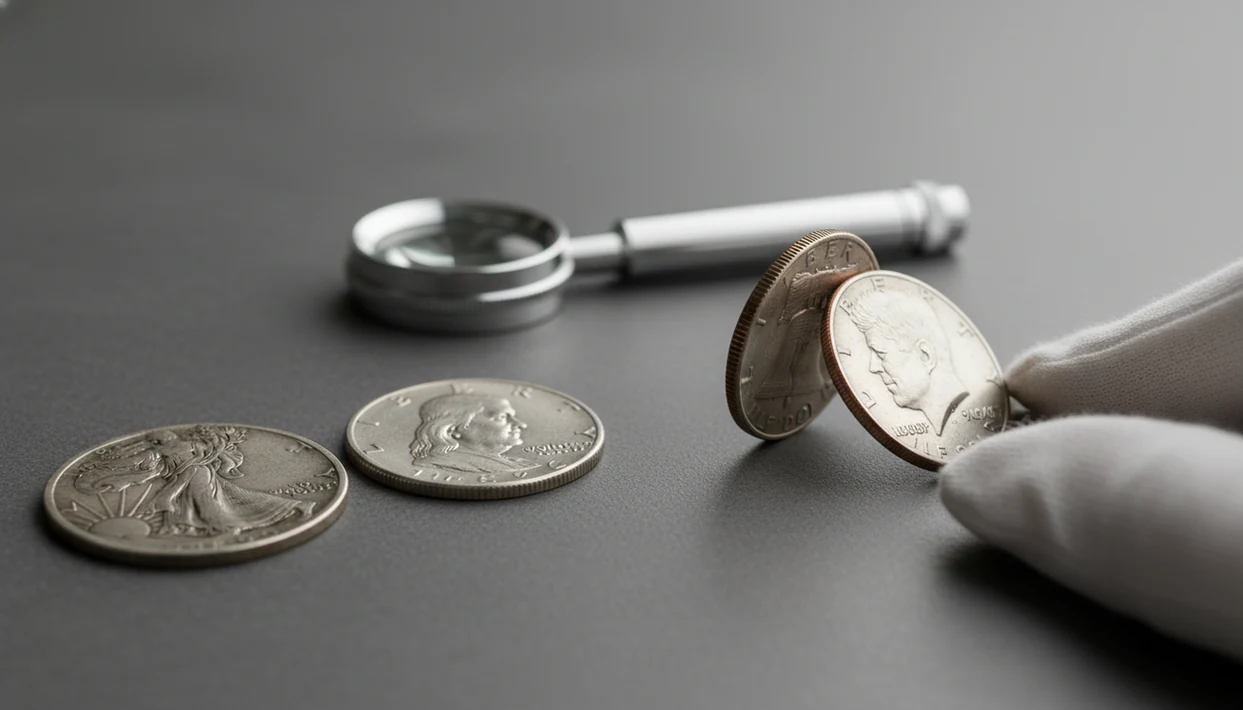


A half dollar identifier helps you match a U.S. half dollar to its design type, date, mint mark, silver content, and likely collectible category. Start with the date and portrait, then confirm the mint mark, edge color, weight clues, and condition before estimating value.
Definition: A half dollar identifier is a photo-first coin identification tool or checklist that helps determine a U.S. half dollar’s series, date, mint mark, metal content, rarity clues, and value context.
TL;DR
- Kennedy halves dated 1964 are 90% silver, 1965–1970 circulation Kennedy halves are 40% silver, and most 1971+ circulation halves are copper-nickel clad.
- Franklin half dollars run from 1948 to 1963, Walking Liberty half dollars run from 1916 to 1947, and Kennedy half dollars run from 1964 to the present.
- Date, mint mark, condition, edge color, and error clues matter more than age alone when identifying whether a half dollar is collectible.
Half Dollar Identifier Facts For Silver, Clad, And Collectible Coins
- Walking Liberty half dollars were made from 1916 to 1947 and show Liberty walking toward the sun, with an eagle on the reverse.
- Franklin half dollars were made from 1948 to 1963 and show Benjamin Franklin on the obverse, with the Liberty Bell on the reverse.
- Kennedy half dollars began in 1964; 1964 circulation coins are 90% silver, 1965–1970 circulation coins are 40% silver, and most 1971+ circulation coins are copper-nickel clad.
- Age alone does not make a half dollar rare. A worn common-date Franklin half may be worth mainly its silver value, while a sharper date-mint variety can be worth a closer look.
- Mint mark, date, condition, and variety checks drive value context. A photo-first check can sort the series quickly, but the result should be compared against a trusted reference database.
The first pass is simple: portrait, date, reverse design. The second pass is where many beginner mistakes happen.
How A Half Dollar Identifier Works
A half dollar identifier works by matching the coin’s visible design to known U.S. half dollar series, then narrowing the result with date, mint mark, and metal clues. It treats the portrait and reverse as the primary evidence, with edge color and weight used only as backup signals.
The process starts with visual classification, meaning the tool or checklist asks whether the coin looks like Walking Liberty, Franklin, or Kennedy. Date ranges then separate the main groups: 1916–1947 for Walking Liberty, 1948–1963 for Franklin, and 1964 onward for Kennedy. After that, the mint mark must be checked in the correct place for that series and year, because its location is not the same across all half dollars. Edge color can hint at silver or clad metal, and weight can support the call if a scale is available, but neither should overrule the date and design. If the result suggests a scarce date, unusual mint mark, major error, or high value, confirm it against grading-service images or sold auction records before trusting the estimate.
Before You Start A Half Dollar Lookup
Before you start a half dollar lookup, protect the coin and make the photo easy to read. A careful setup prevents false silver calls, missed mint marks, and avoidable surface damage.
- Handle the coin carefully with clean, dry hands, or hold it only by the edge. Fingerprints can leave marks, especially on brighter uncirculated or prooflike surfaces.
- Place the coin on a plain background that is not shiny. A white, gray, or matte black surface usually works better than wood grain, glass, foil, or a patterned towel.
- Photograph the whole coin so the full rim is visible. Take the obverse with the date, then a close view of the mint mark area if needed, and then the reverse.
- Leave the surface alone before identification. Do not clean, polish, rub, or test-scratch the coin, even if dirt or toning makes the details harder to see.
- Keep follow-up tools nearby only after the photo check. A small scale or magnet can help investigate odd pieces, but they are backup checks, not the starting point.
Coin Photo Clues Used By A Half Dollar Identifier
A photo-first half dollar identifier reads visible coin features, then compares them with reference data for series, date range, mint mark, metal content, mintage, and known varieties.
A good scan starts with the obverse, then the reverse. The identifier looks at the portrait, lettering, date, rim shape, reverse design, mint mark area, and edge color. Image-recognition systems use visual matching and feature extraction, which means the software turns details in the photo into comparable patterns. In plain terms, it asks, “What known half dollar looks most like this?”
Photo lookup tools can help match a half dollar image to a likely series and organize collection details for research. Still, confidence drops on coins with heavy wear, dark toning, rim dents, or off-center photos. Desk lamp glare across shiny copper-nickel can also hide the edge line. For broader denomination checks, a US coin identifier can help keep cents, nickels, dimes, quarters, and halves in one reference flow.
Silver Half Dollar Lookup Steps With A Half Dollar Identifier
Use a silver half dollar lookup as a sequence, not a single guess. The date gets you close, but the mint mark, edge, and condition decide what to research next.
- Photograph both sides in clear, even light, with the coin flat and the full rim visible.
- Read the date and compare it with the main silver ranges: Walking Liberty, Franklin, Kennedy 1964, and Kennedy 1965–1970.
- Locate the mint mark and inspect the edge for a solid silver look or a copper-colored clad stripe.
- Review condition and errors by checking high points, rim damage, doubling, missing clad layers, and rotated reverse alignment.
- Save the result in collection notes or a tracker, then research further if the date-mint pair or error clue looks unusual.
A good photo-first coin identifier and value estimation app for collectors and beginners gives structured clues and value context, not a guaranteed appraisal or certified grade.
Kennedy Half Identifier Rules For 1964, 1965–1970, And 1971+ Coins
All U.S. half dollars dated 1964 to the present are Kennedy half dollars. A Kennedy half identifier mainly separates 90% silver, 40% silver, and copper-nickel clad issues by date.
| Kennedy half dollar group | Circulation metal rule | Practical clue | Edge-color note |
|---|---|---|---|
| 1964 Kennedy half | 90% silver | First-year Kennedy issue | Often shows a mostly silver edge |
| 1965–1970 Kennedy half | 40% silver | Silver-clad era issue | May look gray, but less bright than 90% silver |
| 1971+ Kennedy half | Usually no silver in general circulation | Copper-nickel clad issue | Often shows a copper-colored center stripe |
According to the U.S. Mint's Kennedy half dollar history page (https://www.usmint.gov/learn/coin-and-medal-programs/circulating-coins/kennedy-half-dollar), 1964 Kennedy halves were struck in 90% silver and 1965–1970 circulation halves in 40% silver; PCGS CoinFacts lists the 1964 half at 0.36169 troy oz ASW and 1965–1970 halves at 0.1479 troy oz ASW (https://www.pcgs.com/coinfacts/category/kennedy-half-dollar-1964-date/12). The edge test is useful at a counter or sorting table, but it is not proof by itself. Plating, damage, and toning can confuse the eye.
Franklin Half Dollar Identification Clues From 1948 To 1963
How do you identify a Franklin half dollar? A Franklin half dollar has Benjamin Franklin on the obverse, the Liberty Bell on the reverse, and a date from 1948 through 1963.
Mint marks matter on Franklin halves. Many Philadelphia issues have no mint mark, while Denver and San Francisco pieces show their letters in the reverse area above the Liberty Bell. The exact date-mint combination can affect demand, especially when the coin is sharply struck.
Condition matters too. Collectors look at Franklin’s cheek, hair detail, the bell surface, and the horizontal bell lines. Full bell line detail can add interest, but most circulated examples are still common silver coins. We often see beginners wipe dust from a cardboard 2x2 flip before checking the date. That’s fine. Don’t clean the coin itself.
Walking Liberty Half Dollar Identifier Clues For Older Silver Halves
How do you identify a Walking Liberty half dollar? A Walking Liberty half shows Liberty striding toward the sun on the obverse, an eagle on the reverse, and a date from 1916 through 1947.
These coins can be harder to identify than Kennedy or Franklin halves because many circulated examples are heavily worn. Dates may be faint. Mint marks can be small. Weak strikes also make feather, skirt, and branch details look flatter than expected.
A worn Walking Liberty half is still a silver half dollar, but key dates and higher grades can be more collectible. For older halves with weak details, compare the photo against a reference image or use an app-based lookup. A coin centered inside a cardboard flip usually scans better than one held between fingertips. For smaller silver coin comparisons, a dime identifier app is useful when a mixed lot includes Mercury or Roosevelt dimes.
Silver Half Dollar Lookup Table By Series, Date, And Edge Color
A silver half dollar lookup works fastest when the series, date, design, and edge are checked together. The edge is a helpful clue, but date and type should carry more weight.
| Series or type | Date range | Likely silver content | Main design clue | Edge clue |
|---|---|---|---|---|
| Walking Liberty | 1916–1947 | 90% silver | Liberty walking toward sun | Usually solid silver-gray |
| Franklin | 1948–1963 | 90% silver | Franklin and Liberty Bell | Usually solid silver-gray |
| Kennedy 1964 | 1964 | 90% silver | Kennedy portrait | Usually solid silver-gray |
| Kennedy 1965–1970 | 1965–1970 | 40% silver | Kennedy portrait | Often gray, sometimes mixed-looking |
| Kennedy 1971+ | 1971–present | Usually clad | Kennedy portrait | Often copper stripe visible |
Proofs, silver collector products, and special mint issues can differ from ordinary circulation coins. Edge color can also be altered by plating, toning, or damage. Quietly annoying, but true.
Mint Mark, Condition, And Error Clues In A Half Dollar Identifier
After the main type is identified, the value check moves to mint mark, grade, and possible error clues. These details explain why two half dollars with the same design can sell very differently.
- Mint marks: No mint mark, D, S, and later P marks can identify the mint facility, depending on the series and year. Always check the correct location for that design.
- Condition: Wear on Franklin’s cheek, Liberty’s body, Kennedy’s hair, rims, and reverse high points can change the estimated value range dramatically.
- Varieties: Doubled dies, repunched details on older issues, and recognized die varieties need comparison against specialist references.
- Errors: Missing clad layers, rotated dies, off-center strikes, and broadstrikes can be collectible when they are true mint errors.
- Damage: Scratches, heat exposure, polishing, holes, and chemical color often look unusual but are post-mint damage.
If an error looks valuable, compare it with an error coin identifier, grading-service examples, and sold auction records before assuming it is rare.
Bad Half Dollar Value Estimates From Identifier Mistakes
Bad half dollar value estimates usually come from treating one clue as the whole answer. The most common mistake is assuming every Kennedy half is silver, even though most 1971+ circulation examples are copper-nickel clad.
Another mistake is treating age as rarity. A 1940s or 1950s half dollar can be silver and still common in circulated condition. The date-mint pair, grade, eye appeal, and demand all matter.
App estimates can also run high when the photo hides wear. Phone photos taken on a dark wooden table can make copper-nickel halves look warmer, and copper cents look redder than they are. Damage adds another trap. A scraped rim, stained surface, or flattened design may look like an error at first glance. Use several evidence points: date, mint mark, metal content, condition, and recent sold-price context.
Half Dollar Verification Checklist Before Selling Or Grading
Before selling or paying for grading, verify the coin the same way a careful collector would. Confirm the series, date, mint mark, metal content, and approximate grade before you attach a value claim.
Check bullion value separately from collectible premium. A common 90% silver Franklin half may trade largely on silver content, while a scarce variety or high-grade piece may need deeper research. Compare recent sold prices, not active asking prices, because asking prices often sit above the market.
For potentially high-value coins, professional grading can make sense. PCGS and NGC-style holders carry market recognition that a photo estimate cannot provide. A saved photo log can help organize results and value context, but it does not replace authentication. If the coin is part of a larger inherited group, keep notes on where it came from. The clink of mixed nickels, dimes, and foreign coins poured from an inherited coffee can onto a towel is a sorting moment, not a final appraisal.
Limitations
Half dollar identifier apps and photo lookup tools are useful for triage, but they cannot prove everything. Treat them as research aids, especially before selling, grading, or calling a coin rare.
- AI can misread worn, dirty, toned, polished, or damaged half dollars.
- Photo lookup may miss rare die varieties, minor doubled dies, and small mint mark differences.
- Value estimates can lag silver bullion moves, auction demand, and local dealer pricing.
- Apps cannot guarantee a certified grade, authentication result, or final sale price.
- High-value coins, suspected counterfeits, and major errors need professional authentication.
- Standard weight assumptions may fail on damaged, altered, holed, plated, or counterfeit coins.
- Edge color is helpful, but plated and environmentally damaged coins can fool a quick visual check.
A collection log can keep photos, notes, and estimated value context in one place. Still, a certified opinion is different from a saved scan.
FAQ
Which half dollars are silver?
Walking Liberty halves from 1916–1947 and Franklin halves from 1948–1963 are 90% silver. Kennedy halves are 90% silver in 1964 and 40% silver from 1965–1970 for circulation issues.
Are all Kennedy half dollars silver?
No. Kennedy halves dated 1971 and later for general circulation are usually copper-nickel clad and contain no silver.
Where is the mint mark on a half dollar?
The location depends on the series. Check the reverse on many Walking Liberty and Franklin halves, and check Kennedy references because mint mark placement changes by era.
What is a Franklin half dollar?
A Franklin half dollar is a U.S. 50-cent coin made from 1948 to 1963. It shows Benjamin Franklin on the obverse, the Liberty Bell on the reverse, and is 90% silver.
Which half dollar design came before Kennedy?
The Franklin half dollar came immediately before the Kennedy half dollar. Walking Liberty came before Franklin.
Is a bicentennial half dollar silver?
Most 1776–1976 Kennedy half dollars found in circulation are copper-nickel clad. Some collector issues were struck in silver, so packaging, mint mark, and specifications matter.
Can an app grade half dollars?
An app can estimate condition from photos and help organize grade notes. It does not replace certified grading by a professional service.
Are half dollars still made?
Yes. U.S. half dollars are still produced, but they are not commonly seen in everyday circulation.