
Coin Value Timeline for Researching a Possible Rare Coin
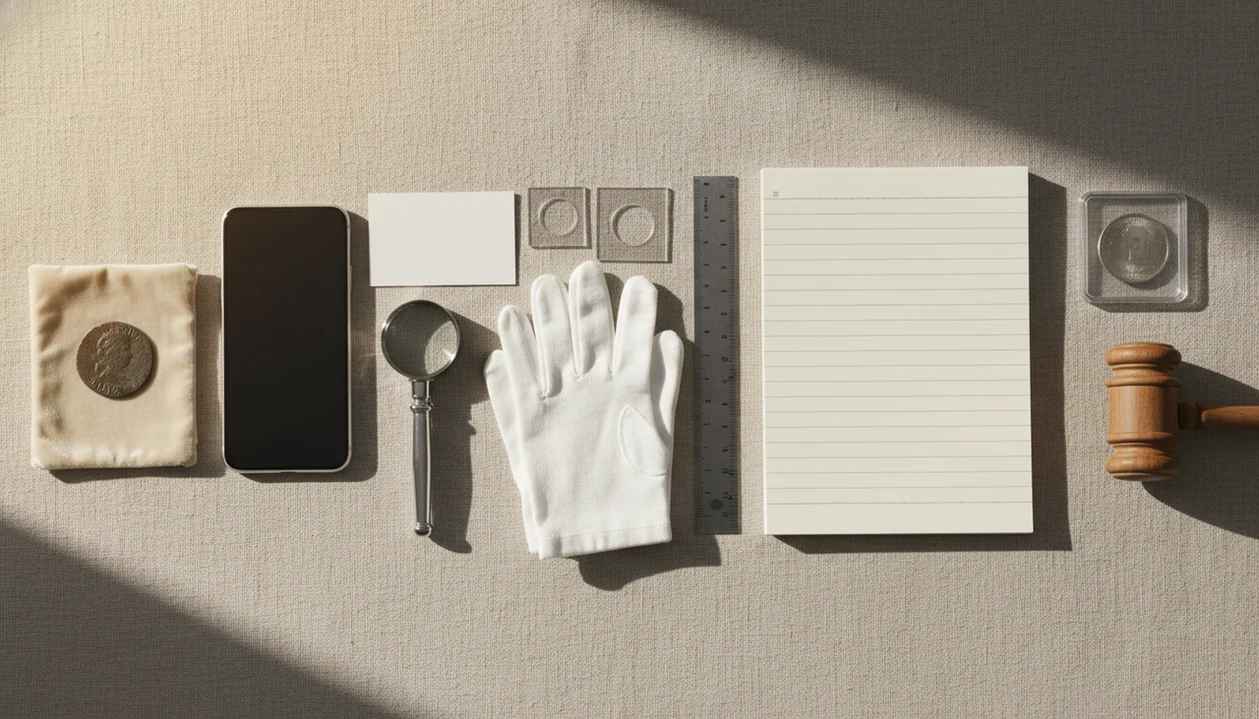
A coin value timeline is the practical path from finding a coin to identifying it, estimating condition, checking comparable prices, deciding whether expert review is worth it, and choosing a sale route. The safest timeline starts with photo-first identification, then moves slowly through rarity, grade, market data, and selling options before you accept an offer.
Definition: A coin value timeline maps the research and decision steps between discovering a coin and making a responsible keep, grade, insure, or sell decision.
TL;DR
- Start with the coin’s date, mint mark, denomination, country, and design type before looking up any value.
- Condition and grade can change value dramatically, so never clean a coin and do not rely on one online listing.
- Use multiple sources, recent sold prices, and expert review for potentially rare or high-value coins before selling.
Coin Value Timeline at a Glance
The coin value timeline moves from safe handling to identification, then to rarity checks, grade estimates, market comparisons, and a final sale or keep decision. Most coins are common circulation finds, even when they look old.
Day 1 is simple: photograph both sides, identify the coin, and protect it without cleaning. Week 1 is for confirming the date and mint mark, checking mintage, noting possible varieties, and making a rough grade estimate. Weeks 2 to 4 are for comparing price guides, auction records, dealer ranges, and completed marketplace sales.
Month 1 and beyond is decision time. Grading, insuring, holding, or selling only makes sense after the evidence lines up. The U.S. Mint's circulating coin production reports show billions of U.S. coins produced annually, including 2023 totals by denomination (https://www.usmint.gov/about/production-sales-figures/circulating-coins-production), which is a useful reminder that ordinary production pieces greatly outnumber rare ones.
Old is not enough.
Before You Start: Safe Coin Handling and Research Setup
Before researching value, set up a clean, calm workspace so the coin is protected and your notes are useful. A few careful minutes can prevent scratches, fingerprints, and bad photos that make later decisions harder.
- Wash and dry your hands before touching ordinary circulated coins, and use cotton gloves for proofs or mirrorlike surfaces that show marks easily.
- Hold the coin by its edge over a soft towel, not over tile, wood, or a cluttered desk where one drop can nick the rim.
- Use natural light near a window and place the coin on a plain neutral background before taking photos of both sides.
- Prepare a simple notes sheet for the date, mint mark, denomination, visible damage, color, weight if available, and where the coin was found.
- Leave the surfaces alone until research is complete; do not clean, polish, rub, dip, or “brighten” the coin, even if dirt seems to hide details.
The safest first move is documentation, not improvement.
Coin Value Timeline Mechanics: Identification, Grade, Rarity, and Market Data
A responsible coin value timeline works by separating four questions: what is the coin, how worn is it, how scarce is it, and what have similar coins actually sold for. Correct attribution comes first because the date, mint mark, denomination, country, metal, and variety define the price category.
Rarity is not just mintage. It also depends on survival rates, certified population, collector demand, and whether a variety is widely recognized. Grade then converts physical condition into market language, usually through the numismatic 70-point scale from heavily worn coins to Mint State examples. The American Numismatic Association describes the Sheldon 1-to-70 scale used in U.S. coin grading (https://www.money.org/coin-grading/).
Market value comes from realized prices, not asking prices alone. Historical charts can show long cycles, including boom-and-bust periods, so sale timing may affect the final result. A good ai coin identification, rarity lookup, and collection value estimation app for collectors and beginners should narrow the research path, not replace authentication, certified grading, or a written appraisal.
Found Coin Research Timeline: 6 Steps from Photo to Sale Decision
Use this found coin research timeline when a coin looks unusual, inherited, silver, foreign, or possibly rare. The goal is to slow the decision down before money changes hands.
- Photograph both sides in natural light before handling the coin more than necessary.
- Identify the coin from the photos, then verify the result against trusted guides before assuming a value range.
- Record the basics: date, mint mark, denomination, country, portrait, reverse design, and visible errors.
- Estimate grade conservatively before comparing prices, especially if the coin has rim nicks or dull surfaces.
- Check several sold-price sources and decide whether professional grading is worth the fee.
- Choose keep, grade, insure, or sell based on evidence, not urgency.
For beginners, a written sequence is often safer than a one-screen value estimate because it forces identification, condition, and market checks into separate decisions.
The notes matter later.
Step 1: Coin Identification Before Any Value Research
“Why identify the coin before checking value?” Because one wrong digit, mint mark, or reverse design can put the coin in the wrong value category.
Start with the country, denomination, date, mint mark, portrait, reverse design, and metal color. On many U.S. coins, mint marks appear near the date, under a wreath, beside a building, or on the reverse, depending on series and year. A beginner turning over a wheat cent under a kitchen light may need to angle the coin twice before seeing the tiny letter under the date.
Photo-first identification can be a fast starting point, but it is not a formal appraisal. Worn dates, filled mint marks, and damaged rims need extra caution. Save the photos and findings in a collection record before researching prices; a U.S. coin identification workflow can help keep those observations organized.
Step 2: Rarity and Mintage Checks in the Rare Coin Research Timeline
Rarity checks separate common old coins from coins worth deeper research. A rare coin research timeline should compare production, survival, demand, and variety status before any sale talk begins.
- Mintage is the starting number: compare how many were made, but remember that mintage is not the same as surviving supply.
- Old does not mean rare: many worn cents, nickels, and dimes survive in large numbers.
- Circulation output gives context: the U.S. Mint produced billions of coins for circulation in 2023, so most pocket finds are ordinary production pieces.
- Demand changes the result: a low-mintage coin with little collector demand may sell for less than a popular key date.
- References should overlap: PCGS, NGC, Greysheet, auction archives, and specialist books each answer a different part of the rarity question.
When a buyer asks about composition and mintage, you want notes, not guesses.
Step 3: Grade Estimate in the Coin Value Research Steps
Grade is where many coin value research steps become real. A raw condition estimate is your own opinion; a certified grade is an opinion from a grading service after authentication and encapsulation.
- The market uses a 70-point scale: broad labels include Good, Fine, Extremely Fine, About Uncirculated, and Mint State.
- Grade can change value sharply: PCGS price guide data for a 1909-S VDB Lincoln cent shows a large gap between lower circulated grades and higher Mint State grades.
- Population affects price behavior: certified census reports often show far fewer high-grade examples than average-grade coins.
- Surfaces matter: cleaning, polishing, rubbing, dipping, or chemical treatment can reduce numismatic value.
- Conservative estimates are safer: if you are unsure between Fine and Very Fine, price the lower grade first.
Wipe dust from the cardboard 2x2 flip if needed, but do not clean the coin itself. For value ranges, the coin value vs appraisal distinction is important.
Step 4: Price Comps and Historical Coin Value Trends
Price comps work best when they compare similar coins that actually sold. Asking prices show what sellers want; sold prices show what buyers accepted.
| Source type | What it helps answer | Main caution |
|---|---|---|
| PCGS and NGC price guides | Grade-based retail context | May not match today’s exact buyer demand |
| Greysheet | Dealer-oriented pricing | Often needs hobby experience to interpret |
| Major auction archives | Realized prices for better coins | Fees and eye appeal can affect results |
| Dealer buy prices | Fast-sale expectations | Usually below retail resale prices |
| Marketplace completed sales | Current public demand | Photos and descriptions may be unreliable |
Look across weeks or months, not a single day. Bullion-sensitive coins can move with silver or gold, while numismatic rarities follow collector demand. Long-run rare coin price histories show growth periods interrupted by sharp declines, so timing can affect realized sale price. For phone-based checks, our guide to how to check coin value with phone covers the photo side.
Step 5: Expert Review and Coin Sale Timeline Decisions
Expert review is worth considering when a coin is a key date, has a high estimated value, belongs to a counterfeited type, comes from an estate, or shows a rare variety. It is also useful when grade differences change value enough to justify the cost.
| Sale route | Speed | Fees and risk | Fit |
|---|---|---|---|
| Local dealer | Fast | Lower offer, simple transaction | Common coins or quick estate sorting |
| Online marketplace | Medium | Listing risk, returns, buyer disputes | Lower to mid-value coins with clear photos |
| Specialist auction | Slower | Seller fees, stronger audience | Varieties and collector-grade material |
| Major auction house | Slowest | Higher thresholds and fees | Important rarities or large collections |
| Private sale | Variable | Trust and payment risk | Known buyer, documented coin |
U.S. economic data has reported multibillion-dollar retail sales activity tied to coin and medal collecting, so the market is real but uneven. Document offers, especially for inherited collections poured from a coffee can onto a towel. A coin value app can help organize scans and notes before conversations start.
Common Coin Value Timeline Mistakes That Lower Offers
Most low offers trace back to missing records, surface damage, or unrealistic comps. Avoid these mistakes before listing or walking into a shop.
Cleaning the coin: Cleaning usually lowers numismatic value and can make original surfaces look altered.
Trusting one active listing: A live asking price is not a reliable value comp unless similar coins have sold near that amount.
Mixing value terms: Face value, melt value, catalog value, dealer buy price, and realized sale price are different numbers.
Overtrusting AI output: Image tools can narrow possibilities, but valuable coins still need authentication.
Skipping estate inventory: An estate collection should be photographed and grouped before accepting a bulk offer.
Losing the paper trail: Save screenshots, collection notes, grades, photos, and offer details. A dark wooden table can make copper cents look redder than they are, so keep lighting notes too.
Limitations
A coin value timeline reduces guesswork, but it cannot remove uncertainty. Treat every estimate as a research position, not a guaranteed sale price.
- AI coin identifier apps can narrow type, date, and design, but they cannot replace professional grading or authentication.
- Historical price charts do not predict future prices.
- Thinly traded rare coins may have few recent comparable sales.
- Professional grading costs time and money, and it may not be economical for low-value coins.
- Online price guides can lag bullion spikes, speculative booms, or sudden demand shifts.
- Counterfeits, altered mint marks, cleaned surfaces, and repaired coins can invalidate beginner estimates.
- A value estimate is not a guaranteed offer, auction result, or insurance appraisal.
- Phone photos may hide hairlines, rim damage, color changes, or prooflike flash reflection.
Early identification tools can support type recognition and collection notes, but final value decisions still need human judgment.
FAQ
How do I value a coin I found?
Identify the coin first, then estimate grade, check rarity and mintage, compare recent sold prices, and seek expert review if the coin may be valuable. Do not start with a single online listing.
Is my old coin rare or just common?
Age alone does not prove rarity. Date, mint mark, mintage, survival rate, condition, variety status, and collector demand all matter.
Should I clean old coins before selling them?
No. Cleaning usually lowers numismatic value and can make a coin harder to sell.
Where is the mint mark on my coin?
Mint mark location depends on the country, series, denomination, and year. Check both sides against a trusted reference before assuming it is missing.
Are online coin price guides accurate?
Online price guides are estimates, not guaranteed sale prices. Compare them with recent sold prices from multiple sources.
When should I send a coin for professional grading?
Professional grading is most useful for valuable, rare, counterfeit-prone, or condition-sensitive coins. It may not be worth the cost for common low-value coins.
Where should I sell coins for the best balance of speed and price?
Dealers are usually faster, while auctions and specialist venues may bring stronger prices for better coins. Marketplaces and private sales can work, but they carry more listing, payment, and return risk.